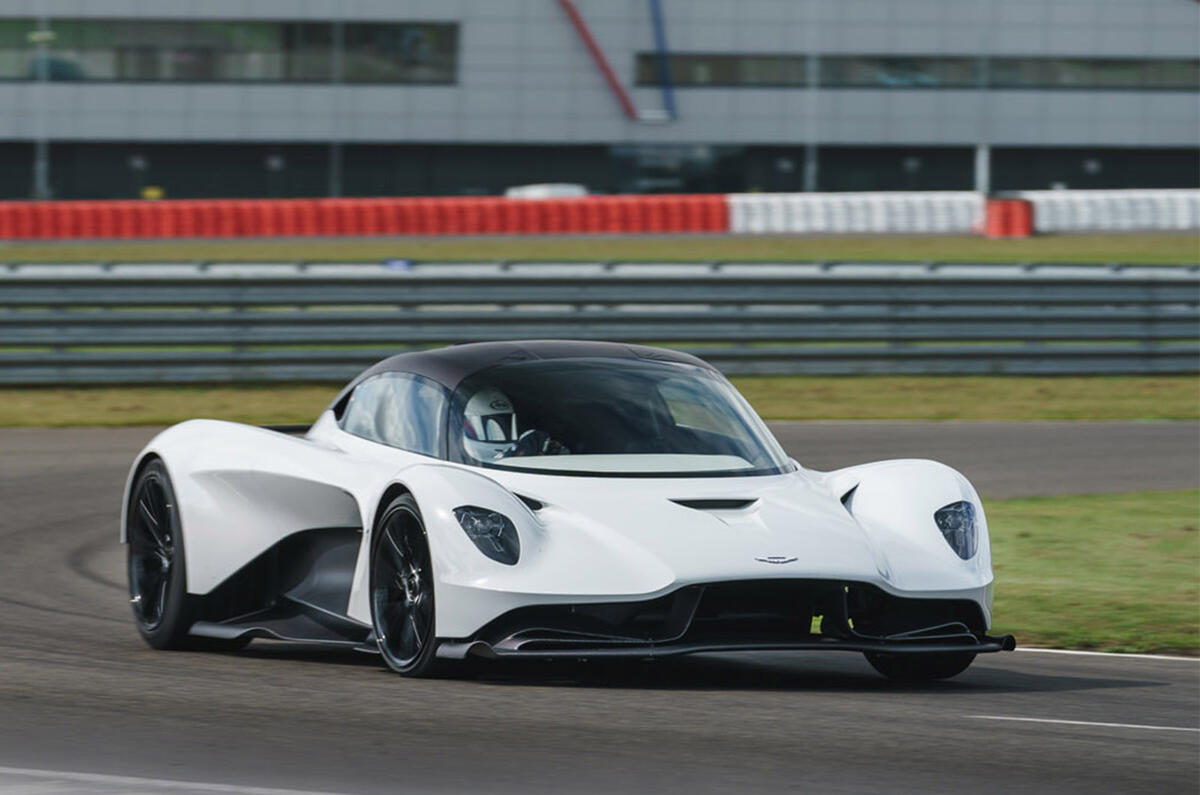

Aston Martin’s hybridised V6 will rapidly be deployed across most of the marque’s range once it has made its debut in the Valhalla supercar, Autocar has learned.
The all-new powerplant, due to enter production in 2022, will replace the Mercedes-AMG 4.0-litre V8 that’s used in the Aston Martin Vantage, the lower reaches of the Aston Martin DB11 range and the soon-to-be-launched DBX SUV.
“Mercedes have made no secret of where their engine technology is moving to, and obviously we don’t foresee four-cylinder engines in our Astons,” CEO Andy Palmer told Autocar. “So we’ve got to make our own journey.”
With integrated electrical assistance, the Aston Martin V6 should effectively be a modular replacement for the AMG V8, with Palmer confirming that it can be mated to existing transmissions.
Just as important, it will make at least as much power as the AMG engine in these applications.“As you move on, you normally expect a power increase, not a decrease,” Palmer said. “You’re supposed to do that even with a smaller power unit, so there’s no way our customers are going to expect to step backwards.”
Aston Martin confirmed the new engine would be its most powerful yet when used in the Valhalla but that it would also be detuned and reconfigured to suit a variety of needs.
The British company has a long history of making straight sixes but has never done a V6 before. However, Palmer insists it will be possible to make sure it delivers a brand-appropriate experience. “The key is sound,” he said. “Tuning the pipes to make it sound like an Aston.
“Obviously we can use the hybrid system and the electric motor to fill in on torque, so you can compensate for the cylinder size with the electrical assistance.
“As long as it feels like a V8 and sounds majestic, I think it’s a perfectly sensible way to go and a lot more sensible than a [four-cylinder] would be.”
The V6 will be made in the UK by an as-yet-unspecified supplier. Autocar has been told that it definitely won’t involve Ford’s soon-to-close engine plant in Bridgend, despite its proximity to the new Aston Martin factory in St Athan.
We have also learned from insiders that Aston Martin is planning to move production of its twin-turbocharged 5.2-litre V12 engine to the UK (it’s currently made at a Ford factory in Cologne, Germany), with the plan being to add an electrical element.
Aston Martin sold nearly 1800 V12-powered cars last year, and repatriating the powerplant to the UK shows a continued commitment to it.
“You can see in the longer term that it won’t last,” Palmer admitted, “but certainly over the next few years, we can continue to produce V12 engines, and we can make them more CO2-friendly.”
While the UK government’s planned ban on the sale of all new petrol and diesel-fuelled cars – including hybrids – by 2035 will create big challenges, Palmer echoed McLaren boss Mike Flewitt by confirming his company won’t stop developing part-combustion cars for other markets if demand is still there.