Currently reading: Goodbye Boris Bus: Retirement looms for the Routemaster Autocar helped design

New Routemaster is being phased out two decades after Autocar helped design it – then gave it the full road test

London is preparing once again to say goodbye to the Routemaster bus – two decades after the iconic AEC original was taken off the city's streets. 

The New Routemaster, launched in London in 2012, is being removed from several key routes in the capital as part of a city-wide transition to full-electric alternatives. 

The Standard reports that the Wrightbus-manufactured diesel hybrid is being taken off four important routes this year, and another in 2028, with operators lining up pure-EV alternatives as replacements. 

London mayor Sadiq Khan was robust in his criticisms of the departing double-decker, orders for which he cancelled upon replacing Boris Johnson in the role in 2016.

Slamming the so-called 'Boris Bus' as a "legacy of the mess made by the previous mayor", he pledged to introduce a new fleet of zero-emission alternatives to London's roads, which would provide better value to users and taxpayers and rectify some of the New Routemaster's notorious design flaws.

"I want to make sure we have value for money when it comes to TfL’s expenditure. I know there were huge challenges that the New Routemaster had in relation to windows that don’t open, air conditioning that doesn’t work. They have been incredibly expensive.

"What we have tried to do is make sure the buses we buy aren’t these inefficient diesel buses but are zero emission and have windows that open, that are value for money," he told The Standard.

Bus companies in London are turning to new alternatives including the Wrightbus Electroliner and BYD BD11, with EVs now making up around 30% of the city's 8500-strong bus fleet.

However, an anticipated 14-year usable life cycle means the youngest Routemasters in operation could still be carrying passengers past 2030, and the latest forecast from Transport for London (TfL) cites 2034 as the final year of operation for diesel buses.  

Nonetheless, the Routemaster's gradual withdrawal from service marks the beginning of the end for an icon of the city's modern era, whose conception Autocar was closely involved with.

In 2007, we commissioned bus designer Capoco to imagine a replacement for the recently decommissioned Mk1 Routemaster, resulting in the RMXL – an aluminium-spaceframed hydrogen-fuelled hybrid with more seats and standing space than its predecessor, while retaining the trademark open rear platform and various retro-themed design cues.

Johnson liked the proposal so much that upon taking office in 2008. he launched the New Bus for London competition to identify a design in the same vein that could be taken forward to production.

The final result was the New Routemaster, of which Northern Ireland's Wrightbus started mass production in 2012 – but not before Autocar was allowed behind the wheel for a road test, in recognition of its contributions to the programme, which you can read in full below.

Boris Bus: the full Autocar road test

Public bodies have a tendency – understandably so, given that they’re spending our money – to commission products on very specific and objective sets of factors. A jet fighter, for example, is measured by its ability to blow up other jet fighters; road signs are chosen for their clarity, not their beauty. Public procurement cares little for sentimentality.

Back to top

Here, however, is something different. Think of it as more like Heathrow’s state-of-the-art Terminal 5 rather than the (barely) functional Terminal 3. Its creators, Northern Ireland bus builder Wrightbus and design studio Heatherwick, won Transport for London’s competition to create a new London bus with a product that’s almost as much about design flair as it is about transport. Almost.

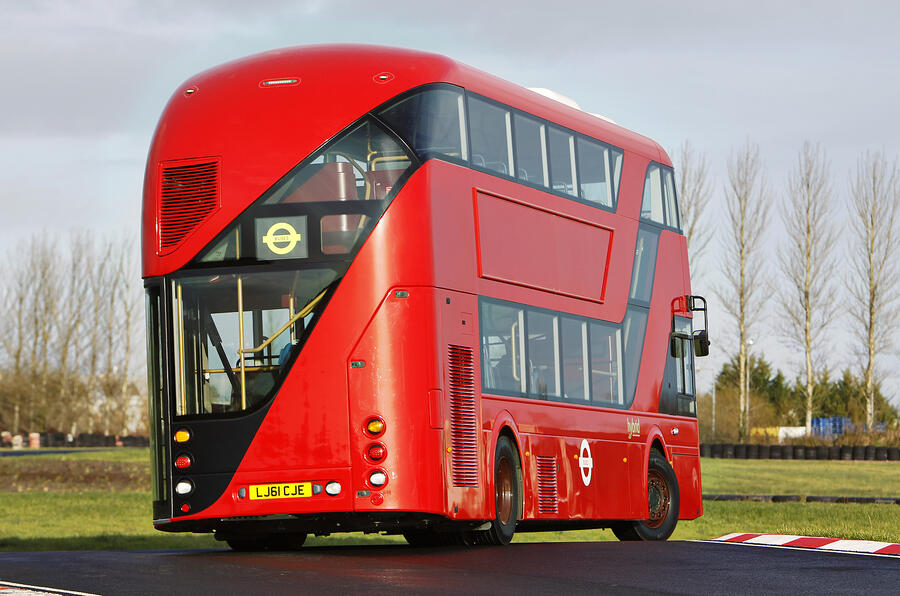
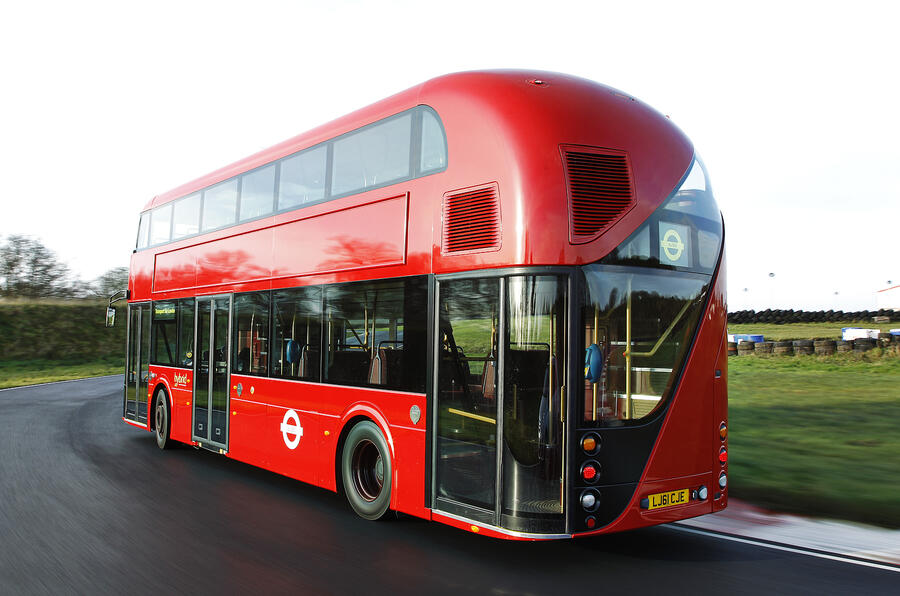
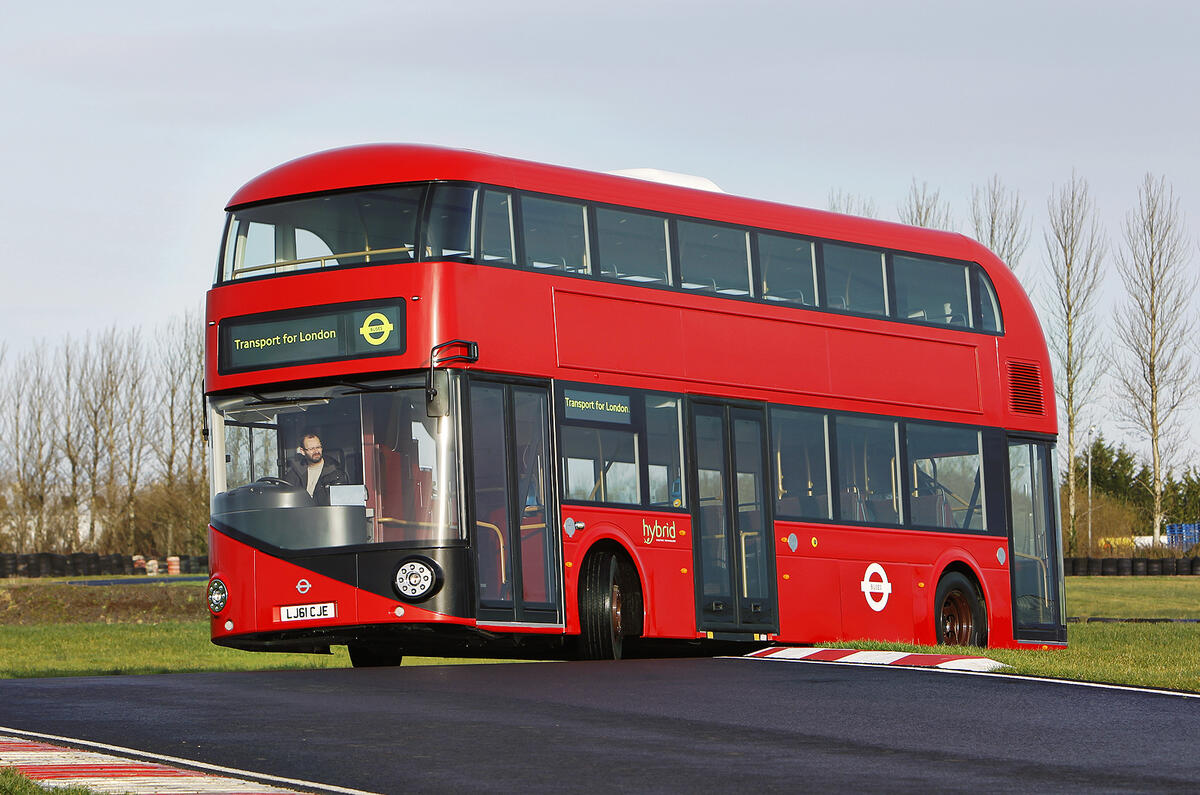
There’s only so much you can do with a bus, after all. On the outside, the NBfL (New Bus for London) has a close approximation of an asymmetric front body, with a bold black strip that skims like an eyepatch across the perhaps overly blinged-up headlights.

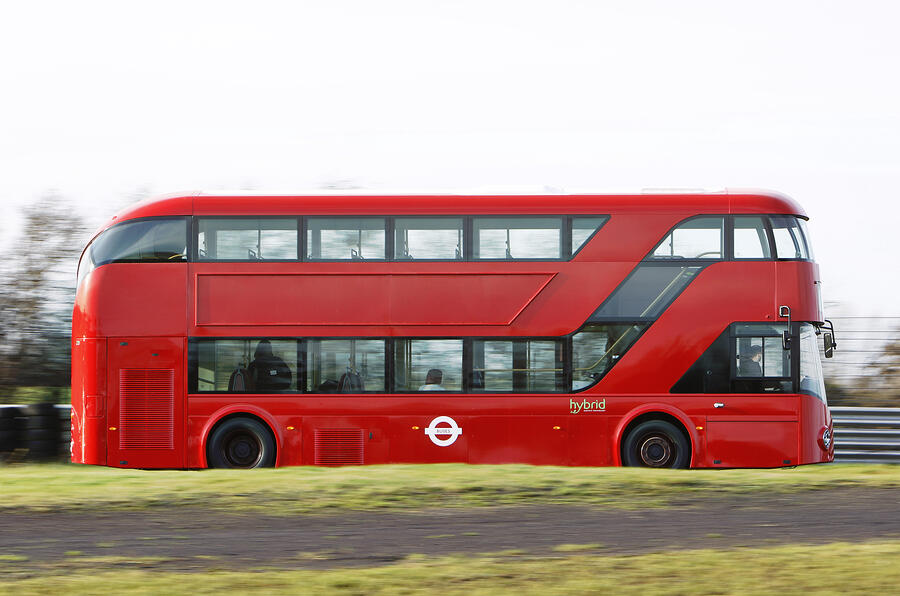
At the sides and around the rear are where the NBfL more closely resembles the Routemaster (which is a Transport for London trademark). The bold slashes of glass scribing up one side and down the tapering rump suggest the twin stairs and elegant rear of the Routemaster. To our eyes, from the rear three-quarter on the passenger side is where it shows its best – as well as its convenient three sets of doors.

Underneath its London Transport Red skin lie the innovative bones of a novel product. The NBfL has a Wrightbus steel backbone chassis, to which is attached an aluminium superstructure and body. At 11.2m, the NBfL is a long bus, and its length is augmented by a composite rear section incorporating the rear stairwell. This also covers the generator (the NBfL is a series hybrid, more on which later) and, crucially, acts like a stiffener for the whole shebang.

Back to top

Interior

If a supercar is dominated – and judged – by its engine, and a sports car by its handling, then a bus is absolutely defined by its interior. And nowhere on NBfL is the introduction of surprise and delight, so often a feature in today’s cars but conspicuous by its absence in contemporary public transport, more prominent than inside.

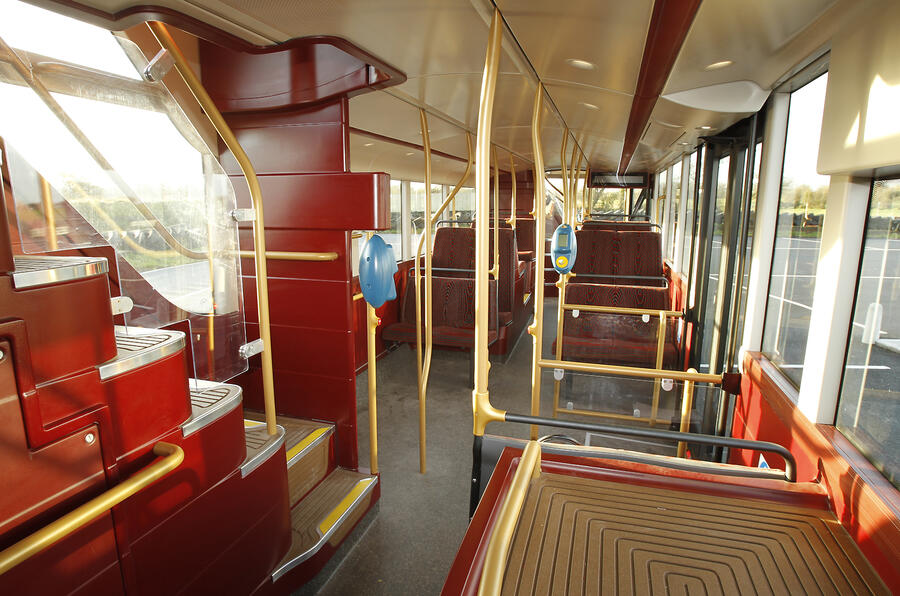
We don’t think it’s particularly controversial to suggest that, in general, bus interiors are ugly. It is cheap to fit a squared-off, plain rooflining and strip lights. It maximises interior space, too, but it looks desperately uninviting. By comparison, the NBfL is a triumph of interior design flair. The upper deck’s ceiling has the gentle curve of a classic airliner’s cabin, while LED soft-light pods casts a warmer, cosier glow than fluorescent tubes could ever hope to illuminate (yet are placed at each row to provide sufficient reading light). The windows are shallower upstairs than is the current trend, too. Why? Aesthetics, mostly; the old Routemaster had shallow upper windows, too. They also reduce heat build-up in the upstairs cabin.

Some aspects are not only aesthetic, though. There is real purpose to NBfL’s two staircases – it allows quicker entry and egress – as do the three sets of doors, even if combined they serve to limit the NBfL’s total capacity. NBfL can take 87 passengers (40 seated downstairs, 22 upstairs and 25 standing downstairs). The capacity of double-deckers is usually around 90; London’s bendy buses could hold more than 150.

Back to top

TfL thinks this is a compromise worth making on busy routes, where the NBfL will be able to make quicker progress by dint of less time being spent stationary at stops. On the busiest routes, some NBfLs will even get a conductor. With the rear deck manned and open, stopping times will be reduced yet further.

Performance

If you’ve ever seen an urbanite double-decker tottering along a motorway, you’ll know that ‘performance’ doesn’t mean the same thing to bus operators as it does to you and me.

We didn’t have time to strap our VBox timing gear to the NBfL during our test drive, but putting foot flat to floor at Nutts Corner circuit, near Wrightbus’s Ballymena factory, revealed that NBfL is capable of making only sedate, albeit sustained and linear, progress.

Step-off from rest is decent enough; the 4.5-litre Cummins turbodiesel generator provides power to an air compressor (for the brakes and steering), a 75kWh battery and the Siemens electric motor, which lies beneath a raised seating area at the rear, from where it drives the back axle. It makes, as electric motors do, peak torque (of 1844lb ft) from zero revs, so step-off is as brisk as NBfL gets.

The electric motor does all the driving; the diesel generator is tuned to sit at optimum revs and provide all the power the batteries need, and it runs only when those batteries need topping up (which was most of the time during our test, although regenerative braking will assist on a proper bus route). The generator is overly grumbly during stop-start at the moment, but Wrightbus engineers are working on a fix.

Back to top

Braking is both by the drive motor and pneumatically assisted discs all round; retardation is fine and there’s ABS, but pulling the NBfL to a rapid stop, perched as you are in front of, and mostly below, nearly 20 tonnes of metal, isn’t the most enjoyable thing you’ll ever do in your life.

Ride and handling

Here, then, is where we get to the nub of the Autocar road test: what’s she like to drive?

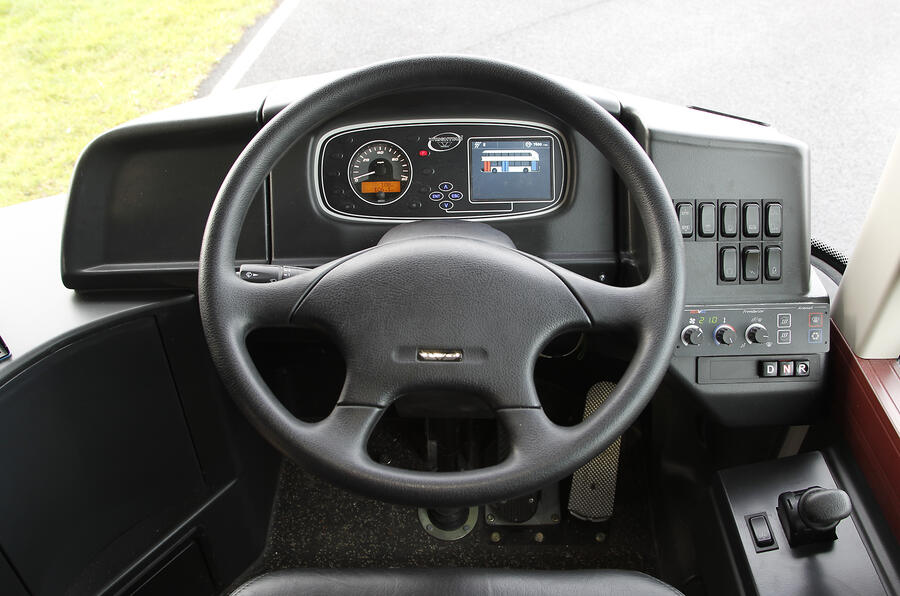
Seated in the widely adjustable but pretty flat driver’s seat (which does without a seatbelt, incidentally), you get a supremely clear view forwards. The low-set steering wheel is very adjustable, so finding a comfortable driving position is a cinch, but the upright stance and wide chair mean it’s more like sitting at a desk than in a car. The pedals are on the flat floor and the wheel is barely off the horizontal.

Still, foot on the long-travel brake pedal, handbrake off and, as you ease off the pedal, the NBfL creeps forward with eerie smoothness. Never before has a hybrid drivetrain seemed so suited to a vehicle.

It’s hard to gauge the ride across what amounts to a big kart track, but where the NBfL did meet imperfections, it ironed them out pretty admirably. On the road we’d expect the largely comfortable float you get in most buses, but with less of the accompanying crash over bigger potholes thanks to the composite rear end’s body-stiffening properties.

Back to top

At 2.5 metres across, the NBfL takes up its share of road space, but its turning circle is superb at little more than twice the bus’s length.

Nonetheless, if you haven’t driven a cab-forward piece of kit before, it takes some getting used to: you turn the easy, slick and consistently light steering through its 4.5 turns later than you might think when exiting junctions, to give the ample sides room to clear apexes. But the NBfL’s flat sides mean that its mirrors are supremely effective at letting its driver judge clipping points and gaps. Get into a groove and there’s real pleasure to be had from driving the NBfL smoothly and placing it accurately – even more so because the power delivery is so smooth. The brake pedal could use a little more feel for our taste, though.

Buying and owning

A return of 11.6mpg and 640g/km of CO2 don’t sound that great until you consider that a typical hybrid double-decker returns just 8.6mpg and 864g/km, and a conventional diesel bus 5.8mpg and 1295g/km. London has to make big improvements to its air quality, and the reduction in emissions that comes from replacing several hundred of TfL’s 8000 buses with NBfLs will contribute to the clean-up. If all goes well, TfL might even clean up financially, too; if Wrightbus can sell this design to other cities and countries, TfL gets a cut of each sale.

Specs

Economy: 11.6mpg; CO2: 640g/km; Kerb weight: 17,900kg; Generator: 4 cyls in line, 4460cc, rear-mounted, turbodiesel; Transmission: RWD Siemens full-series hybrid system with DC inverter, Siemens AC electric moto and 75kWh lithium ion battery pack; Power: 174bhp; Torque: 1844lb ft

Join our WhatsApp community and be the first to read about the latest news and reviews wowing the car world. Our community is the best, easiest and most direct place to tap into the minds of Autocar, and if you join you’ll also be treated to unique WhatsApp content. You can leave at any time after joining - check our full privacy policy here.

Felix Page

Felix Page
Title: Deputy editor

Felix is Autocar's deputy editor, responsible for leading the brand's agenda-shaping coverage across all facets of the global automotive industry - both in print and online.

He has interviewed the most powerful and widely respected people in motoring, covered the reveals and launches of today's most important cars, and broken some of the biggest automotive stories of the last few years. 

Join the debate

Comments
1
Add a comment…
JP_Onstwedder 6 March 2026

It's a good design with a major flaw:

the lack of ventilation. In summer it's stiflingly hot upstairs.