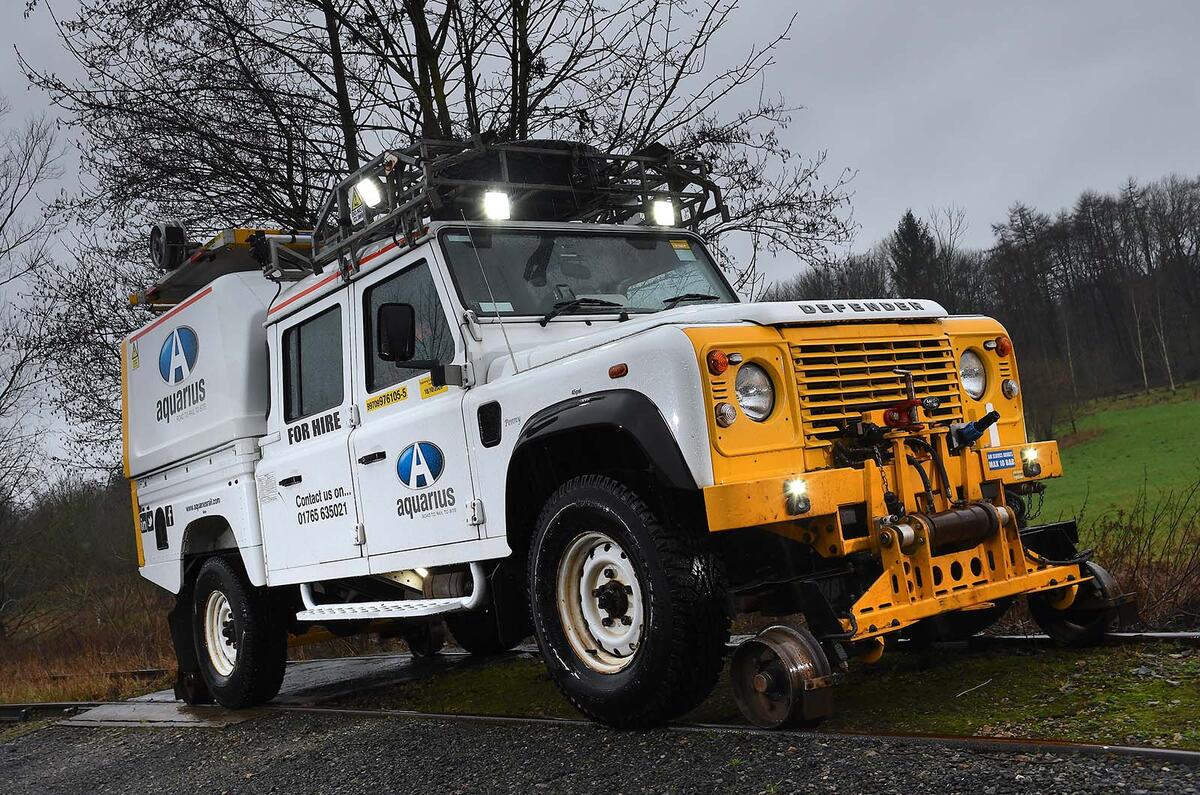
Strange things happen at night - sleepers snore, foxes scream and Land Rovers turn into trains.
Well, not trains exactly, but when we're all tucked up in bed, some do swap their road wheels for train ones and drive along rail tracks. Not only Land Rovers but also Ford Rangers and Isuzu D-Maxes. And no, it's not a desperate way of avoiding potholes; instead, they're vehicles used by rail network operators and contractors to ferry workers, equipment and materials to often remote track locations. They do so at night because that's when the trains stop running: it allows the maintenance companies to have what's called 'track possession time.
Time is of the essence, too. The railway timetable can't be changed or commuters delayed just because workers are on the track surveying it, fixing it, laying fresh ballast, spraying weeds, clearing leaves or the 1001 other jobs they do. So they have a window of around six hours to get in, do the work and get out again - and the best way to do that is with a road vehicle that can quickly drive to a pick-up point, take everyone and everything to the nearest track entry ramp (a short length of concrete on a level with the rails) and speed along the line to the job.

In fact, on the tracks 20mph is as fast as the vehicles are allowed to go, but that's a lot quicker and safer than walking. A British firm called Aquarius is a leading specialist in road-to-rail conversions. Located deep in the countryside near Ripon, North Yorkshire, it was founded in 1996 and employs 25 people. We're all familiar with the term 'test track', but Aquarius does have exactly that: a short stretch of railway track on which it tests its vehicles.
When I visited, there was a Land Rover 130 parked beside it. It looked like a regular Landie but for two pairs of small train wheels: one pair mounted ahead of the front road wheels and the other behind the rears. Kelly Brown, the operations director of Aquarius, climbed aboard and skilfully drove the vehicle up a short entry ramp and square onto the track. Now for the transition: Brown switched off and then restarted the engine, there was a hiss of hydraulics as the rail wheels pivoted down to the tracks and, as they made contact, raised the car and the road wheels slightly.
This action transferred vital load to them, ensuring they were in secure contact with the tracks. With the road wheels also in contact, when Brown engaged first gear and let out the clutch, the Land Rover moved forward, and when she braked, it slowed. Genius, except, I wondered, what would happen when she turned the steering wheel? Happily, Brown explained that on starting the engine, with the road wheels pointing straight ahead, the steering wheel was then automatically locked in position.


Add your comment