It’s hard to remember now, but there was a time when the only high-riding vehicles you saw on the roads were heavy-duty off-road 4x4s, bought by people who needed them to do heavy-duty things off roads that needed four-wheel drive.
But then people decided that a high driving position and rugged looks were the sort of things they fancied in cars. Car makers noticed this and started making cars that looked and felt a lot like off-roaders but weren’t really designed to ever go off road. And, well, the rise of the SUV doesn’t really need charting from there.
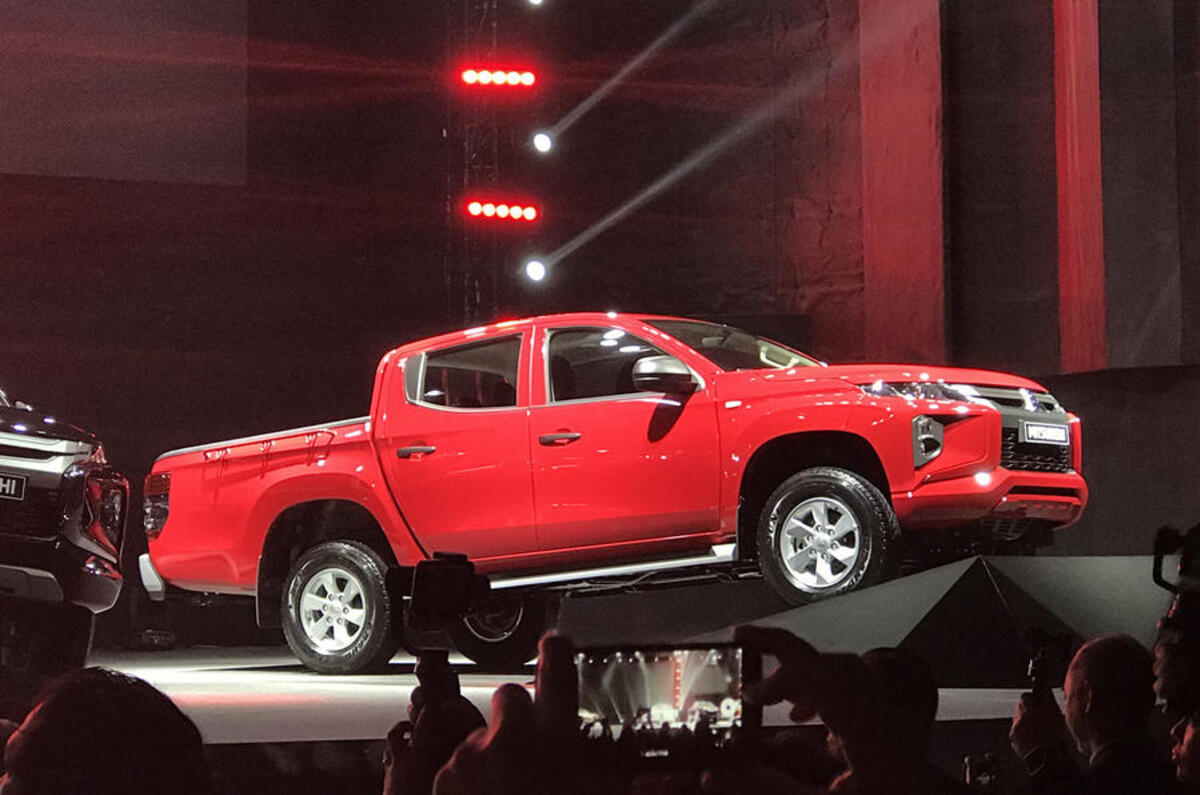
Still, the development of the SUV class came to mind when I was at the launch of the latest Mitsubishi L200 pick-up. Being a pick-up, it’s effectively a commercial vehicle, designed to meet the tough needs of various tradespeople and businesses. But it seems to me that pick-ups are, increasingly, becoming a lifestyle choice.
They’re certainly an increasing sight on UK roads: according to the Society of Motor Manufacturers and Traders (SMMT), registrations of new trucks are up 3.2% year on year. And I’m sure the vast majority of those are still sold and used as commercial vehicles, and the key determining factors are things like load beds, payload, towing weights and running costs. You know, the sort of things that businesses need to consider.
It’s worth noting that the SMMT still lists pick-up registrations among its commercial vehicle data, and not its passenger car data. Which means that the near-10,000 L200 trucks that Mitsubishi sells per year – second only to the Outlander PHEV in its line-up – don’t count towards its passenger car sales figure of 17,591 that the SMMT lists.
But there are definite lifestyle trends creeping in – and it’s a trend Mitsubishi acknowledges, although it reckons that any appeal to lifestyle buyers is a by-product of making a tough, reliable, capable machine for commercial users.
But the new L200 features ‘rugged’ new styling designed to appeal to buyers, along with a choice of eight colours – not all of which seem designed to have your phone number, email and company logo slapped on the top.
The new truck also gets a whole wave of driver assistance and safety systems. And it’s notable that Mitsubishi won’t be offering the single-cab version – the one sold almost purely as a commercial vehicle due to its limited cabin space – in the UK and mainland Europe. That’s because the bulk of the previous-generation Mitsubishi L200 sales were of the top-spec Barbarian double-cab version: the one you could fit a family in as easily as your work tools.
It’s not just Mitsubishi, of course: think of the Ford Raptor Ford Ranger, a high-performance version of the truck that isn’t exactly going to be high on the lists of those who base their pick-up purchases on the results of a spreadsheet calculation.

Then there’s the likes of the Mercedes X-Class, which editor-in-chief Steve Cropley recently ran as a long-term test car. Again, it’s a machine that exists as a commercial vehicle, but it aims to do so by bringing a touch of premium feel to the market. Maybe the inspiration comes from America, where larger pick-ups are by far the most popular vehicles – to the point that Ford is phasing out sales of old-fashioned cars to pump out more F-Series pick-ups like the F-150.
Now I’m not suggesting that, in 20 years or so, London’s streets are going to be clogged up with lifestyle versions of pick-ups. At least I really hope they won’t. But with the beneficial tax breaks in place for such ‘commercial’ vehicles, and the appeal of their rugged, reliable, go-anywhere styling, I do think that you’ll see an increasing number of them on the roads being used as private or lifestyle vehicles.
Whether it’s a blip or a trend, I’m not sure. But I do wonder this: now that SUVs are so common, could buyers who want a bit of 4x4 tough authenticity, and to stand out from the crowd, be turning to trucks?
Read more
Mitsubishi reveals revised L200 with ‘significant’ changes
Mitsubishi committed to future PHEV development
How to go rallying in a Mitsubishi Outlander PHEV

Join the debate
Add your comment
Yes, from what I observe they
Yes, from what I observe they already have.
Albeit the pickup drivers in my street are a landscaper and a builder who often tow trailers, and could be forgiven for needing something that can work off road.
But I'm seeing an increasing number of crew cab pickup trucks doing the school run, the weekly shop etc. with 4 doors and a truckman rear top they are effectively SUV shaped.
Plus for business users the tax benefits mean that they are cheaper than an equivalent family hatchback/crossover.
The marketing people know this, and that's why they give them names like "L200 Barbarian" or "D-Max Denver Rodeo"
Comparisons
My mate has a Navarra for all the business/tax/ family reasons, and it makes sense for him BUT
1. the back seats are only suitable for children, as there is no room to put your feet under the front seats, so you sit folded up and your bum goes numb after an hour.
2. On a day out to go climbing in Glen Shiel, I drove my car within the speed limit and cornered gently, and he couldn't keep up because he couldn't go around corners at anything like the speed I can.
3. I can get 2 bikes into my car, without taking off wheels etc. He has to take off both wheels to get a bike into his truck
4. I can overtake safely in places where he has to wait
5. I'm doing 45+ mpg, he is doing 30
6. road tax for my car is £20. His is £200, commercial vehicle rate.
If I was using a company vehicle, a pick-up would make sense for tax, but an ordinary 2-wheel drive car makes better sense for 360 days of the year
But his truck is great if he needs to carry a tonne of stuff in the back and he can claim back the VAT on it through his business.
So I think pick-ups are great if you have a business but otherwise make no sense.
Tax Breaks for Pick-ups
My advice is to fix the tax advantage ASAP. Here in NZ we also have large tax breaks for them and now the No. 1 selling vehicle is the Ford Ranger and the city roads are clogged with pick-ups.
Is this the real reason why CO2 emissions are rising?
In the UK, it's hard to see the logic of 4x4 pick-ups for most people - these are heavy, thirsty vehicles with high emissions.
A 4x4 pick-up makes sense if you're driving round a desert at low speed with abnormal loads to carry. You only have to watch the news to see how numerous Toyota pick-ups are in the Middle East or Africa.
Here in Britain, unless you regularly go off-road, surely you'd be better off with a van? Especially electric vans, which are incredibly cheap to refuel and run. I suppose they don't fit the macho image though?