Standard Range 43kWh Sound Edition SUV 5dr Electric Auto (168 ps)
Submitted by dev_editor on
"A jet engine is not that much different from an internal combustion engine in that it pushes the air in, squeezes it, ignites it and pushes it out.”
Simon Lipscombe’s idiot-proof explanation of the jet engine’s basic operating principle would surely have delighted Sir Frank Whittle, inventor of the jet engine. That he knows how one works is because he bought one, like you do…
“I found it on eBay,” he says. “It’s from a Mk3 Avro Shackleton. The plane had two jet engines, one each behind the outermost Griffin V12 prop engines to push it along. It produces 2600lb of thrust and with a few extra bits it cost me and my dad Richard £2000.
With his new jet engine safely in his garage, Simon, who is chief mechanic at a hire car firm, began exploring how it worked. He says: “I started fiddling around, working out what everything did.
YouTube was my friend; there’s enough information out there to give you an idea where you should go. Once I had worked it out, I decided to run it up, so screwed it to a trailer attached to a tree. My friends were all gathered behind an 8ft dirt bank but I was too busy looking for oil leaks to be scared.”

Now with the jet engine running, Simon’s next task was to decide what to do with it. “I already had a Ford P100 with a V8 in the back, so another with a jet engine seemed like a good plan,”he says.
“The P100 can carry a ton and has an 8ft load bay. The jet engine weighs 800kg and is quite short. You can buy an unrestored P100 for as little as £2000, so that’s what I did.”
Second P100 sourced and restored, Simon then fitted the jet engine to its load deck, wisely leaving the vehicle’s original 1.8-litre diesel engine in place at the front. “The pick-up is driven by the normal engine and the jet engine provides thrust,” he says.
“You only want to drive it in a straight line under jet power. Jet engines don’t go around corners very well. The centrifugal forces in the engine tend to make things go in a straight line.”
Simon controls the jet engine using a small hand control with two buttons on it. One kills the engine and the other is a three-way switch that allows him to nudge the throttle up or down.
The engine is a multi-fuel type that can burn unleaded petrol, diesel or paraffin. “Avgas is about three times the price of petrol so I’m relieved it can run on ordinary fuels,” he says.

For insurance reasons, Simon isn’t allowed to run the engine at shows. Instead, he plans to take it to Santa Pod and run it down the drag strip. He says: “They will probably only let me do a soft run rather than full throttle. It will be a noisy but interesting spectacle.”
Whatever he does with it, his P100 jet car has given him an idea for a future project: “I’ve just bought a Nimbus 105 turboshaft engine out of a Wasp helicopter. I’m thinking of taking the V8 engine out of my other P100 and putting it in that.
Being shaft driven, it can be connected via a drive box to the Ford’s axles. It should be fun!”
"A jet engine is not that much different from an internal combustion engine in that it pushes the air in, squeezes it, ignites it and pushes it out.”
Simon Lipscombe’s idiot-proof explanation of the jet engine’s basic operating principle would surely have delighted Sir Frank Whittle, inventor of the jet engine. That he knows how one works is because he bought one, like you do…
“I found it on eBay,” he says. “It’s from a Mk3 Avro Shackleton. The plane had two jet engines, one each behind the outermost Griffin V12 prop engines to push it along. It produces 2600lb of thrust and with a few extra bits it cost me and my dad Richard £2000.
With his new jet engine safely in his garage, Simon, who is chief mechanic at a hire car firm, began exploring how it worked. He says: “I started fiddling around, working out what everything did.
YouTube was my friend; there’s enough information out there to give you an idea where you should go. Once I had worked it out, I decided to run it up, so screwed it to a trailer attached to a tree. My friends were all gathered behind an 8ft dirt bank but I was too busy looking for oil leaks to be scared.”
Now with the jet engine running, Simon’s next task was to decide what to do with it. “I already had a Ford P100 with a V8 in the back, so another with a jet engine seemed like a good plan,”he says.
“The P100 can carry a ton and has an 8ft load bay. The jet engine weighs 800kg and is quite short. You can buy an unrestored P100 for as little as £2000, so that’s what I did.”
Second P100 sourced and restored, Simon then fitted the jet engine to its load deck, wisely leaving the vehicle’s original 1.8-litre diesel engine in place at the front. “The pick-up is driven by the normal engine and the jet engine provides thrust,” he says.
“You only want to drive it in a straight line under jet power. Jet engines don’t go around corners very well. The centrifugal forces in the engine tend to make things go in a straight line.”
Simon controls the jet engine using a small hand control with two buttons on it. One kills the engine and the other is a three-way switch that allows him to nudge the throttle up or down.
The engine is a multi-fuel type that can burn unleaded petrol, diesel or paraffin. “Avgas is about three times the price of petrol so I’m relieved it can run on ordinary fuels,” he says.
For insurance reasons, Simon isn’t allowed to run the engine at shows. Instead, he plans to take it to Santa Pod and run it down the drag strip. He says: “They will probably only let me do a soft run rather than full throttle. It will be a noisy but interesting spectacle.”
Whatever he does with it, his P100 jet car has given him an idea for a future project: “I’ve just bought a Nimbus 105 turboshaft engine out of a Wasp helicopter. I’m thinking of taking the V8 engine out of my other P100 and putting it in that.
Being shaft driven, it can be connected via a drive box to the Ford’s axles. It should be fun!”
"A jet engine is not that much different from an internal combustion engine in that it pushes the air in, squeezes it, ignites it and pushes it out.”
Simon Lipscombe’s idiot-proof explanation of the jet engine’s basic operating principle would surely have delighted Sir Frank Whittle, inventor of the jet engine. That he knows how one works is because he bought one, like you do…
“I found it on eBay,” he says. “It’s from a Mk3 Avro Shackleton. The plane had two jet engines, one each behind the outermost Griffin V12 prop engines to push it along. It produces 2600lb of thrust and with a few extra bits it cost me and my dad Richard £2000.
With his new jet engine safely in his garage, Simon, who is chief mechanic at a hire car firm, began exploring how it worked. He says: “I started fiddling around, working out what everything did.
YouTube was my friend; there’s enough information out there to give you an idea where you should go. Once I had worked it out, I decided to run it up, so screwed it to a trailer attached to a tree. My friends were all gathered behind an 8ft dirt bank but I was too busy looking for oil leaks to be scared.”
Now with the jet engine running, Simon’s next task was to decide what to do with it. “I already had a Ford P100 with a V8 in the back, so another with a jet engine seemed like a good plan,”he says.
“The P100 can carry a ton and has an 8ft load bay. The jet engine weighs 800kg and is quite short. You can buy an unrestored P100 for as little as £2000, so that’s what I did.”
Second P100 sourced and restored, Simon then fitted the jet engine to its load deck, wisely leaving the vehicle’s original 1.8-litre diesel engine in place at the front. “The pick-up is driven by the normal engine and the jet engine provides thrust,” he says.
“You only want to drive it in a straight line under jet power. Jet engines don’t go around corners very well. The centrifugal forces in the engine tend to make things go in a straight line.”
Simon controls the jet engine using a small hand control with two buttons on it. One kills the engine and the other is a three-way switch that allows him to nudge the throttle up or down.
The engine is a multi-fuel type that can burn unleaded petrol, diesel or paraffin. “Avgas is about three times the price of petrol so I’m relieved it can run on ordinary fuels,” he says.
For insurance reasons, Simon isn’t allowed to run the engine at shows. Instead, he plans to take it to Santa Pod and run it down the drag strip. He says: “They will probably only let me do a soft run rather than full throttle. It will be a noisy but interesting spectacle.”
Whatever he does with it, his P100 jet car has given him an idea for a future project: “I’ve just bought a Nimbus 105 turboshaft engine out of a Wasp helicopter. I’m thinking of taking the V8 engine out of my other P100 and putting it in that.
Being shaft driven, it can be connected via a drive box to the Ford’s axles. It should be fun!”
Submitted by dev_editor on
Submitted by dev_editor on
Submitted by dev_editor on
Submitted by dev_editor on
Landmark hatchbacks – there have been a few - the most obvious, of course, being the Volkswagen Golf.
It not only saved its maker from post-Beetle oblivion but emphatically confirmed the template for the breed after the 1964, Fiat-designed Autobianchi Primula and the 1967 Simca 1100 did the pioneering.
But after the Mk1 Golf, what came next were emulators offering much the same recipe, if sometimes with added spice. The SX version of the Talbot Horizon came with a trip computer, an advance winning it the Car of the Year trophy and its buyers regular packets of wildly inaccurate data. The Renault 14 bodyshell’s slightly banana-like curve inexplicably won it a place in New York’s Museum of Modern Art, while the magnificent, robot-flaunting TV ad for the Fiat Strada was the best thing about this lazy 128 re-skin. There were many more, but what all had in common was that none was as convincing as the Golf. The most serious challengers were the 1978 Opel Kadett, a crisp design of revvy engines and nail-breaking switchgear later available as the Vauxhall Astra, and Ford’s 1980 Escort, this the first front-drive version.
A brilliantly product-planned, pretty car that was immensely more advanced than its history-lesson predecessor, this Escort was a massive hit and should have propelled Ford towards ever-greater heights despite a couple of ear- and bum-battering dynamic flaws. But subsequent iterations succumbed to the Blue Oval’s cost-cutting ways, each more mediocre than the last, the barrel bottom crashingly struck with the Mk 4 Escort.
This car was so short of interest that one of its launch presenters resorted to caressing the admittedly appealing hillocks of steel covering its tailgate hinges to highlight a rare item of sexy design. It was far too inconsequential to prevent this publication from delivering this car the slating it deserved. Suitably stung, Ford performed a major rework. The result was half-decent, this last Escort identifiable by a surfeit of oval motifs that the design department had become obsessed with. Ford was back to its just-good-enough ways, few thinking that it was about to perform a spectacular reset on the small family hatch, not just for Ford but the entire car industry.
The first clues came with the extraordinary scoop images sneaked out of customer clinics. High-mounted, cornet-shaped tail-lights completely capped the rear pillars. Wide-spaced wheels occupied flamboyantly blistered wheel arches. Lozenge headlights flanked the slender mouth of an oval-jewelled grille. All these arresting features housed within a shapely six side-window body. Only Fiat’s Bravo and Brava hatchbacks came close for outlandish originality, and the Ford Focus had both beaten. Ford called it New Edge design. Most called it startling.
What was even more amazing, when we got to drive it, was that the Focus had the Fiats, the Golf and every other comer beaten, for handling, powertrains, packaging, refinement and sophistication. At much the same moment, the particularly crisp-looking Golf Mk4 arrived, surprising everyone with a high-calibre, soft-feel cabin finish that even ran to damped-action grab-handles. The Ford’s slash-sculpted dashboard was more imaginative but couldn’t match the VW for finish. But in every other way, the Focus had the Golf beaten. It rapidly became Britain’s best-seller, a deserved position sustained for years. It also became a benchmark. Some Fords had previously achieved this, but at the other end of the spectrum.
The Focus also set new standards for durability, this more subtle step change a reason why these cars remain so commonplace today. And therefore uncoveted and very cheap. There will be plenty more draining of the Mk1 Focus pool before their importance is recognised. So buy one now.
Car designer Peter Stevens, famed for the McLaren F1, is revealing the inspiration behind one of his latest projects: “I was working away from home in Coventry and staying in a very basic hotel.
"There wasn’t even a chair in my room. So, one evening, I’m sitting on my bed eating a takeaway and feeling quite depressed when I thought: I know, I’ll buy a camper van with all mod cons, park it in the car park of the firm I’m working at and sleep in that instead!”
We’ve all got to kip somewhere, of course, but Stevens – the designer of all-time classics including the F1, Jaguar XJR-15, Lotus Elan ‘M100’, Lotus ‘X180’ Esprit and the 1999 Le Mans-winning BMW V12 LMR – putting his head down in a client’s car park?
“There are some people who like being designers and some who like designing,” he explains. “I’m the latter. I certainly don’t expect special treatment. In any case, living in the motorhome gave me ideas for the project I was working on.”
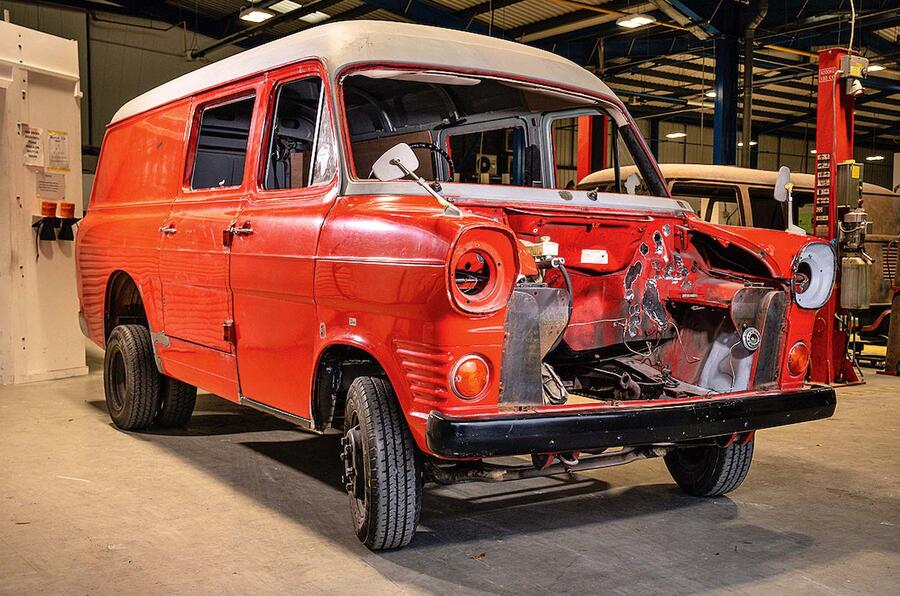
That project was designing the interior of a Mk1 Ford Transit, an event vehicle commissioned by eBay to promote the availability of new and used car parts on its website and which it has dubbed the eBay Lounge.
The former German fire service Transit was registered in 1975 and restored and converted last year by the Envisage Group, based in Coventry. It had worked with Stevens in the past and thought the legendary designer the obvious choice to remodel the van’s interior.
This year marks the Ford Transit’s 60th anniversary, and while eBay might have been tempted to commission an attention-grabbing tribute, instead it has respected the donor vehicle’s original design and specification.
The eBay Lounge is still powered by its original 1.7-litre V4 petrol engine, for example, albeit modified to burn E5 fuel, and has the four-speed gearbox it left the factory with.
The only major change, apart from Stevens’ redesigned event space, has been its conversion from left- to right-hand drive and the addition of a pop-up roof.
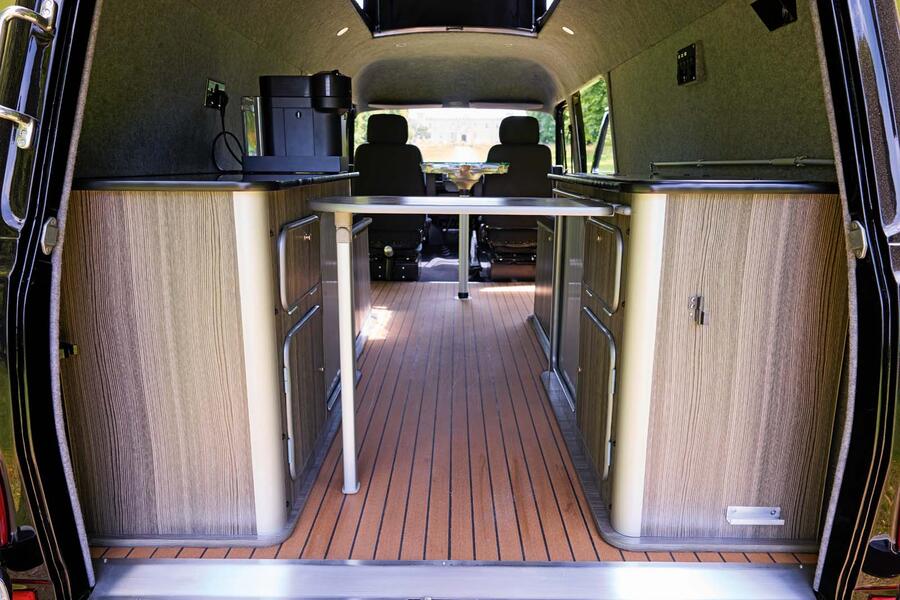
“During the early discussions, we agreed it would have no silly 21in wheels or be lowered,” says Stevens. “Instead, we said it must respect the original design and specification and not spoil it with a sad caravan interior.”
On that point, Stevens was able to draw on the experience of his motorhome. “That vehicle showed me what I don’t like in a caravan interior,” he says. So in place of pastel shades and floral fabrics, Stevens has chosen dark wood for the cabinets, a brushed steel sink with a smoked glass cover, a cool-looking counter-top fridge and a tough, uncarpeted floor, all from eBay sellers.
Also from eBay are a Bentley alloy wheel table, passenger and driver seats that can turn 180deg and a pair of ‘old timer’ retro sports seats for use outside.
Stevens’ favourite item is the Classic JLR retro radio sourced from the Jaguar Classic Parts store on eBay. Envisage also went shopping for parts on the website, sourcing everything from Mk1 Transit headlights to drivetrain and suspension components from the official eBay Ford store. Fuel pipes, brake lines and electrical and other parts also came from eBay.
In his spare time, Stevens, 82, still races and enjoys driving his collection of cars, which includes a 2CV van, a Ford Model A roadster pick-up and a 1932 3.2-litre ‘Alexander Special’ hot rod.
He rides shotgun with me as I take the Transit for a few circuits of the track at Bicester Heritage. I’m impressed by his composure as I wrestle with the old commercial’s woolly steering and wand-like gear selector.
After a few laps, I’m getting the hang of it but the mushy brakes can still generate a few surprises. Either there’s nothing in the cabinets or whatever is there is stowed securely, but there are few rattles from the back.
It’s a pukka job and Stevens is pleased to have his name attached to it: “Whether it’s a supercar or a camper van, I just love designing!”