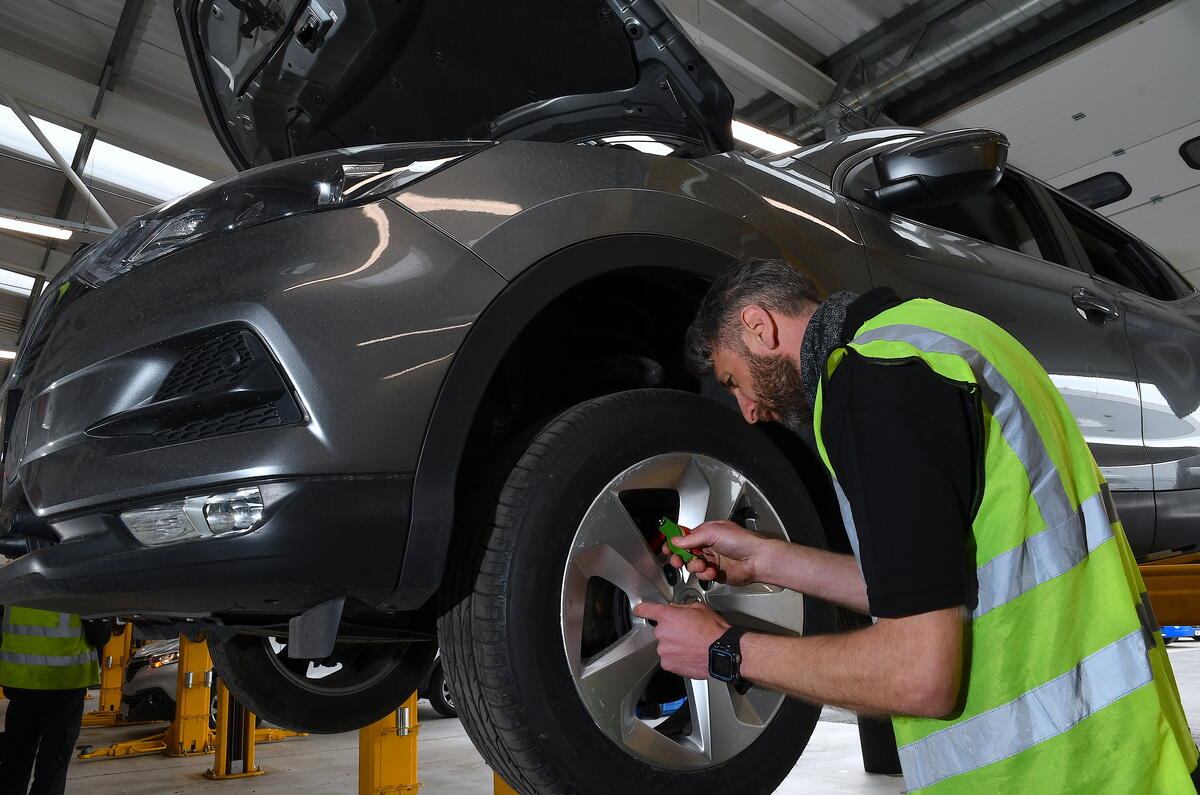



Fleets are experiencing major delays with warranty work as waiting times for repairs reportedly reach up to five months.
Mark Sinclair, downtime management specialist at leasing firm Ogilvie Fleet, said five-month wait times for warranty work on company cars are “not unrealistic… particularly with the premium manufacturers”.
He said the firm has resorted to independently handling repairs to keep fleets’ vehicles on the road by paying for work and seeking out franchised garages with availability.
“We’re almost taking things into our own hands. We sometimes just need to spend the money and bypass the warranty on these vehicles to make sure that people are getting the product that they lease from us," said Sinclair. "Do we want to put a customer in a position where they’re waiting weeks for a repair just to utilise a warranty, or do we put our hands in our pockets?
“We, as the leasing company, now have to do most of the work in terms of finding a garage that’ll take the vehicle a lot sooner than that. We don’t have any problem sending a vehicle to Nottingham, for example, if it’s based up here in Stirling [Ogilvie’s HQ] if we can’t get it into a [local] garage.”
Sinclair claimed Ogilvie’s efforts have seen its average vehicle off-road times for 2024-2025 fall by 17% or 3.6 days, from 21.4 days to 17.8 days. He said its longest downtime case last year was 225 days, down from 412, while the percentage of incidents over 30 days old fell from 19.6% to 16.6%.
A long-term parts shortage is the main cause of delays, as the pandemic and international conflicts have repeatedly hindered production. Technician shortages exacerbate the problem, especially those qualified to work on electric vehicles, as newer technologies and software are prone to teething trouble. The Institute of the Motor Industry said 35% of technicians were qualified to work on EVs at the end of 2025 and suggested demand could exceed supply by more than 43,000 technicians by 2035.
Martin Nørgaard Høgh, CEO of Tjekvik, which specialises in dealership automation services, said OEM warranty policies are also having an impact.
“In many cases, it actually conflicts with the brand requirements to be proactive toward warranty work,” he said. “Most OEMs have a requirement in their dealer contract saying you cannot approach a customer to do a warranty case, because they don’t want to just pay money out for warranty work. It has to be the customer who makes the claim and then you can bill reactively, even though that’s a worse customer experience.”
Lead times have reportedly fallen for vehicles out of warranty. In May, fleet service, maintenance and repair (SMR) specialist Epyx reported that overall fleet downtime had fallen to its lowest level since before the pandemic. It said the average length of time vehicles spent off the road for maintenance or repair work was 1.46 days in January, 1.47 in February and 1.53 in March. That was down from 1.54 days in January 2020 and the peaks of 1.83 days in May 2023 and November 2025 and 1.91 days in December 2025.
The company stipulated that its data does not include warranty work, lead times for which are the preserve of OEMs.