Currently reading: Volvo EX60: first impressions of Europe's only "true" software-defined vehicle

We get a passenger seat ride in Volvo's most advanced car yet, which it dubs a "game changer"

The new Volvo EX60 is Europe’s first “true” software-defined vehicle, the firm's engineering chief Anders Bell has told Autocar. 

Volvo revealed its new electric SUV in January, and first deliveries are due in September. The model’s advanced specification will be a key advantage in the market against rivals such as the new BMW iX3 and Mercedes-Benz GLC, say its creators. 

Unlike any previous Volvo, the EX60 incorporates battery packs, electric motors, unique software and the new “uncompromised” SPA3 platform that are all made in-house. Its launch is also closely linked to the opening of a £250 million software development centre near Volvo’s home city of Gothenburg. 

“We believe we have made the first true software-defined vehicle,” Bell told Autocar at an exclusive event last week, when journalists got to experience the car on the road for the first time (see below). Bell said it was a “massively pivotal launch that begins a new era for the company”, adding: “At the moment the car world is divided into those who have gone through the pain of this big change, and those that have still to begin or are in the process. I think we are safely through it now.”

Explaining why Volvo believes software is so important for this and future models, Bell (pictured below) said that to stay competitive cars would need to progress as quickly as the software itself, rather than by industrial timetables, while utilising core architectures that allowed advances to be rapidly incorporated. 

“In previous, domain-based cars, systems like lighting, steering, braking were all controlled by ECUs [electronic control units] that came to us from suppliers,” he said. “It’s a bit of a simplification, but in essence our job was to make all those black boxes communicate with one another without any hitches.” 
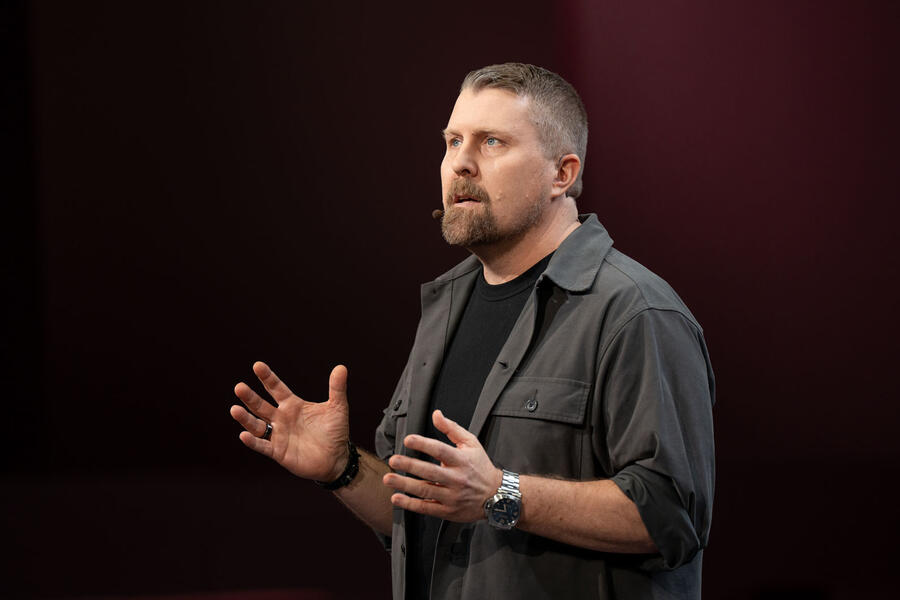
According to Bell, every time you wanted to add a new function, you had to add new ECUs and lots of cross-wiring, which increased complexity and weight and took up space. “What we now have is a much more efficient open network with its software centralised. As we add functionality, we can integrate [additional features] into the car much more easily.” 

He added that this approach saves “kilometres of wiring and bucketloads of ECUs”. The result, he said, is an EX60 with D-segment exterior dimensions but the cabin space of an old-style E-segment model. 

Bell said software-defined cars can take steps, large or small, whenever the maker wishes. He promises “a very exciting roadmap” for improving the EX60’s functions and capabilities – but he sees technology advancing so fast that even he can’t predict exactly what cars will be offering in six or eight years’ time. 

Back to top

Describing the future potential of Volvo’s SPA3 architecture, on which EX60 sits, Bell said: “It’s not just a platform, it’s much more like a technology stack. I’ve worked at Volvo since 1998, and I guarantee to you that Volvo in 2026 has much more in common with Apple in 2026 than with Volvo in 1998…”

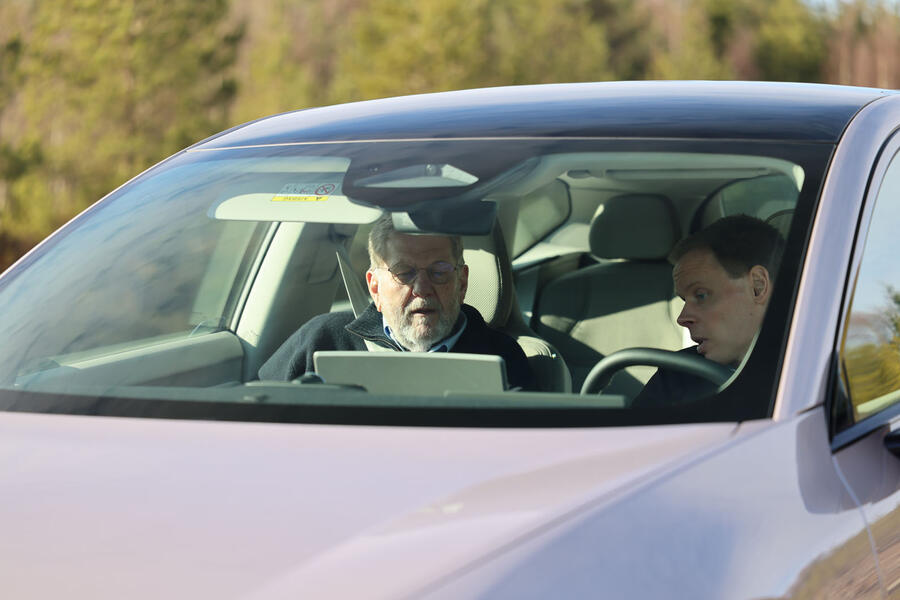
First ride in new EX60: it feels very well house-trained

I’ve headed to Volvo’s very large Hällered Proving Ground in Sweden’s back of beyond to experience the EX60 for the first time. 

I settle into the exceptionally supportive front passenger’s seat of a mid-spec EX60 P10 4x4, running adaptive damping. This spec is tipped to cost about £65,000 when it arrives in the UK; the line-up will start at £56,850. 

Test engineer Mattias Davidson is at the wheel. As we drive gently away he says we are to tackle three tracks: an evil, pockmarked country road with ruts and drain covers; a slightly faster handling road that still incorporates funny surfaces and offcamber corners; and a classic speed bowl for testing stability and noise at 100mph. 

In one sense, the Volvo is versatile. It has three drive modes (Soft, Normal, Firm) and you can adjust steering effort and accelerator response separately. 

The drive modes feel more differentiated than in many other cars. In Soft the car obviously concedes body control in favour of extra-supple absorption of individual bumps, and in Firm it’s quite the reverse, with Normal nicely situated in the middle. I’d be a Normal man. 

Back to top

What is most fascinating is that the car feels the same in all conditions, whether tackling rough roads or smooth, travelling fast or slow. It’s always quiet and composed, with low road and tyre noise, almost no mechanical humming and not much wind noise below 80mph or so. However you drive, it’s very well house-trained. 

There’s also a very pleasant overall tautness, which makes bump absorption quiet and quick. In fact, from the passenger’s seat it has all the hallmarks of a very modern, very good car. 

A good first impression, then, but we’ll have to see if it can match that from the driver’s seat – and on UK roads.

Join our WhatsApp community and be the first to read about the latest news and reviews wowing the car world. Our community is the best, easiest and most direct place to tap into the minds of Autocar, and if you join you’ll also be treated to unique WhatsApp content. You can leave at any time after joining - check our full privacy policy here.

Steve Cropley

Steve Cropley Autocar
Title: Editor-in-chief

Steve Cropley is the oldest of Autocar’s editorial team, or the most experienced if you want to be polite about it. He joined over 30 years ago, and has driven many cars and interviewed many people in half a century in the business. 

Cropley, who regards himself as the magazine’s “long stop”, has seen many changes since Autocar was a print-only affair, but claims that in such a fast moving environment he has little appetite for looking back. 

He has been surprised and delighted by the generous reception afforded the My Week In Cars podcast he makes with long suffering colleague Matt Prior, and calls it the most enjoyable part of his working week.

Join the debate

Comments
8
Add a comment…
Autojer 9 March 2026
If its truely software defined then expect lots of blast radius issues where a single issue may cause other problems . All eggs in one basket.
mrking 9 March 2026
What a joke, bought to you by the company who used to make dependable, sturdy cars that lasted ages and now makes the £100k EX90 that sometimes unlocks and sometimes doesn't. Oh and it has a taxi sign on the top with a bit of kit that was considered totally neccecary for safety but they then disabled "because"...

How far Volvo have fallen, from an ex-owner and fan

Andrew1 9 March 2026
So not for you, then?
Peter Cavellini 9 March 2026
mrking wrote:

What a joke, bought to you by the company who used to make dependable, sturdy cars that lasted ages and now makes the £100k EX90 that sometimes unlocks and sometimes doesn't. Oh and it has a taxi sign on the top with a bit of kit that was considered totally neccecary for safety but they then disabled "because"... How far Volvo have fallen, from an ex-owner and fan

Seem we have £50+K for the family car these days, how?

xxxx 9 March 2026

How, because some people have more money than others and can afford 50k cars.  If you cannot get a 30k family car, or a 25k one or a secondhand one.  Next question.

Andrew1 9 March 2026
We just need to remove those 50k ones from Mobility Scheme.
Bob Cat Brian 9 March 2026
Andrew1 wrote:

We just need to remove those 50k ones from Mobility Scheme.

No we dont. The cost to the tax payer is the same.

Andrew1 9 March 2026
Well, let's lower it, shall we?