Currently reading: Model student: How to win at slot car racing - according to the pros

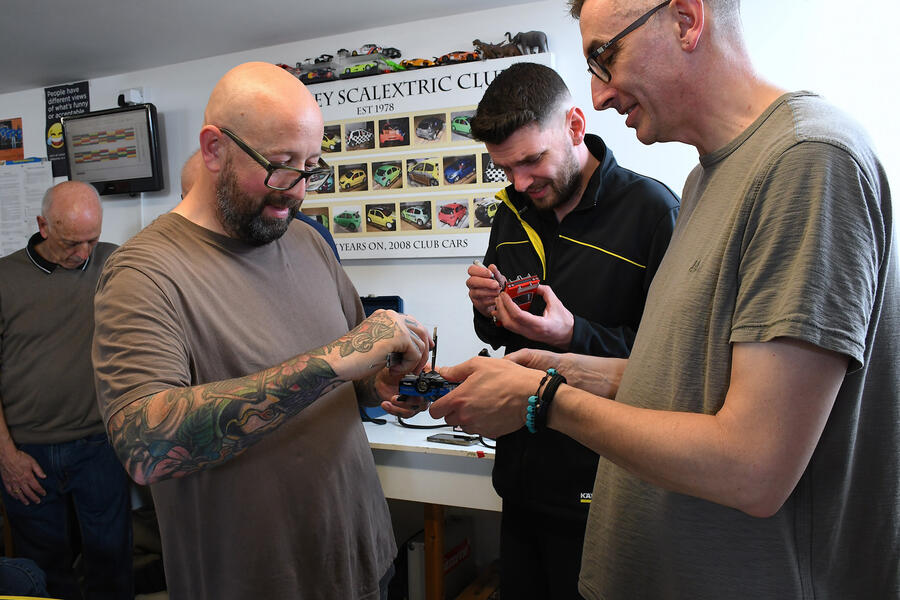
Welcome to Molesey Scalextric Club, home to some of the UK's fiercest and most addictive motor racing

Back to top

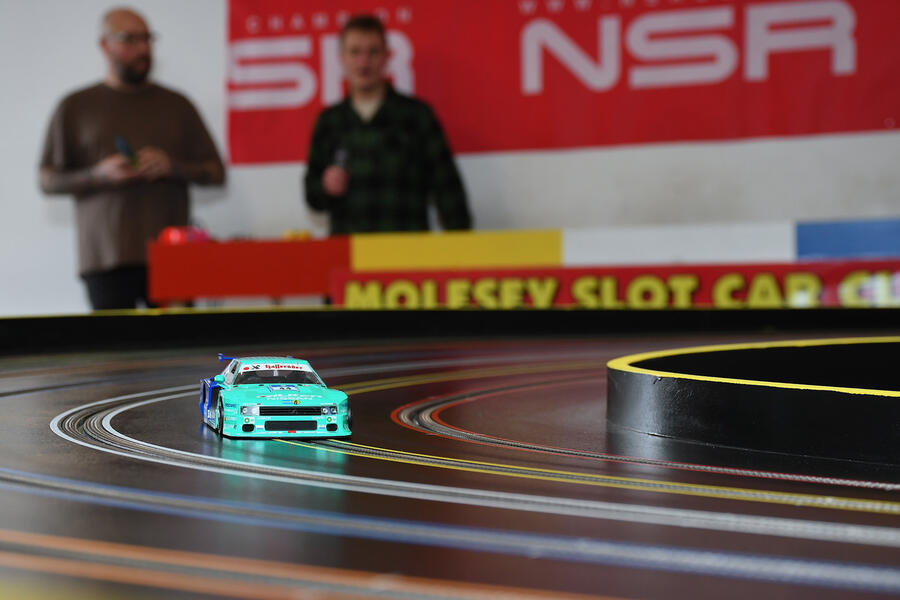
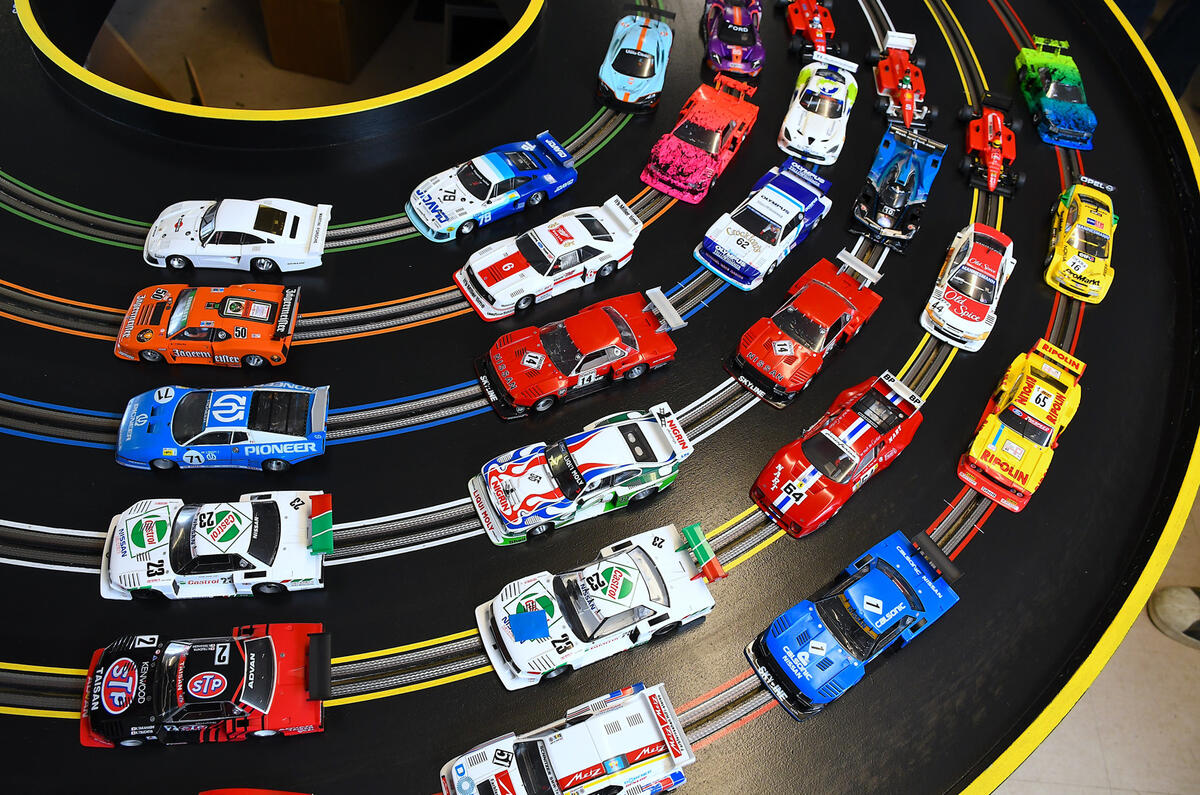
A Nissan Skyline Turbo Super Silhouette racer barrels into the first corner at a hair under full throttle, its comically outsized rear end just beginning to spin out wide as its super-sticky slick tyres concede to the laws of physics and lose grip on the glass-smooth track surface.

For a fraction of a second, it looks as if its steely-eyed pilot can pull everything back in line and send the Group 5 icon scrabbling towards turn two at full pelt, in pursuit of another blistering lap record. But then, disaster: the Porsche 911 RSR endurance racer on the inside misjudges its pace on corner exit and careens haphazardly across the track, slamming into the opposite barrier and eventually coming to rest on its roof – whereupon it is brutally impacted by the Nissan at a closing speed well north of 200mph.

Scale speed, anyway. Had an incident of that magnitude occurred in real life, the consequences could have been catastrophic, but as it is, the crash is glossed over with a snigger from the spectators and a sharply worded suggestion that the Nissan driver visit the local branch of a well-known chain of opticians.

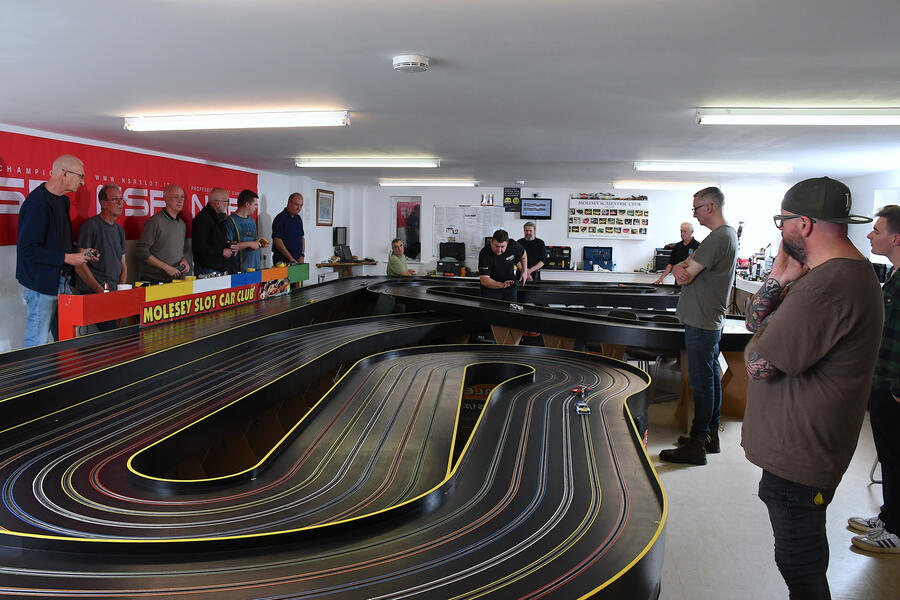
Welcome to Molesey Scalextric Club – home to perhaps the most intense and fiercely contested motor racing you’ll find inside the M25, and touted as one of the most competitive and highly skilled groups of slot car racers in the country. You could walk right past its venue and never know it was there, though, as I do several times – before club chairman Neil Green pops out of the door of an anonymous-looking block of flats and beckons me from the cold to the sanctuary within.
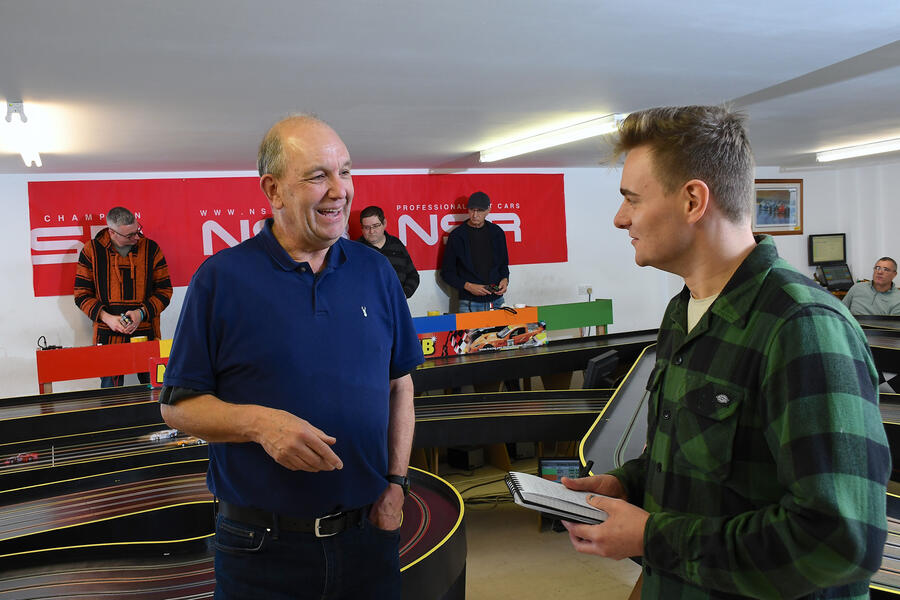
It may be subtle, but it’s the perfect home for this thriving community, as he explains: “We’ve been around for 50 years. We’ve had various buildings: when I joined 20 years ago, we owned a hut probably not as wide as this, just 50 yards away on a school field.”

When that land was sold out from under them a few years later to make way for a new housing development, it looked like all was lost, but after “a lot of negotiation” the local Surrey council agreed that the club added a lot of value to the local community and gave it a permanent home on the ground floor of one of the new development’s apartment blocks – where it remains today.

The track itself – a fearsome six-lane complex featuring twists and turns inspired by some of the world’s most challenging real-world circuits – is relatively new. The complete custom design is an intimidating 43-metre (that’s about 0.86 scale miles for the cars) ribbon of fastidiously well-kept plastic that took four weeks to build and requires hours of dedicated practice to master. The reward when you do is a lap time nudging seven seconds – and the stony glare of concentration on the faces of the six members running their cars around when we arrive is testament to the skill needed to achieve such scalding pace.

“You have to understand this club,” explains Green. “It’s probably the quickest and most experienced – the level here is crazy. Everybody wants to push, and push, and push – which is really good, but bloody hell, it’s hard to get there!”

Within minutes, it’s plain to see why people get so stuck in. It’s a fabulously warm and friendly environment – even if the racing can get rather heated. Each member is only too happy for me to nose around their ‘pit garage’, talk me through their own personal set-ups and offer me tips and tricks on how to negotiate various sections of the track. Some of these guys are near as dammit lifelong members – Green’s own son has been coming along since he could hold a controller. Some are newer to the pursuit, but there’s no sense of exclusivity or ‘gatekeeping’ here: everyone is welcome, everyone is having a good time. Within minutes I’m checking my calendar to see if I can make the weekly meeting next Thursday evening.

All too soon it’s time for me to have a go. Long-standing club member Jim ‘Jimbo’ Toohig, who has kindly prepared us a car and controller to use for the evening, offers a few words of wisdom as I warily lower the racer into its allocated lane and tighten my clammy grip on the controller. Save for a few members studiously sanding their rear tyres or straightening their cars’ braids, it feels like all eyes are on me.

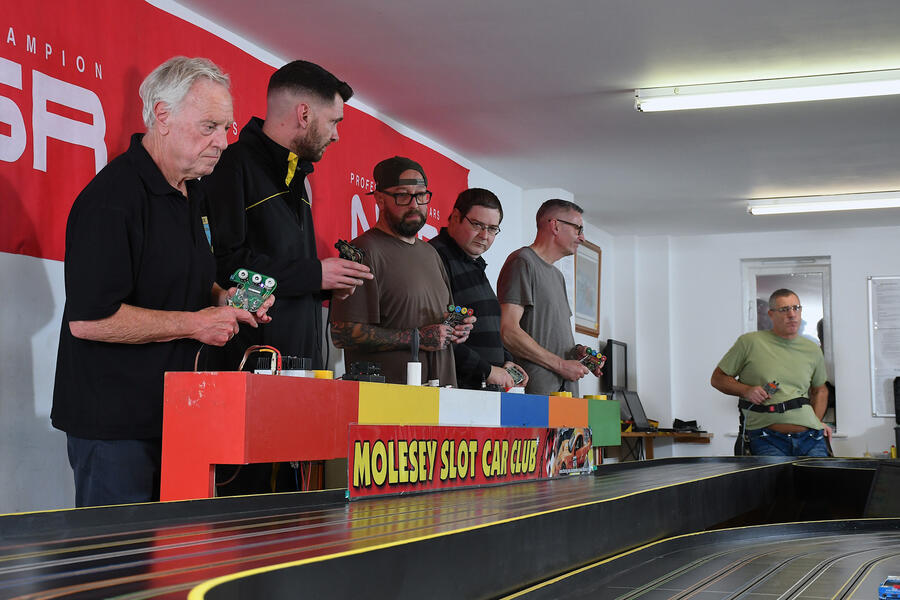
He suggests I watch the drivers, rather than the cars, for tips on how to get around quickly – and in one piece. “When they get to a corner, watch their fingers – they come right off the trigger,” he says. “You’ve got to get used to being fast – on, off, on, off – and it’s like a normal car: do all your braking before the corner.” Sure enough, if you tune out the high-pitched buzzing of the five diddy motors whizzing around at full chat, all you can hear is the rhythmical click-clack of triggers being rapidly released and reapplied with almost unfathomable confidence and dexterity, so expertly managed you can barely detect any change in speed as the cars nip in and out of turns.

I try to banish from my mind everything I know about slot car racing – although, in truth, that doesn’t extend beyond memories of hurling my ’67 Corvette Stingray into hairpins at full pelt in a bid to knock my brother’s Impreza 22B into the skirting board. Whatever happens here tonight, at least, it’s unlikely my dad will come charging up the stairs at the sound of wailing and confiscate my controller.

With Jimbo’s words ringing in my ear, I apply a judicious dab of throttle and send our Skyline whirring towards turn one at about a quarter of the speed of the other racers, who must be faintly irritated at having this clueless newbie occupying a precious lane during the final few minutes of this evening’s free practice session – even if they (kindly) don’t show it.

Safely clear of the apex, I accelerate harder for half a second and gather speed on the approach to turn two – a sharp 180deg hairpin that has already proved the undoing of many a seasoned expert since we arrived. I can’t bear to crash out so soon, so I opt for an all-too-cautious approach, lift my finger off the trigger and… come to an abrupt halt before the track has even started to bend. Ah: off means stop, it seems.

Red-faced, I set off again and find myself gaining confidence with every bend. Before long, I’m heading – knuckles whitened and brow furrowed – into my fifth or sixth lap, bearing down on a coveted single-digit lap time as I learn the nuances of each section of the track and become more familiar with the controls. Trying not to look too smug as I clock a 10.43sec time – just three seconds off the track record – I floor it up the back straight and loudly proclaim my intention of “going for a nine”.

Prematurely, as it turns out, for my exuberant entry into the tricky final hairpin proves far too boisterous and my car ploughs straight into the barrier. One of the unflinching marshals – one is posted to each corner during a race – has me back on track in a couple of seconds, and I soon make good on my promise, eliciting a heart-warming nod of approval from some of the club’s most experienced members as I bring it home in 9.5sec on my final lap.

But I’ll have to come back another time to shave any more seconds off, because the first race of the evening is looming. The first group of six take to the control panel for the preliminary heat, a marshal is installed every few metres – ready to pounce on any wayward racer and set it straight in seconds – and a hushed, respectful silence falls as the competitors flex their index fingers in nervous anticipation.

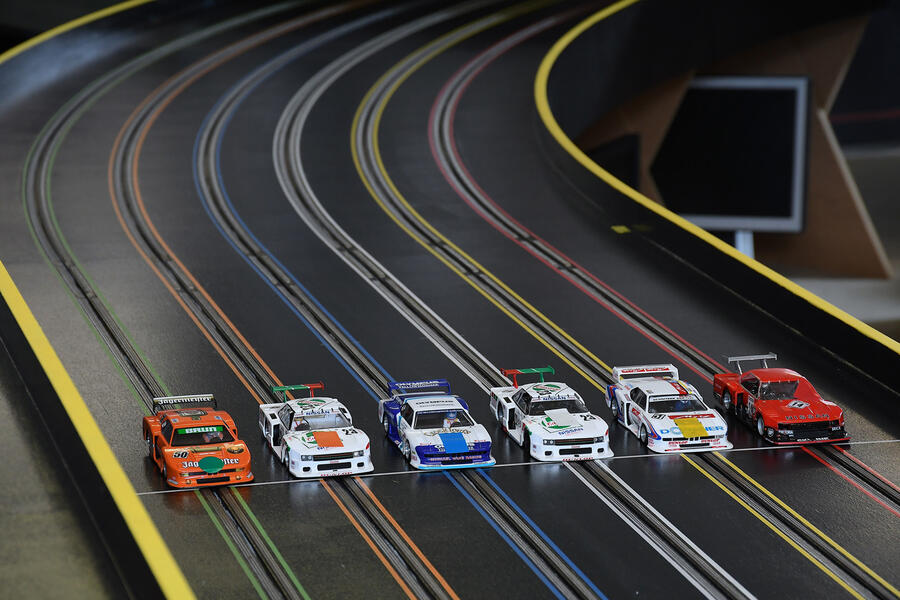
Then, with surprisingly little ceremony, it’s lights out. The racers thunder, kind of, into turn one six abreast, almost as one unit, but then almost immediately the field starts to spread out as different tactics and skill levels come into play; there’s almost a second between first and sixth even by the end of the first lap, and by mid-race it seems obvious who will bring it home first.

Until, that is, the BMW M1 in the outside lane skids off, bounces back into lane five and bats the leader’s Ferrari 512BB into the Armco. They’re back under way in the blink of an eye (“thank you, marshal!”), but it’s enough to affect the result, and there are some frustrated faces in the control booth when the 15 laps are up and all six cars are brought to a halt.

It will be gloves-off when they return to the start line for the second heat in a few minutes, but for now, with the cars off the track and controllers quickly swapped for crisps, it’s smiles all round and jokes about ‘butter fingers’.

Nobody is hurt, nobody is now broke and – crucially – nobody has called for an urgent FIA stewards’ review into any of the on- or off-track incidents. This is just good-natured and highly enjoyable competition – accessible on a budget, welcoming to all comers and brutally addictive. 

I can’t wait to go back.

Slot car racing rules okay?

Each session, before racing begins, comes the rather more serious affair of scrutineering, when Neil and Jimbo break out the dreaded callipers to ensure each car is within the club’s stringent Group 5 guidelines, which state: “The rear track can be extended to 64mm max, but no part of the wheel or tyre should be visible when the car is viewed from above.”

Tyres, meanwhile, can be ‘glued and trued’ but must not be sponge or silicone-based; rear wheels must be at least 15.8mm in diameter; suspension can be fitted but only aft of the motor mount; and any optional ballast must be securely attached within the body - and that’s just for starters. 

Despite that intimidating stack of rules, though, there’s a lot of freedom built in, and most cars that race here use only a basic bodyshell and chassis from the factory, otherwise being almost entirely bespoke. “You can spend a bloody fortune” says one racer – who, I sense, would rather his partner didn’t know that – on building a championship winner.

Felix Page

Felix Page
Title: Deputy editor

Felix is Autocar's deputy editor, responsible for leading the brand's agenda-shaping coverage across all facets of the global automotive industry - both in print and online.

He has interviewed the most powerful and widely respected people in motoring, covered the reveals and launches of today's most important cars, and broken some of the biggest automotive stories of the last few years. 

Add a comment…