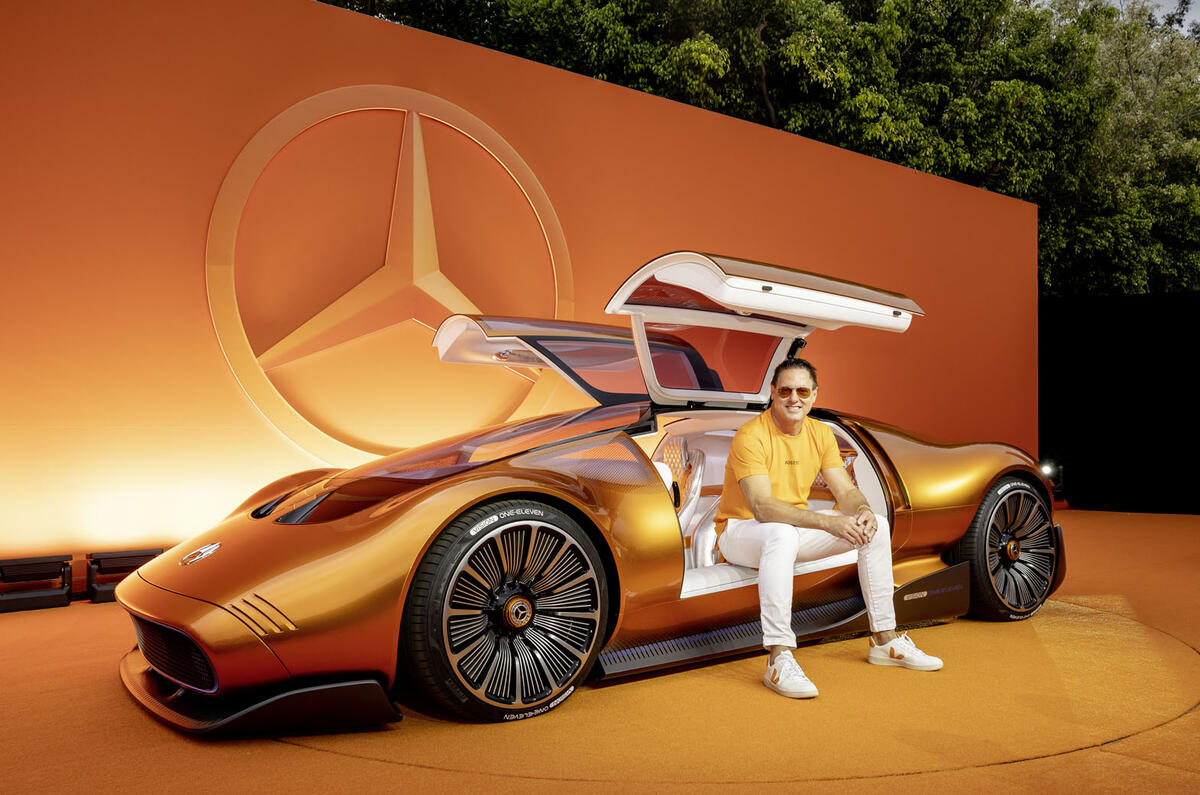

Mercedes-Benz design boss Gorden Wagener will step down in January, ending a 28-year career that radically reshaped both the styling of its production models and the internal design culture at the German car maker.
The 56-year-old, who joined Mercedes in 1997 and has led its global design operations since 2008, will be replaced by Bastian Baudy, the head of Mercedes' AMG performance car design department.
Wagener will leave the German firm on 31 January. It is at his own request and by mutual agreement.
His departure closes a significant chapter in Mercedes' design history. Under his direction, the design of its production cars underwent a comprehensive overhaul, moving from the conservative, engineer-led styling of the early 2000s to the more emotional and sculptural forms that define the existing Mercedes line-up.
Mercedes CEO Ola Källenius said: “Gorden Wagener has shaped the identity of our brands with his visionary design philosophy. Over many years, he has made a decisive contribution ensuring that our innovative products are synonymous with unique aesthetics worldwide. His creativity and his sense for the future of automotive design have sustainably enriched Mercedes-Benz."
How Wagener revolutionised Mercedes design
When Wagener was appointed vice-president of Mercedes design in 2008 at age 39 (making him the youngest lead designer within the global automotive industry at the time), he inherited an operation struggling to reconcile its heritage with contemporary design trends. His predecessor, Peter Pfeiffer, had championed a more traditional design approach heavily rooted in engineering principles.
Wagener's response was to develop what he termed "sensual purity", a design philosophy introduced in 2009 that aimed to create models that would appeal to "both your head and heart". The approach prioritised clean surfaces, sculptural forms and reduced visual complexity in a marked departure from the angular, heavily detailed designs that had characterised Mercedes' core models in previous decades.
"We don't want to be conservative any more," Wagener explained in 2019. "Mercedes has to be emotional. You have to fall in love with the car before you even sit in it."
The zenith of this design lineage is arguably the AMG GT sports car, which Wagener has frequently cited as his most cherished design. "Sports cars were always my favourite design projects," he said. "The GT is pure emotion and fascination; that is what makes the GT so special for me."
Wagener is also credited with a long line of flamboyant Mercedes concept cars, the final of which, the art deco-inspired Vision Iconic, was revealed in Shanghai in October. This previewed the bold new design language set to be adopted by future key production models, including the upcoming electric C-Class and E-Class saloons, due out in 2026 and 2027 respectively.
Born in Essen in 1968, Wagener studied industrial design at the University of Duisburg-Essen before specialising in transportation design at London's Royal College of Art. His career began with stints at Volkswagen, Mazda and General Motors before he joined Mercedes in 1997 as a transportation designer working under its then design boss, Bruno Sacco.
His rise through the ranks was rapid. By 1999, he was managing exterior and interior styling for the R-Class, ML and GL. In 2002, he moved to passenger car development, overseeing design for the A-Class, B-Class, C-Class, E-Class, CLK, CLS and McLaren SLR. A brief transfer to Mercedes' advanced design studio in California in 2006 preceded his 2007 promotion to director of design strategy and global advanced design.