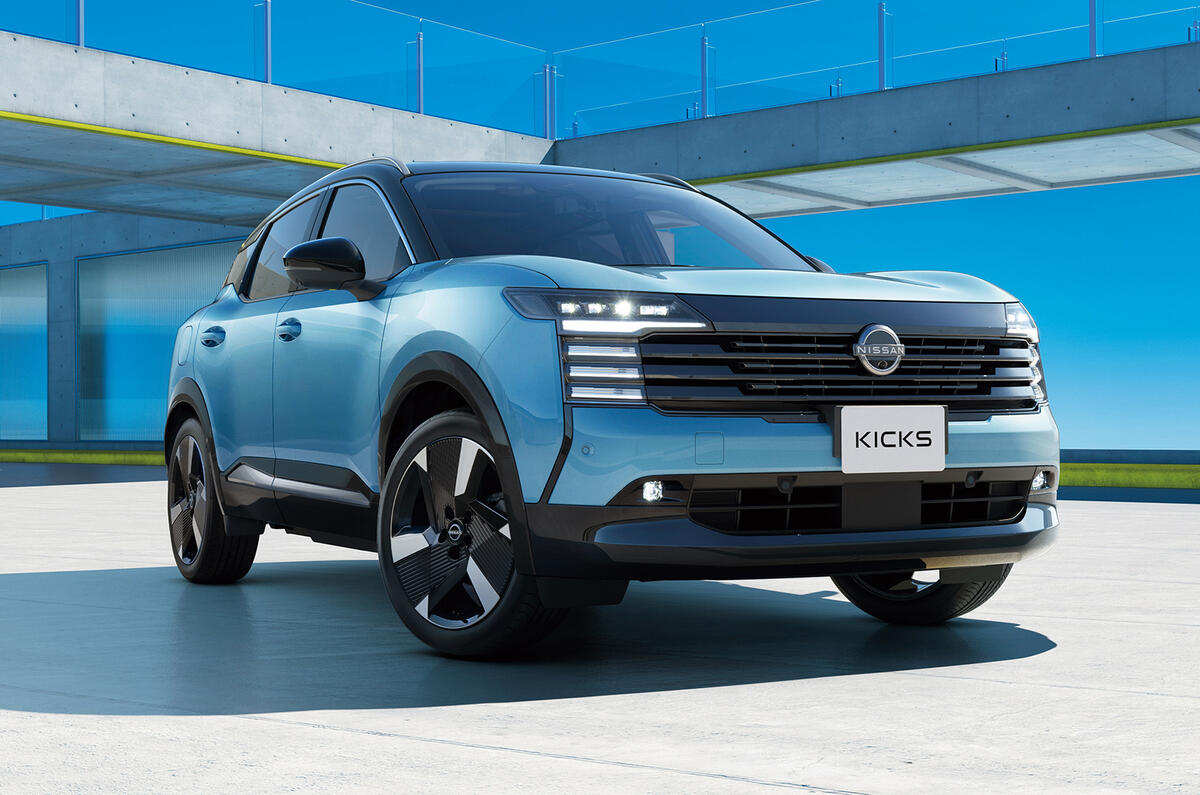
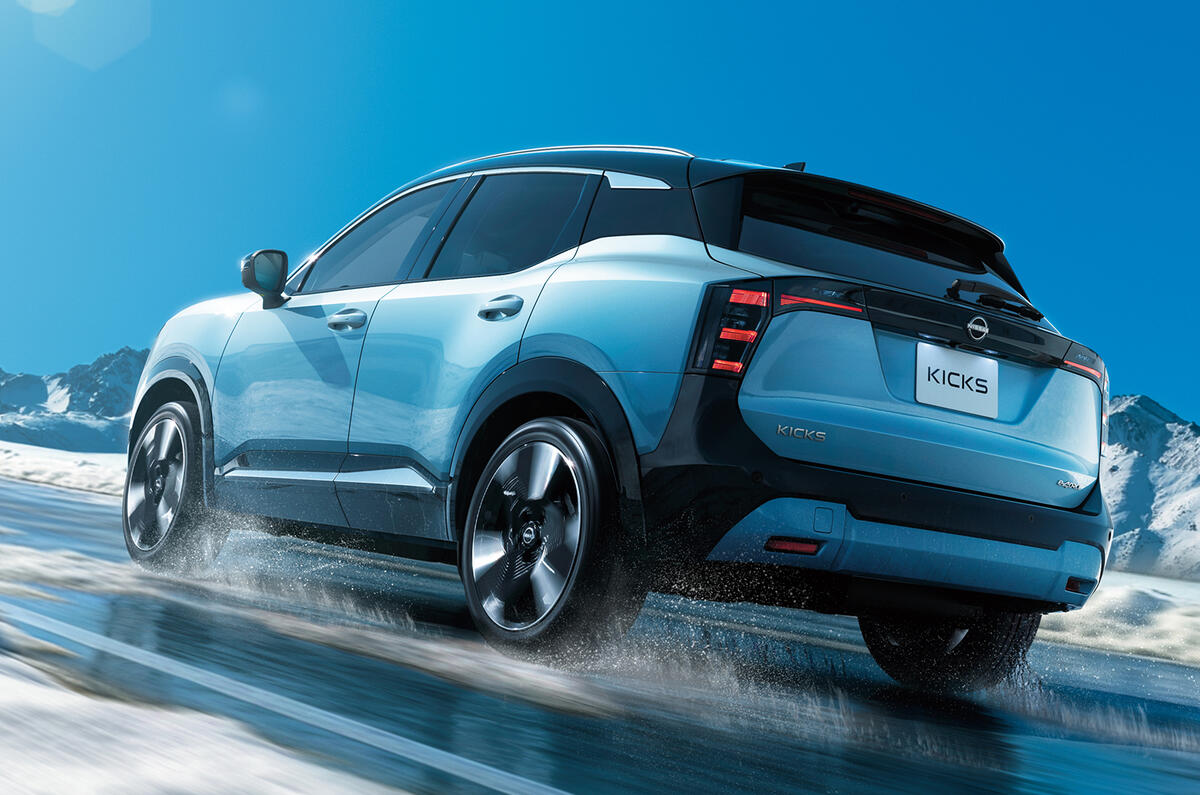

Nissan will bring its popular Kicks crossover to Europe with hybrid power – and plans to build it at its Sunderland plant following an investment worth £170 million.
The B-segment car was launched in 2016 with a focus on Brazil, and the second-generation model, launched in 2024, is currently manufactured in Brazil, Japan and Mexico. While the Kicks has never previously been offered in Europe, it is sold in most of Nissan’s other global markets.
Sunderland currently produces the Qashqai, Juke and new Leaf. It will build the electric next-generation Juke, but plans for an electric Qashqai have been scrapped, so the arrival of the Kicks will be a major boost for the plant.
The Kicks will sit beneath the Qashqai in Nissan's line-up of ICE SUVs, and replace the similarly sized ICE-powered Juke, which is now in its seventh year on sale. The international version is 4365mm long, making it slightly longer than the Juke, with which it shares the CMF-B platform.
However, Nissan has warned that the decision to bring European production of the Kicks to the UK might not happen if the government doesn’t relax its ZEV mandate to a level acceptable to the company in the UK.
“A large part of this is subject to the ZEV mandate amendment,” European head Max Messina said after Nissan announced the investment in Sunderland.
The announcement that Sunderland will build the Kicks confirms Nissan’s commitment to the plant. However, the SUV is a powered by a hybridised combustion engine rather than electric, which could limit Nissan’s ability to sell it in the UK past 2030, when 80% of all new car sales must be electric.
Messina said Nissan is looking for the government to drop that to 50% or lower as part of a review of the legislation announced in August.
“We expect the mandate to be amended to the level that allows us as a UK manufacturer to be competitive,” Messina said. “To us 50% is something that makes sense financially; 40% would be better.”
The government has said it aims to ensure the EV sales mix targets "remain pro-business and grounded in the real world".
EV sales have jumped in recent months as more consumers have switched to electric due to rising petrol and diesel prices and the launches of cheaper models. EV market share reached 30% in August after sales jumped 28%.
However, car makers have yet to reduce costs on EVs to the point that profit margins are on par with those of ICE models.
Messina said he expected car makers to have more visibility of the planned changes by next week,and urged the government to move fast.
“Sooner is better, because the sooner we can engage with suppliers to prepare our line in Sunderland to welcome the car,” he said.
Nissan, along with other car makers, is locked in an existential battle with Chinese manufacturers, who are attacking the volume segment with better-value models offering more technology.
Messina said car makers operating in the UK need help to stay competitive, because “we have some competition which is not necessarily paying the same salaries, it's not paying the same social charges, not paying the same taxes".