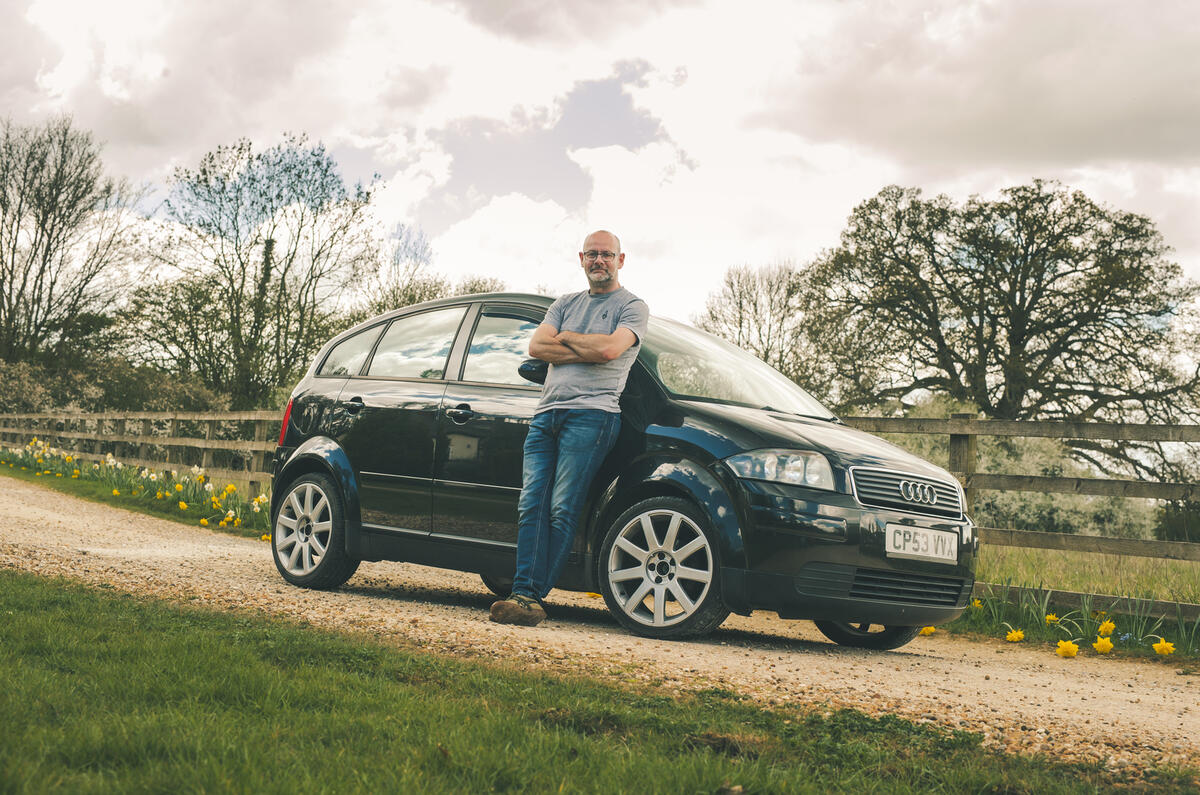
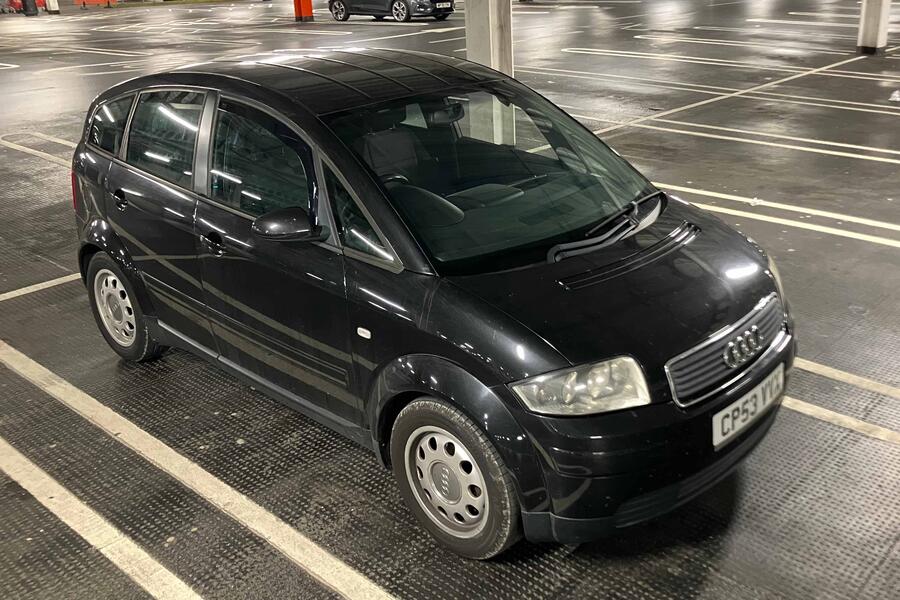
I've fitted a new set of wheels and tyres to my Audi A2, smaller ones than before, and improved its fuel consumption notably.
"I reckon it would be pushing 80mpg behind a lorry at 55mph," said a colleague when I told him how the trip computer readout (measuring over the duration I've owned the car) had climbed from a steady 68.8mpg to 71.8mpg and rising since the new hardware was fitted. I think that's a considerable underestimate.
Since making the wheel swap, I had put the difference down to narrower and more efficient tyres, plus the fact the new wheels were lighter. Then I read some quotes from a man with an ever more important job. Moni Islam, Audi's head of aerodynamics and aeroacoustics, recently told Autocar: "The A2 pushed the boundaries of car design with its proportions based on the work of [famous 20th-century car designer and aerodynamicist] Wunibald Kamm, and its optimised underbody and wheels."
I had so concerned myself with width, which affects the car's frontal area (which you multiply by the drag coefficient to find overall aerodynamic drag), and the friction of the tyre itself that I hadn't considered the aerodynamic effects of the wheel design in the improvement. I've gone from nine thick, sharp-edged wheel spokes to basically a disc with 10 discreet holes in it, so of course each wheel will be spinning less turbulently than its predecessor.
And because the wheels are sitting more inboard the body, they're even less likely to upset airflow down the sides of (and underneath) the car.
What kind of difference do small airflow changes alone make to the economy of a car? The American TV show Mythbusters once experimented with this by seeing how running a car clean versus dirty would affect its economy. They took a typical US-market saloon and got it as filthy as they could, measured its economy, then gave it a sensationally good clean and tried again.
As with most practical experiments, if you tried you could pick a hole here or there in the method, but I think it stood up pretty rigorously. The filthy car returned 24mpg at a steady 65mph; the clean car returned 26.4mpg. So if you've ever cleaned your car and thought it felt faster or more responsive afterwards but dismissed this as placebo effect, don't be so sure.
You had just removed weight from and improved the aerodynamics of four rotating masses, perhaps reducing their inertia notably. Mythbusters' versions of clean and dirty were extremes, but I will bet the human mind can detect smaller back-to-back changes.
Audi, it's worth saying, has long had form working on aerodynamics. Its C3-generation 100 of 1982, which had its efficiency figure proudly etched into its rear quarterlights ("Cd 0.30"), set new standards in the big saloon class. "Rivals' combinations of performance and economy are suddenly made to look pathetic by this unsupercharged 2.2-litre," we wrote when we tested it.

The effect of aerodynamics increases as speed rises, so rivals that matched the 100's acceleration to 50mph were trailing it by half a second to 60mph and each took nearly four seconds longer than it to reach 100mph. But the benefit in daily driving was that this five-cylinder petrol saloon would do 38.2mpg if driven gently.
I mentioned aerodynamicists' jobs becoming ever more important because, while some car makers haven't worried too much about it with combustion-engined cars, they can't afford to ignore it with electric ones.
You can improve an ICE car's economy considerably with good aerodynamic efficiency, but most of the energy in its fuel will still become heat and noise rather than forward motion.
An EV has far fewer heat and noise losses, so much more of the energy you put in it becomes motion. The proportional effect of making it slipperier, then, is much greater: the same aerodynamic improvements will garner a bigger improvement in overall efficiency. And that's important, because an EV with poor aerodynamic efficiency doesn't just cost money but also, if it has lower refuelling speeds, costs time. And there's nothing more valuable than time.

Join the debate
Add your comment
I spent a decade of my life working for the AA as the organisations fuel economy expert and we developed some very accurate equipment and techniques for measuring small changes in fuel consumption (to the extent we could easily and repeatedly detect the increase in consumption for example with headlights on and off). First of all there is little point in a simple A/B comparison with and without a vehicle change - it's really important to do multiple A/B/A/B etc tests before looking at the average difference. And in the case of wheel/tyre changes it is essential that the tyre revs per mile figures are equivalent, or that an accurate odometer correction is made. And even then different tyres may have marked differences in rolling resistance.We never carried out tests between clean and dirty cars but I would be surprised if the differences are actually measurable unless for example the test was carried out at very high speed, or there was a sufficient depth of mud or debris.to really interfere with airflow.
I can see that wheel sizes would make a significant difference due to the change in inertia and weight, but would expect the aero effect to be smaller at normal speeds.
In my experience there are too many myths created as a result of poor testing and inaccurate measurement. And today's reliance on vehicle trip computers (potentially very accurate but usually calibrated to over read to keep consumers happy) does not hep!
My car only does 40mph , I drive 5000 miles a year roughly, my car isn't a manual it has start Stop tech, I'm retired so chasing the mpg figure isn't a priority, I'd say how you drive can increase the mpg, im not going to list all the driving tips to save fuel we know the all.
Peter's car only does 40mph! Are we going to take guesses on what it is: Invacar? Very early 2CV?
No, a good old fashioned not reading it as I go, should have been 40mpg,but hey ho worse things in life the spelling mistakes.
However in this case has the owner corrected for the change in circumference of the new smaller wheels?
A smaller wheel will turn more times compared to a larger one thus increasing the distance shown to be travelled.
Which wheels was the car originally calibrated for?
When I’ve had electronic bike speedometers/milometers I’ve had to put the wheel size in at the start.
My electric car could achieve a better range if it had flush wheel covers, I hardly use the brakes. But if I took it up and over mountain passes it would need cooling slots/gaps in the wheels for brake cooling. It’s all a compromise.