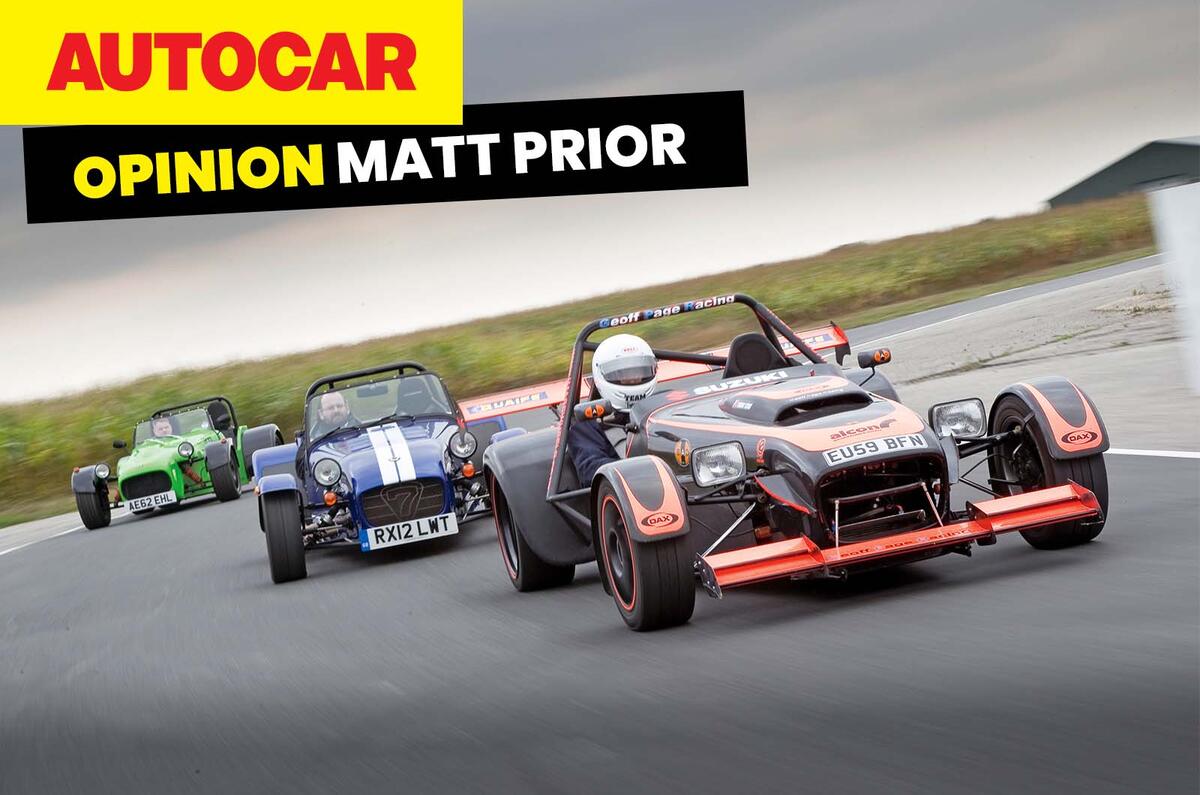
The latest government consultation on how quickly the UK car market should migrate to fully electric vehicles concerns what will happen between 2030 and 2035.
But it has made it 100% clear where the entire industry, even small- and micro-scale manufacturers, will stand after that.
All new cars, no matter who makes them, must be fully zero-emissions after 1 January 2035. No engines. No exemptions. Nobody, as was the case previously and which remains the case in the EU, is ‘out of scope’ of the regulations.
Are you a car maker that produces five newly registered cars a year by hand? From 2035, you will be in the same boat as Ford.
It’s worth reiterating how clear this is. The latest consultation, launched on Christmas Eve and running to 18 February, asks questions and puts forward proposals that include whether small-scale car makers should be included in the 2030 changes.
They’re the reason why Lister boss Lawrence Whittaker was on the news last week seeking urgent clarification, having stopped all of the firm’s future development plans.
The government has acknowledged that “there is a precedent for treating small manufacturers differently” and stated: “Kit cars represent a very small overall segment of the market.
It is proposed that applying the requirements to kit cars would therefore not be proportionate.”
Beyond that, though, there’s no doubt, no hidden meaning, no ambiguity, as paragraph 62 of the consultation reads: “It is clear that all manufacturers must decarbonise according to the ambitious timetable for all new cars and vans to be ZEV by 2035, including those made by low-volume manufacturers.”
Paragraph 64: “For all manufacturers of all sizes, new cars and vans must be 100% zero-emission by 2035.”The short of it is: if you want a combustion- engined Caterham, you have 10 years left.
This is despite the acknowledgement that “smaller-volume manufacturers account for a very small proportion of overall UK vehicle sales and limited amounts of CO2” and that “they play a vital role in supporting jobs, investment, skills and expertise within the UK automotive industry”.
It’s hoped that in future they “will play an important role in the transition to ZEVs” (all from paragraph 61), whether they and their customers want to or not.
It doesn’t matter that, as it stands, it requires considerably more CO2 emissions to make a zero-emissions car than it does a pure-ICE one, nor that micro-volume cars are typically driven such small distances annually that it could take decades, if ever, for one to reach the point where a BEV would have been better for the planet.
This will especially be the case once non-fossil-based, renewable ICE fuels – which will be so essential for construction, aerospace and agriculture – come on-stream.
Concessions for these are being considered within the EU.It doesn’t matter that Ariel’s annual output wouldn’t keep Toyota in business for nine minutes. It doesn’t matter that these small companies win awards for exports.
It doesn’t matter that most UK race circuits don’t have and may not get the electrical capacity to quickly charge EVs’ batteries. It’s as simple as this: if it has four wheels, to be sold new in 10 years, it must have no tailpipe.Perhaps you think this is fine.
These are agile companies employing clever people. Previously Ariel has said an electric future doesn’t faze it, while Caterham has dabbled with a prototype Seven EV – although it couldn’t get it to work or, more pertinently, find many interested customers.
And it may be that promised new battery technology of the sort that is dissuading some current ICE car owners from making the EV switch (the solid-state batteries promised by Nissan in 2028, Stellantis’s lithium-sulphur batteries for 2030) will make an electric niche car better, lighter and more fun than it is today.
If that is the case (and this is true to an extent of the wider car industry), the regulations won’t be necessary.
We didn’t mandate cassettes, CDs, minidiscs or MP3 players into existence because of a dislike of vinyl; new tech was just preferable, so we chose it and left the hobbyists alone.
The same path would easily suit niche car makers: if we want to buy it, they will want to make it, and those who don’t will be so few that it will make no difference to the world.
In the meantime, I’m not a natural fan of whataboutery or ‘they hate you’ conspiracies, but I find myself being tested.

Join the debate
Add your comment
If the volume manufacturers are not making engines anymore, the small manufacturers won't be able to source engine the way they currently do, and it will be very expensive to make low-volume engines that meet even current regualations.
p.s. Autocar autoplays annoyingly distracting video for other stories (counter-productive as I tend to click off the page more quickly instead of hitting the small pause button, and the more I do that, the less often I bother visiting), but now there is scrolling text that stays moving when the video is stopped. Do you really not want us to use your website?
Sad old petrolhead Matt wheels out the "let the market decide" trope. Matt, sometimes governments have to legislate and regulate for our health, safety and the environment. Without government regs we wouldn't have seatbelts (and be forced to wear them), unleaded petrol, low emission engines, vehicle weight limits, MOT requirements and latterly mandatory emergency breaking and driver drowsiness warning. Do you have a problem with all those or maybe you wish to return to the 50s?
It seems quite obvious to me that any CO saving in use will never be recoved from the making of the batteries, and most of these niche cars have long lives, with a great deal of inactivity, neither of which suggests one battery pack will last the life of the car, making the CO2 caes against ICE even worse.
But if they admit that some cars might be better for the planet running on petrol, then their argument against others wont look so strong either. So i expect an absolute ban.
ICE running on man made fuel would be better still, but i cant see those making the rules have the sense to see that either.
In the end I think niche car makers should plan on restoring, and rebuilding the cars they have already made, and selling as 'better than new'. There are no rules anywhere against that
ICE vehicles also cause deadly air pollution.
EVs are also faster and more fun to drive, ICE is dead, people need to accept it and move on.
Clearly one of us is an EV fanboy and one of us isnt.
It still makes no sense to put energy intensive batteries in limited use fun cars. I dont agree regarding the ICE pollution, but even if you are right, the amount the average Caterham, or Morgan produces wont make any difference to anyone.
As for fun, i dont need someone else to tell me what i will and wont enjoy, but thanks all the same for your thoughts. But of course, if there were a large demand for EV sports cas we would already have plenty of choice, and the makers of the cars in question would already have a range of EVs for us to buy. We wouldnt have a ZEV mandate either
Perhaps some people need to accept not everyone shares their view of the world, and move on?