Performance Plus 105kWh Turbo Saloon 4dr Electric Auto 4WD (11kW Charger) (884 ps)
Submitted by dev_editor on
On driving pleasure per pound spent, an early Porsche Boxster has to be a front-runner right now.
You can buy a distantly-travelled, base 2.5-litre-engined 986 for little more than £4000 these days, and while that might be a pool to dip into with caution, you don’t have to spend a heap more to get a car that’s a long way short of 100,000 miles.
For your money you get a Porsche flat six for starters and yes, it will wail your neck hairs to attention if you exercise it hard enough. It sits right behind you, of course, so that your Boxster seems to pivot from a point deep beneath the handbrake, its main heft located for optimal direction changing.
More optimal than big brother can naturally deliver in fact, the flat six shifted rearwards in the interests of 911 tradition and the provision of an extra pair of seats. The Boxster’s steering wheel swivels with oiled, well-measured resistance, it twitches in sympathy with the topography beneath, and vibrates as the front tyres break their grip if you’ve pushed it hard enough. In other words, you get real feel at the rim.
You’ll also enjoy a low-roll, forgiving ride, firmly potent brakes, a solidly slicing shift and a feelsome clutch, all the controls melding and blending in a way that confirms this car’s breeding every time you drive it. Even to the shops.
Few cars offer such tactile pedigree for so little money. One reason these Porsches are relatively cheap is that they’re relatively old, the youngest 986-generation Boxster now 15 and looking slightly dowdy because it’s gone out of fashion. That also means that some are looking tired and a little unloved now.
There’s another reason for the low prices, and it may well be familiar, this the much scribbled-about issues with the Boxster and the 996-generation 911.
Cylinder liner cracks, the destructive failure of the intermediate shaft bearing and leaky crankshaft main oil seals are the risks, the first two potentially very expensive. But mitigating modifications can be made – if you have them done when the clutch is changed you’ll get better value from the gearbox-out labour bill – and the pre-2000 Boxsters use a more durable intermediate shaft bearing.
The problems actually occur pretty rarely, and quite a number of cars may have been modified, but there’s no doubt that these threats reduce Boxster prices. An engine rebuild will almost certainly cost more than the car is worth.
Which gives you the intriguing possibility of running a cheap Boxster until its engine blows. Which it may never do, of course, but equally, you could be looking at the smoking ruin of a flat six mere hours after you bought the car. In which case your chosen descriptor of the situation might not necessarily be “intriguing”. That would be an unlucky outcome, and in most other respects the Boxster is a pretty robust machine. It’s certainly not prone to corrosion.
Spend more, buy a lowish-mileage car with a fat sheaf of Porsche and specialist bills and you might be looking at an investment, or at least a low-cost classic that will be nothing short of a joy to drive. That early Boxsters will be sought after is surely guaranteed.
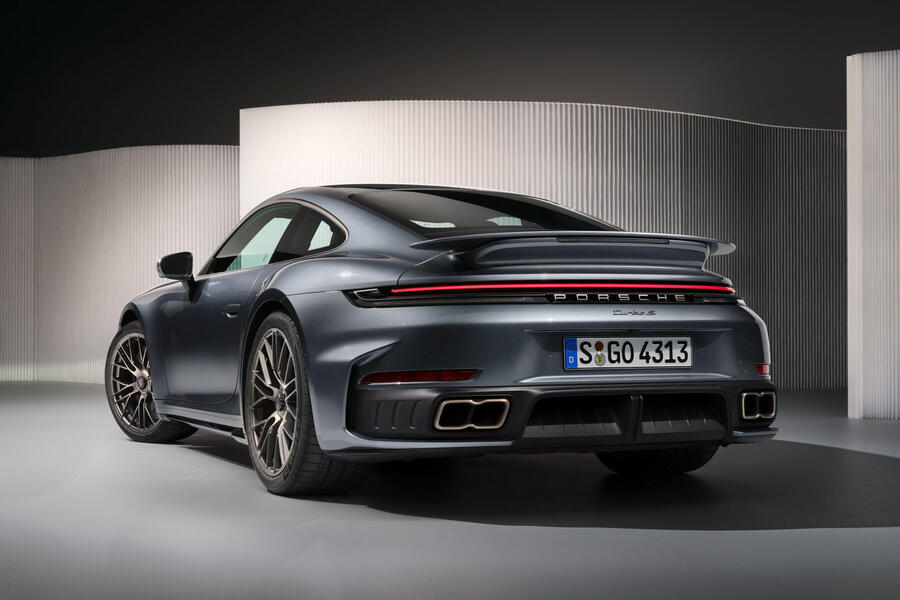
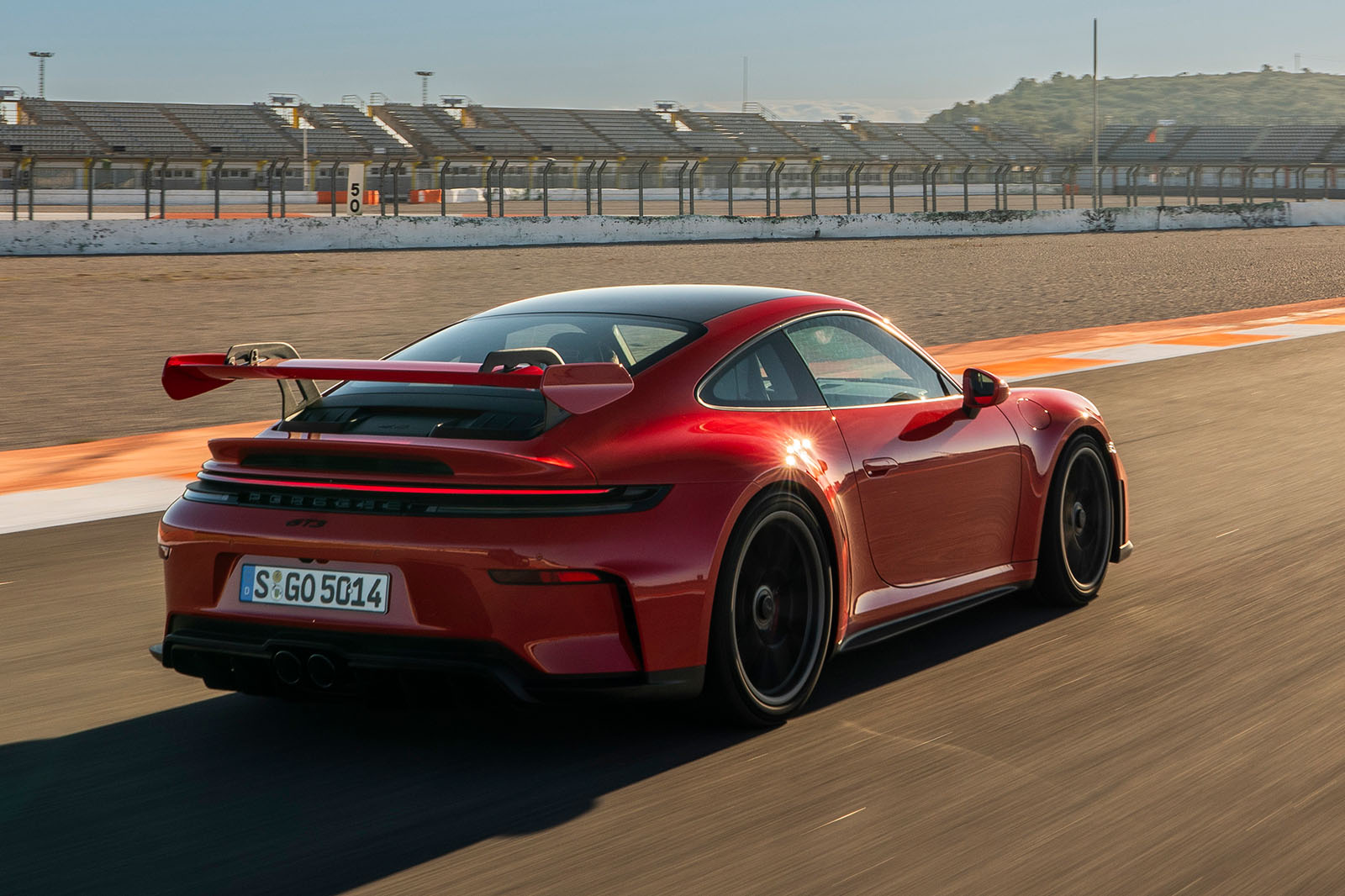
The new Porsche 911 Turbo S features a hybridised flat six that pumps out more power than any version of the sports car so far.
Electrifying the Turbo S is the most significant change to the model’s technical recipe since a second turbocharger and four-wheel drive were introduced in the mid-1990s. The move pushes Porsche’s flagship road car beyond the 700bhp mark, with a corresponding increase in price.
The hybrid Turbo S will start from £199,100 in coupé form, with the cabriolet costing £10,000 more. First deliveries are expected in late 2025.
A non-S derivative is so far unconfirmed – and may never come, reflecting the fact that in modern times the maximalist S has been the stronger seller.
While this 992.2-gen model is technically a mid-life facelift for a car that has been on sale since 2020, the changes under the skin are wide-ranging. The 3.7-litre flat six of the outgoing 911 Turbo S is replaced by a version of the 3.6-litre engine found in the 911 Carrera GTS hybrid, with the same asymmetric valve timing but new pistons for a higher compression ratio. It also has an additional ‘eTurbo’, with the car’s two blowers working in parallel.
The upshot for this second electrified version of the 911 is 701bhp between 6500rpm and 7000rpm (versus 641bhp at 6750rpm for the old Turbo S) and 590lb ft of torque at 2300-6000rpm. Torque is no higher than before but its scope – what engineers refer to as the area under the curve – is vastly greater than that of the previous Turbo S, no doubt making for even more wild point-to-point performance.
Porsche’s T-Hybrid system uses a 1.9kWh battery ahead of the scuttle to drive an electric motor connected to the shaft between the compressor and turbine wheels in each turbo. This allows the turbos to spool up extremely quickly and reach peak boost “about two seconds” sooner than otherwise, curtailing lag. It gives the new Turbo S unprecedented throttle response.
The battery also feeds an electric motor in the reinforced eight-speed PDK gearbox, further sharpening throttle response by injecting up to 139lb ft into the driveline before the flat six hits its stride.
Once the turbos are at the desired level of boost, the motor is used to regulate the speed of the shaft. In doing so, it can harvest energy, sending it back to the battery or directly to the slim e-motor in the gearbox, which can also feed the battery during deceleration. It is an entirely closed system so the 911 Turbo S isn’t a PHEV.
The claimed 0-62mph time is 2.5sec, but that closely matches Autocar’s road test time for the old model so expect what is the most potent production 911 in history to do even better. The official top speed is slightly lower than before, though, at exactly 200mph.
Elsewhere, the new Turbo S sports wider, 325mm rear tyres and larger rear brakes. Carbon-ceramic discs and rear–steer are standard. A two-tier rear spoiler-cumwing and a deployable front splitter remain, but the new car has further active aero via the gills in its front bumper.
The cross-connected active anti-roll bars are also now electrohydraulic, courtesy of the new 400V circuit, and can actuate much quicker than before.
The exhaust system is titanium, saving 6.8kg, while wiper arms made in a composite are 50% lighter. However, the total weight of the car has increased by 85kg to 1725kg – although that is with the optional rear seats in place.
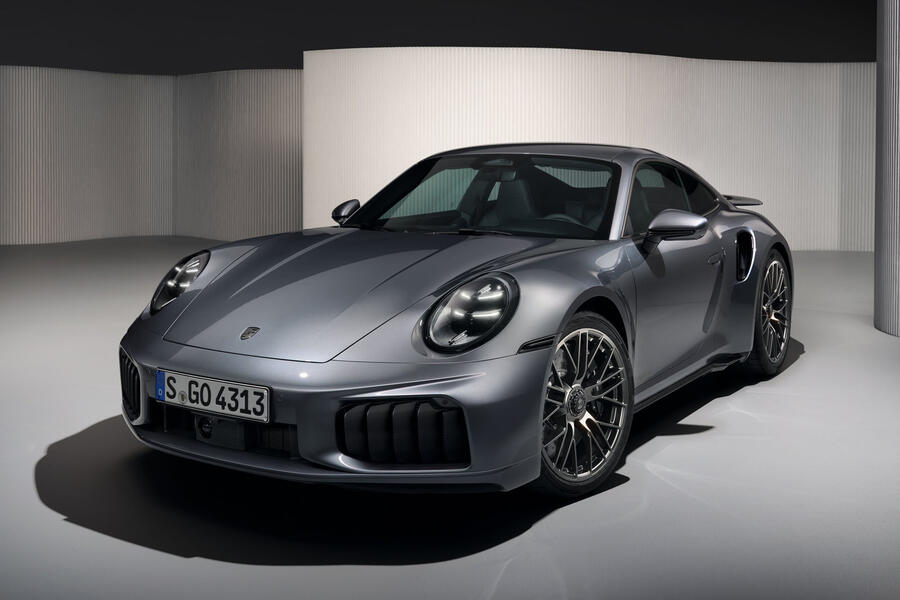
On the test track at Weissach, Germany, a pre-production Turbo S, hot from exertion, peels into the pit lane and sets itself for yet another launch control start.
This time round the driver, Jörg Bergmeister, delays his release of the brakes and for a moment, as the engine is held at 5000rpm and surplus boost pressure furiously bleeds out of the T-Hybrid powertrain, the car roars like a Boeing 747 during static takeoff. Then it seemingly disappears: poof! The new Turbo S might not sound all that romantic but it isn’t in any sense lacking in drama. Its no-holds-barred tech slant also gives it the aura of a reincarnated 959.
A few minutes later, it’s my turn in the passenger seat. I clock the new ‘Turbonite’ detailing inside the updated cabin before Bergmeister releases the bungee cord. It’s tricky to appreciate anything when you’re subjected to this level of longitudinal g but the engine note, now lightly enhanced by the rear speakers, is more serrated than before.
As the laps unfold, it’s obvious that the Turbo S’s limit handling is enhanced by the T-Hybrid system. The performance is also absurd, even on cooked Pirelli P Zero R tyres. On this technical track, even a 911 GT3 RS couldn’t keep up.
“You don’t have turbo lag any more and therefore you don’t drive it like a Turbo,” says Bergmeister while countersteering within a few feet of the Armco. “I drive it like a normally aspirated car, positioning it with the throttle and just playing with it. It’s much more satisfying than always having to anticipate the turbo lag and hoping to get it right.”
Whether all this translates to a more engaging, rewarding road car driven at sane speeds is something we’ll discover later this year, but it seems likely.
We’ve previously driven Kamm Manufaktur’s Porsche 912 restomod in prototype form but this is a production model. One I don’t think it expected to be making just yet, but such is the way with niche restomodders that if you have a request, they’ll try to oblige.
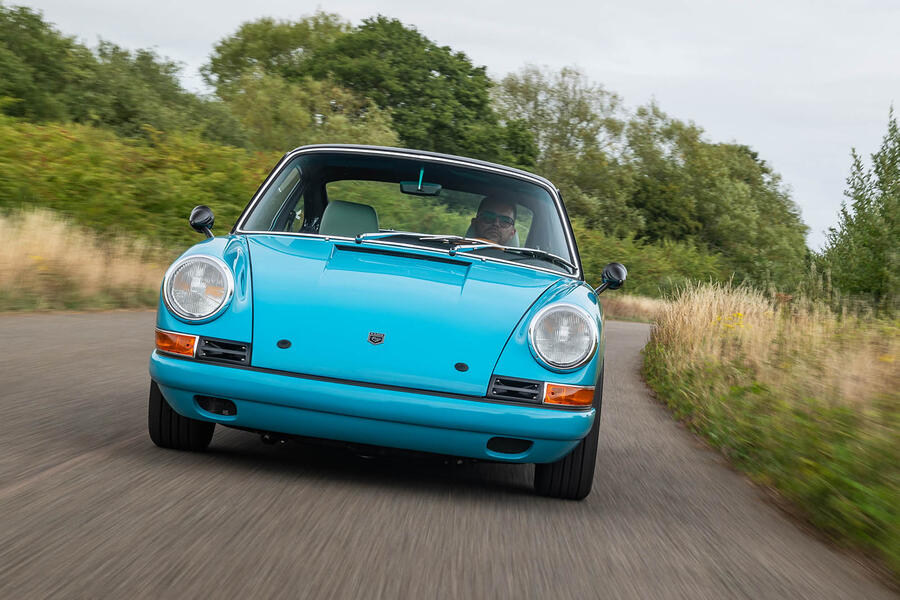
This, then, is a 912C, a full-carbon panelled version of the 912 that can weigh as little as 699kg, depending on specification, because a customer wanted one with as much carbon fibre as possible. Yours for £340,000 (you can have less carbon for less £).
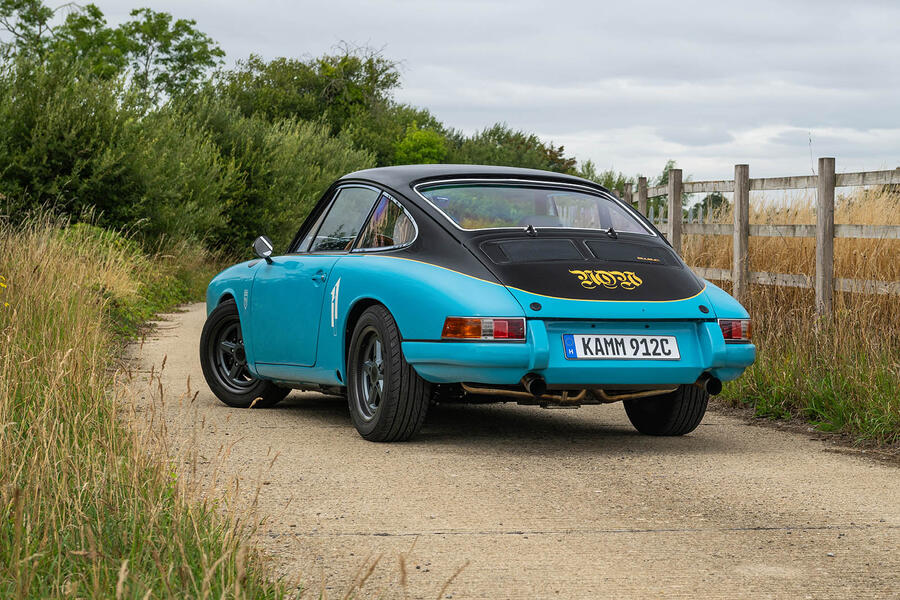
To recap, Kamm is a Hungarian company whose founder loves 912s, four-cylinder coupes that sat alongside early 911s in the Porsche range in the 1960s. Something of an underdog today. But lighter than its six-cylinder contemporary, so that’s what it restores and updates, in short-wheelbase form. Founder Miki Kazmer is something of a purist – his first protype was quite stiff and only 1.7 turns lock-to-lock. When we drove that prototype Kamm had three employees in Budapest; now it has 14 and does its own electrics, paint and carbon fibre, and has specced its own engine.
This new customer car is a good showcase as it features pretty much the works. The steel shell is restored but all outer panels, including roof and wings, are carbon fibre, and the engine is Kamm’s latest iteration of its air-cooled 2.0-litre four-pot, making 182bhp at 6800rpm and 180lb ft at 4300rpm. Kamm’s preference is to start with a shell that’s straight if rusty rather than accident bent. But these are all 1965-1968 cars so to an extent they take what they’re given.
The customer here has gone to town a bit on the exterior finish, but also the interior plushness, with leather seats and a heater and a stereo, so Kamm says it tips the scales at 770kg. Shorn of that, I and I think that would be ideal Kazmer-spec, it’d start with a six.
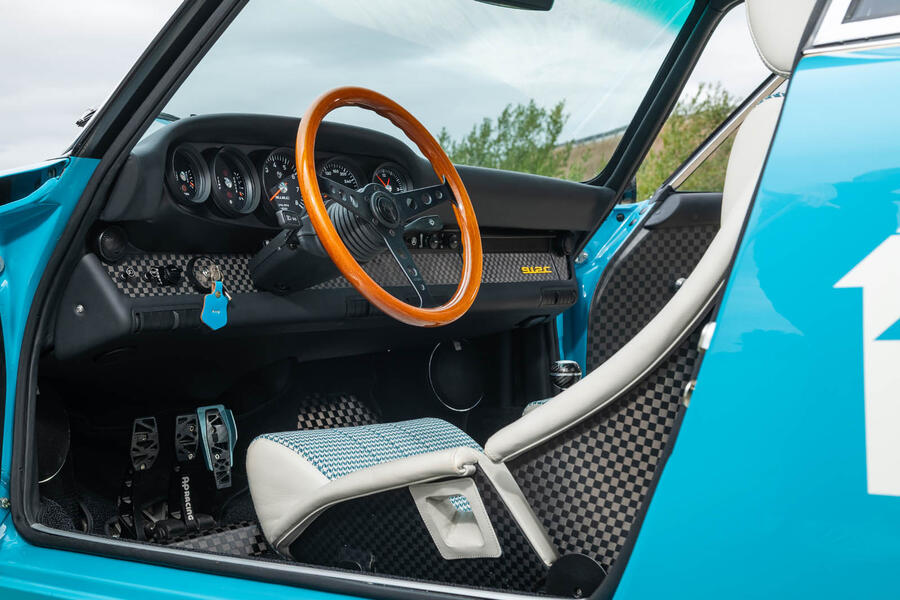
Fit and finish is a lot better than it was a couple of years ago (and it wasn’t bad then). There’s bare carbon on the outside and it looks as good as anyone’s. To reduce wind noise Kamm fits 993-generation 911 door frames and closures – remarkably they’re the same size – and reprofiles the A-pillars. But the doors still make a satisfying clack. Rather than a roll cage there’s some discreet chassis strengthening under the skin, so the interior feels as classy and light and airy as an original might; the stressed body panels enhance the rigidity too.
I find it easy to get comfortable. There’s a new floor-hinged AP Racing pedal box and the seat is supportive. The steering wheel doesn’t adjust but fits me fine – and I’m sure you could spec a deeper dish if you wanted. The five-speed dogleg gearbox’s lever sprouts from the floor between the seats.
It’s a simple cabin; the audio system is discreet; you’d barely know the vents are there if they’re closed. And there are controls for those, plus the five-stage TracTive dampers and one angrier engine (and exhaust) mode, and that’s about your lot. Which is fine by me.
Today’s Kamm is meant to be easier to drive daily than the prototype but this is still a relatively demanding car. There’s a decent amount of mechanical noise, even at idle, which is the only point where this new engine (you’ll be able to order a crate variant to suit early cars or 356s) sounds at all Beetleish. Under way, it sounds like a more recent Subaru or even Porsche’s four-cylinder Cayman, albeit louder. I’m sure reprofiling the front has reduced wind noise, but it’s hasn’t sanitised the experience.
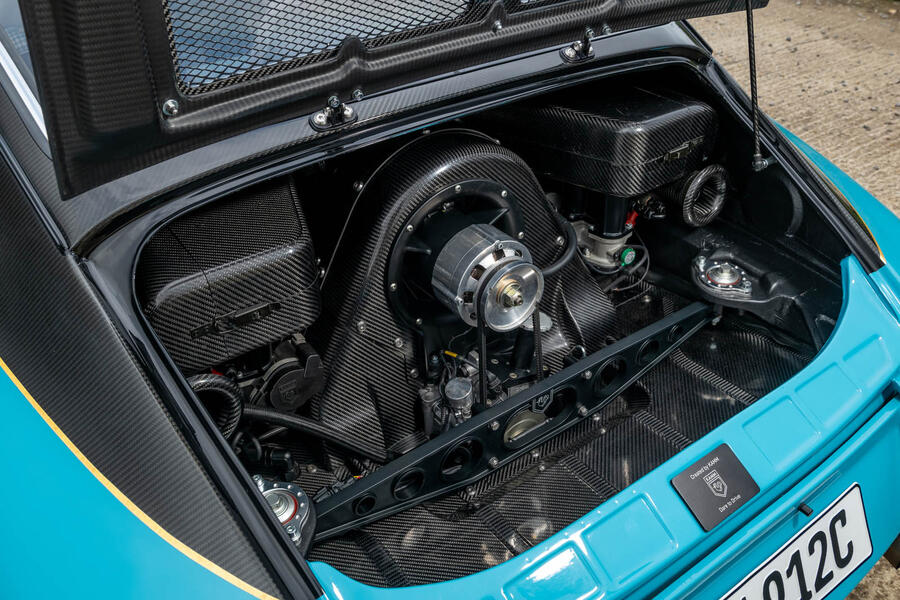
The engine pulls strongly, positively; in really lovely linear fashion. I prefer the throttle response in its sportier mode. The pedal is heavy so it feels like there’s less stiction. The brake and clutch are heavy too, but both pleasingly so. The gearbox is the weak point. Kamm can and does weld in and machine out some components to bring them back to better than production tolerances, but the lever is still a wand whose vagueness is at odds with the enhanced precision elsewhere. They’re working on their own five-speed transaxle.
You can spec three different final drive ratios and this has the longest. It’s quite long, but because there’s such a paucity of weight to lug around, and because there’s 125lb ft from 2000rpm, it feels responsive all the time. You’re always aware of that fleetness – this has the same kind of power, and a not dissimilar butchness, to those 182hp Renaultsport Clios, but is around a quarter of a tonne lighter. With a short wheelbase too, and very solid body control with the dampers turned up, it’s very happy to change direction. There’s quite a modern feel to its ride and responses, yet the steering takes a moment to build up weight, retaining a bit of classic feel. And I really like that.
When we first drove a Kamm, it felt like a Sunday morning blast sort of car. A Caterham Seven with a roof. The past three years haven’t dimmed that, but have upped the usability and finish. It’s pricey – what restomod isn’t? – but if you like lightweight bespoke cars, and I do, this is a hoot.
Price: £340,000
Engine: 4cyls horizontally opposed, 2000cc (est), petrol
Power: 182bhp at 6800rpm
Torque: 180lb ft at 4300rpm
Gearbox: 5-spd manual, RWD
Kerb weight: From 699kg
0-62mph: 6.0sec (est)
Top speed: 140mph (est)
Economy: 30mpg (est)
Rivals: Alfaholics GTA-R, Tuthill Porsche 2.0L Cup
Submitted by dev_editor on
Submitted by dev_editor on
Submitted by dev_editor on
Submitted by dev_editor on
Submitted by dev_editor on