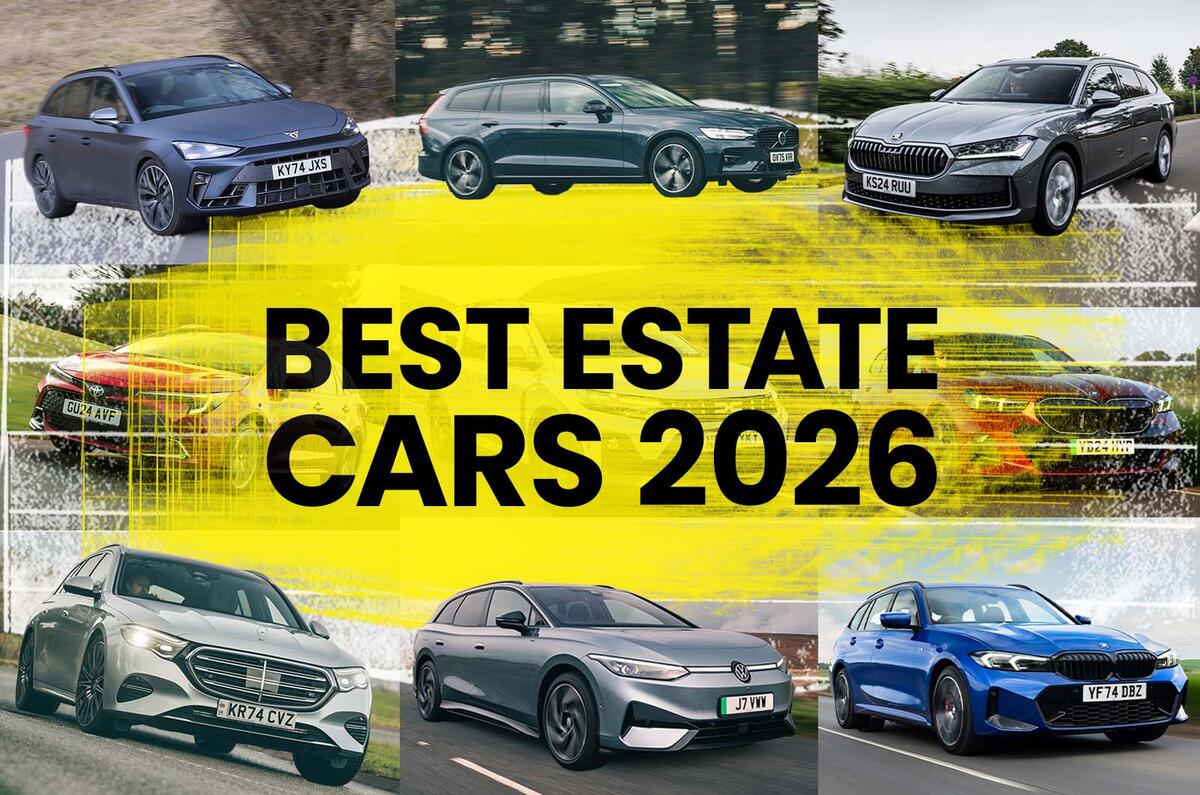
Currently reading: The best estate cars 2026 – driven, rated and ranked
UP NEXT

Our list of the very best load-lugging wagons you can buy new today, with something to suit all budgets

Seven of the 10 best-selling cars in the UK are SUVs, and their dominance over the UK car buying public only looks set to continue. 

But what if there was an alternative that meant you didn't have to bow down to current automotive trends – another type of car that offered the same level of versatility and family capability?

Step forward the estate car. While their popularity has waned in recent years, wagons, tourers and shooting brakes – whatever you like to call them – still have a strong presence in the UK.

Alongside their load-lugging capabilities and everyday versatility, they offer something high-riding SUVs can’t match: a lower centre of gravity for a more engaging drive.

Pleasingly, and much like in the SUV market, there’s a diverse range of powertrains and silhouettes to choose from. You can have anything from a soft-riding cruiser for seamless long-distance travel to a performance derivative with hot-hatch-baiting performance and handling. 

While the market is rich with choice, our expert team of road testers – whose job it is to evaluate and scrutinise every new car on sale – believe the Skoda Superb Estate is the best wagon you can buy today. Its varied selection of powertrains, vast boot and pleasing dynamics makes it one of most complete cars you can buy. 

But there’s a plethora of talented models all vying for your attention, so read on as we rank the ten best estate cars on sale in the UK today. 

The Best estate cars at a glance

Rank Model Starting Price (OTR) Boot Capacity (Seats Up / Down) Autocar Rating
1 Skoda Superb Estate £38,135 690L / 1920L 4.5 / 5
2 BMW 3 Series Touring £44,625 500L / 1510L 4.5 / 5
3 Volkswagen ID 7 Tourer £52,240 605L / 1714L 4.5 / 5
4 Porsche Taycan Sport Turismo £86,500 446L (+84L frunk) / 1212L 4.5 / 5
5 Toyota Corolla Touring Sports £31,500 598L / 1606L 4.0 / 5

https://images.cdn.autocar.co.uk/Skoda Superb Estate
  • Design10
  • Interior10
  • Performance8
  • Ride & Handling9
  • Costs9

Best for: Daily driving 

Big, traditional and offering a choice of petrol, diesel and hybrid powertrains, the Skoda Superb is a prime example of how Skoda can use Volkswagen Group’s hardware and software and tweak them to create a truly likeable, accessible and more usable car.  

The fourth-generation model majors on practicality, versatility, comfort and ease of use, much like its predecessor, only this time there's even more space inside and greater efficiency from its engines. 

Skoda has produced a car that is outstandingly fit for purpose, making the case for the estate car like few current rivals.

It rides on the same MQB Evo platform as the Volkswagen Passat, hence it offers the same 690 litres of boot space – or 1920 litres with the 60/40-split rear seats folded flat. Boot space drops to 510 litres in the plug-in hybrid iV version, with its huge 25.7kWh battery stored under the boot floor.

We can't fault the Superb’s PHEV credentials, though, as it promises a company car tax-friendly electric-only range of 84 miles. Impressive stuff. 

There’s the usual mix of petrol and diesel engines, with the latter being tipped to be a big seller here, after the PHEV and 1.5-litre mild-hybrid petrol. The diesel is quiet, hard-working and during our testing achieved 52.7mpg. 

The Superb isn’t particularly sporty or overtly comfortable, but it neatly balances the two. The long body is kept well in check and the steering builds weight as you load up the suspension in a corner, giving you plenty of confidence in the car’s roadholding. 

Buy it if...Skip It If...
You want a sub-£40,000 load-lugger that maximizes boot spaceYou want something a bit more engaging and dynamic to drive
You regularly cover long distances and want the range benefits of a frugal diesel engineYou're looking for a more premium feel inside
Back to top
https://images.cdn.autocar.co.uk/
  • Design8
  • Interior8
  • Performance8
  • Ride & Handling9
  • Costs8

Best for: All-round ability

The BMW 3 Series Touring packs many of the 5 Series Touring's strengths into a more compact package. 

Few estates at any price are as good to drive, the 3 Series' mix of agility, driver engagement and right-sized exterior making it feel at home on any meandering stretch of Tarmac. 

It continues to handle like a powerful, poised, rear-driven sports saloon no matter how hard you care to push it.

And while it rides a little firmer than some, the sense of solidity and excellent refinement mean it's also relaxing when you just want to mooch. 

The 3 Series also features a lavishly appointed and finished interior, while the boot will swallow 500 litres (or 410 litres in the PHEV version) with the rear bench in place.

A facelift in 2022 mostly concerned the interior, where the 3 Series gained a massive curved screen but lost a lot of its physical controls. We’re no great fans of BMW’s latest iDrive operating system, but at least the presence of the signature rotary controller makes up for a lot.

The 3 Series also had its engine line-up slashed in the UK. The regular range now consists of a 2.0-litre petrol and a 2.0-litre PHEV, but you can still have a straight-six petrol in the sporting M340i.

These are also joined by the magnificent 523bhp M3 Touring, which has all the M3 super-saloon’s incredible pace and poise but an extra dose of practicality as well.

And if you're after truly blue-blooded perfromance, the 542bhp M3 CS Touring offers more hardcore thrills. 

buy it if...skip it if...
You want a dynamically rewarding executive estate that doesn't compromise on daily versatilityYou regularly carry bulky, square cargo, as the sloping roofline sacrifices vertical boot volume
You value clever practicality features, such as the opening glass tailgateYou need a PHEV estate with a flat boot floor: the 330e has a raised load bed and just 410 litres of space

Find BMW 3 Series Touring deals with Autocar

https://images.cdn.autocar.co.uk/
  • Design8
  • Interior9
  • Performance8
  • Ride & Handling8
  • Costs9

Best for: Electric driving

There's a lot to like about the Volkswagen ID 7 Tourer, the German brand's first electric estate. 

It's one of the most well-rounded options for drivers with long commutes, with a range of more than 400 miles and a maximum charging speed of 200kW. 

The ID 7 is arguably the most rounded package in the class.

The ID 7 comes as standard with a single motor producing 282bhp and 402lb ft of torque, but if you need four-wheel drive there's a 335bhp dual-motor GTX variant. 

It may be large and heavy, and it's not quite as sporty as a Tesla Model 3 or BMW i4 saloon, but the ID 7 is still one of the most well-rounded estates (and EVs) on sale in the UK today. It feels agile, has more than enough poke and grips well in the corners.

The ID 7 Tourer has a 545-litre boot - 13 litres bigger than the ID 7 saloon's – and that capacity rises to 1714 litres with the rear seats folded down. 

BUY IT IF...SKIP IT IF...
You want an electric estate truly capable of 300-mile-plus motorway stintsYou're happy with a comfortable cruiser as opposed to an engaging estate car
You regularly transport taller passengers who need extra leg roomYou dislike touchscreen-heavy interiors

Find Volkswagen ID 7 deals with Autocar

Back to top
https://images.cdn.autocar.co.uk/
  • Design9
  • Interior7
  • Performance10
  • Ride & Handling9
  • Costs8

Best for: Electric performance

The Porsche Taycan EV comes in three forms, two of which are estate-bodied: the Taycan Sport Turismo and Taycan Cross Turismo. 

These models boast a 446-litre boot at the rear (increasing to 1212 litres with the seats folded flat) and an 84-litre frunk. 

The Cross Turismo transforms the Sport Turismo into a high-rise, all-surface wagon (while removing the option of a single-motor powertrain).

Porsche offers several powertrain and battery combinations, starting with 429bhp and with a 0-62mph sprint of 4.8sec in the basic Taycan.

The line-up is topped by the Turbo S, which halves that time to just 2.4sec, thanks to a monumentally powerful 938bhp powertrain. 

Range is impressive on all versions, but for the best stamina, opt for the basic Taycan Sport Turismo, which will net you 421 miles.

BUY IT IF...SKIP IT IF...
You want supercar-baiting acceleration and class-leading handlingYou carry five adults and bulky luggage regularly: rear space is a touch cramped and the 446-litre boot isn't the most capacious
You want really rapid charging stops on longer journeysYou're after a more afforable electric estate
https://images.cdn.autocar.co.uk/
  • Design8
  • Interior8
  • Performance8
  • Ride & Handling8
  • Costs9

Best for: Economy

There was a time not that long ago when 'Toyota Corolla' was a byword for humdrum transport: it was durable and dependable but dynamically flat and devoid of charm.

However, that all changed with the 12th-generation car, which features all the Corolla's traditional strengths but mixes in some style and a big dollop of driver appeal.

The Corolla isn’t the hottest, most exciting or trendiest thing around, but there’s something very pleasingly fit for purpose about it.

Thanks to the Toyota Next Generation Architecture, the Corolla is blessed with a fine balance of ride and handling that makes it a genuine pleasure to steer down your favourite road and affords genuine comfort and refinement.

These days, the Corolla is always a hybrid, but you do have the choice of a 1.8-litre or 2.0-litre petrol engine. The 1.8 can be incredibly frugal on congested roads, while the 2.0 might be the better option if you do a lot of motorway miles.

The interior isn’t quite up to premium standards and the infotainment is fairly lacklustre, but there’s decent space and it’s robustly built.

Likewise, the boot lacks some of the clever features of rivals, but it’s roomy enough and benefits from a low loading lip and a decent shape.

It's worth noting that the 1.8 has a slightly bigger boot, because its 12V battery can go under the bonnet, whereas the 2.0's has to live in the boot: 696 litres plays 581.

BUY IT IF...SKIP IT IF...
Your want rock-solid reliabilty and unrivalled economyYou regularly tow trailers or caravans: the Corolla's braked towing capacity (750kg) is significantly lower than diesel rivals'
You want a fuss-free family car that will carry passengers and luggage easilyYou want a more refined gearbox than a CVT

Find Toyota Corolla Touring Sports deals with Autocar

Back to top
https://images.cdn.autocar.co.uk/
  • Design9
  • Interior8
  • Performance8
  • Ride & Handling8
  • Costs7

Best for: Mile-munching

After being taken off sale in a shift towards SUVs, Volvo’s enduring estates returned to the UK in the middle of 2024, and we're glad they did. 

Last year, the larger V90 was pulled for good, leaving the equally refined and very likeable V60 as the brand's only estate offering – but that’s no bad thing. 

The V60’s practicality features really impress me, but it is a shame that its 40/60 folding back seats are split for the benefit of left-hand-drive markets.

The V60 can be had with either mild-hybrid petrol power or as a plug-in hybrid, with the latter producing 448bhp and offering up to 57 miles of electric range. 

Its relaxed dynamic person and long-distance gait also suits the V60 and makes it an ideal choice for those who cover big miles regularly. 

We've long been big fans of the V60's premium cabin and strong electric range, and with a 519-litre boot it can swallow more clobber than the BMW 3 Series Touring or Audi A5 Avant. 

Capacity drops to 481 litres in the PHEV version, but that’s still more than you get than in the BMW 330e Touring.

BUY IT IF...SKIP IT IF...
You want understated refinement, excellent seat comfort and a maximum safety You want a diesel engine
You want a PHEV estate with a genuine 40-mile-plus electric rangeYou want a sport-focused estate with more engaging handling
https://images.cdn.autocar.co.uk/
  • Design8
  • Interior8
  • Performance8
  • Ride & Handling7
  • Costs9

Best for: Value

Is it an estate? Is it an MPV? Is it an SUV? It does have seven seats and a mildly raised ride height, but we reckon the Dacia Jogger is an estate - and a really good one too.

Given the rampant rise in the cost of living that we’ve experienced in the past few years, the Jogger is particularly welcome. It offers all the space and utility you need, including a genuinely usable third row of seats, for significantly less money than most standard hatchbacks.

The Jogger is a product unlike any rival. An MPV/estate/crossover/SUV that’s both affordable and versatile enough to insert itself into myriad buying conversations and ownership scenarios.

And it’s not as if Jogger drivers have to give up a lot of creature comforts. Yes, the plastics are hard and there's no plush leather on the seats, but Dacia has grown very adept at brightening up its interiors with a strip of fabric here and a bit of faux knurled aluminium there without breaking the bank.

Go for one of the still very reasonably priced higher trims and you get heated seats, cruise control and sat-nav, as well as a touchscreen infotainment system that works more logically than a lot of fancier systems.

The Jogger offers lots of space for relatively little money in what is quite a cheery and pleasant package. It’s the opposite of a luxury car, but it’s hard not to like.

BUY IT IF...SKIP IT IF...
You want seven-seat versatility for the price of a mid-spec hatchbackYou want more refinement on the motorway
You want 1807 litres of cargo space (with the rear seats removed)You require four-wheel drive or heavy-duty towing capability 
Back to top
https://images.cdn.autocar.co.uk/
  • Design8
  • Interior8
  • Performance8
  • Ride & Handling8
  • Costs8

Best for: Opulence

Does the E-Class get any more convincing than in estate form? We don't think so, because if a big Mercedes' role is to convey enviable comfort to the whole family, this is where you should spend your money. 

With the seats in place, there’s a healthy 615 litres of boot space, while dropping the 40/20/40-split folding rear bench liberates 1830 litres (although the PHEV's boot is smaller, at 460/1675 litres).

The E-Class has a clear goal: to be the bridge between the traditional executive saloon and the electric, ultra-connected cars of the near future.

The cavernous, flat-floored load area is also well shaped, and there’s a low load lip and a powered tailgate, all of which make it easier to transport awkward items.

Higher trims get what Mercedes calls the Superscreen, which fuses a large central screen and a smaller screen for the passenger in a large expanse of black.

The E-Class Estate has one of the more versatile powertrain line-ups in this list, with a choice of petrols, diesels and hybrids, but our pick of the range is the PHEV, with its 67 miles of electric range and softer suspension set-up. 

BUY IT IF...SKIP IT IF...
You need a long-distance luxury cruiser with a comfortable ride and strong diesel economy You want a minimal, traditional dashboard: the optional Superscreen can feel overwhelming and convoluted
You want a plug-in hybrid with a usable 60-mile electric range and rapid charging capabilityYou want a firm, sporty feel as opposed to a comfortable, long-distance gait

Find Mercedes-Benz E-Class deals with Autocar

https://images.cdn.autocar.co.uk/
  • Design8
  • Interior7
  • Performance9
  • Ride & Handling9
  • Costs7

Best for: Power and performance

The latest BMW 5 Series arrived amid some controversy, losing its diesel engine in the UK and gaining the German brand's edgier new styling. 

The range now consists of petrols and BIK tax-friendly plug-in hybrids. The 520i makes 202bhp, while the PHEVs range from 297bhp to 482bhp, hitting 0-62mph in as little as 4.4sec. That's supercar speed, plus you get 54 miles of electric range. Then there's the all-electric i5 Touring, which offers up to 365 miles of range. 

A recorded 0-60mph time of 4.4sec makes the 550e 0.2sec quicker than the V10-hearted E60-generation M5. And we suspect this is also the first sub-M-car to sprint to 100mph in less than 10sec.

Practicality is still the 5 Series' strong suit, with a boot measuring 570 litres, which increases to 1700 litres with the rear seats folded flat. 

And if those hybrid powertrains aren't enough, there's also the seriously powerful (and seriously heavy) M5 Touring. That has a hefty 717bhp and a 0-62mph sprint time of just 3.9sec, plus around 40 miles of electric-only range. 

BUY IT IF...SKIP IT IF...
You want a tech-laden estate that offers excellent comfort and the option of pure electric powerYou prefer compact estates: at over 5m long, parking the 5 Series can prove challenging
You want a sporting PHEV that seamlessly pairs a six-cylinder engine with an electric motorYou like your car to have an understated look
Back to top
https://images.cdn.autocar.co.uk/
  • Design8
  • Interior7
  • Performance8
  • Ride & Handling8
  • Costs7

Best for: Style

Understated, refined and spacious, the latest Cupra Leon Estate is a good-looking compact wagon that makes for a great daily driver. 

You can also buy a Seat Leon Estate, which is the same car but with a much less sporting character.

There's a choice of mild-hybrid and plug-in hybrid petrol powertrains to choose from, with the latter offering up to 81 miles of electric range.

We would go for the range-topping 2.0-litre turbocharged four, which makes 328bhp and comes with four-wheel drive, giving this Leon a pseudo-hot hatchback vibe. 

With this engine fitted, it’s seriously quick, but also agile and engaging when you want it to be. It’s refined at a cruise, and the fuel economy isn’t too bad: you should get around 35mpg at a cruise on the motorway. 

The seating position is good, rolling refinement is impressive, there’s more than enough room for adults in the back and there's even more room for their paraphernalia in the boot. You get 620 litres of space to play with back there, which is more than you get in the BMW 3 Series Touring.

Volkswagen-based infotainment touchscreens have faced a lot of justified criticism in recent years, but the one fitted to Leon, which features the latest software, is much better. It’s logically configured and easier to use on the move.  

If you want your wagon with a good dose of sporting feel that doesn't compromise on space of refinement, this Cupra is a sensible choice.

BUY IT IF...SKIP IT IF...
You want hot hatch performance, a handsome design and good practicalityYou prefer ride comfort: the sport-tuned suspension and 19in alloys can feel firm on beaten-up UK roads
You're a company car driver seeking low BIK tax from a punchy PHEVYou don't like capacitive climate sliders and touch-sensitive steering-wheel controls

HOW TO CHOOSE THE BEST ESTATE CAR

When choosing the best estate for your own personal needs, you need to consider factors beyond just range and price.

Here’s what to look for:

Interior space

Why it matters: Estates are some of the most practical cars on the market, so you must be maximising their capabilities.

• Boot space: how much can you fit in the back? Is there a load lip?
• Leg room: Can your family comfortably sit in the back? 
• Storage: Are there any storage boxes or hidden compartments so you can safely store your personal items?

Powertrain

Why it matters: Estates are available with all types of powertrains: petrol, diesel, hybrid, plug-in hybrid and electric. 

• Petrol and diesel estates are often cheaper than electric models, and will sometimes be more efficient in day-to-day driving.
• Home charging (EV and PHEV only): Check if it supports 7kW or 11kW AC charging for overnight top-ups.
• Rapid charging (EV and PHEV only): Look for 150kW-plus DC charging to add significant range in 30 minutes.

Technology

Why it matters: A car is your second most expensive purchase and you will likely have it for at least three years, so you will want equipment and technology that keeps your car feeling modern.

• Navigation: Look for built-in route planners that include the ability to map charging stops.
• Assistance: Features such as adaptive cruise control, lane keeping assistance, blindspot monitoring and a 360deg camera make large cars easier to handle.
• Entertainment: Rear-seat charging ports and screens can be valuable for families.

How to decide if you actually need an estate car

An estate car makes sense if:

• You need lots of passenger and boot space.
• You regularly carry lots of bags, cargo or sports equipment.
• You prefer a lighter, better-driving car compared with a large SUV.

HOW WE TESTED AND SELECTED

Reviewing estates is largely the same as any other type of car, but with particular attention given to certain characteristics. Our highly experienced team of road testers judge estate cars based on space, versatility, long-range comfort and practicality. Here’s what we assessed…

1. Interior space

We measured head room, leg room and cabin width across all rows, plus boot capacity with seats up and folded flat. Isofix mounting points and ease of child-seat installation were tested.

2. Performance and driving dynamics

Having an estate car doesn't mean it has to be slow, unrefined or poor to drive. We evaluate ride comfort, body control and steering response on mixed roads and test acceleration with and without full loads (passengers and luggage) to mimic real use. We also examine ride quality, which is important to most buyers. 

4. Technology

Infotainment responsiveness, navigation (with live charging route planning) and smartphone integration were assessed. We tested advanced driver assistance systems (ADAS) such as adaptive cruise, lane centring, blindspot monitoring and automated parking.

5. Comfort

All the cars in this list have been subjected to thousands of miles of testing. We measured seat comfort in each one and took this into account. We also measured cabin noise at motorway speeds and suspension comfort on rough roads.

FAQs

What is an estate car?

An estate car is a practical body style that combines the comfort of a saloon with the extended boot space of an SUV. Estate cars are ideal for families and those who need extra room for luggage, pets, or equipment.

Are estate cars better to drive than SUVs?

Estate cars typically offer smooth handling and a stable driving experience, often more so than an SUV. They're more aerodynamic and many models feature advanced suspension systems and low centers of gravity, making them easy to maneuver, even when fully loaded.

Can I get an electric estate car?

Over the past few years, more car companies have been producing electric estates. MG has the 5 estate, while Volkswagen and Audi also have the ID 7 and A6 Avant. BMW also launched the i5 touring last year. 

Is an estate car good for towing?

Many estate cars have strong towing capabilities. Models like the Audi A6 Avant or Volkswagen Passat Estate are popular among those who need to tow caravans or trailers.

Are estate cars economical?

Generally, estate cars tend to be more fuel-efficient than SUVs due to their lower weight and more aerodynamic design. They’re a great choice for drivers who want extra space without high fuel costs.

Join our WhatsApp community and be the first to read about the latest news and reviews wowing the car world. Our community is the best, easiest and most direct place to tap into the minds of Autocar, and if you join you’ll also be treated to unique WhatsApp content. You can leave at any time after joining - check our full privacy policy here.

Sam Phillips

Sam Phillips
Title: Senior Staff Writer

Sam joined the Autocar team in summer 2024 and has been a contributor since 2021. He is tasked with writing used reviews and first drives as well as updating top 10s and evergreen content on the Autocar website. 

He previously led sister-title Move Electric, which covers the entire spectrum of electric vehicles, from cars to boats – and even trucks. He is an expert in new car news, used cars, electric cars, microbility, classic cars and motorsport. 

Sam graduated from Nottingham Trent University in 2021 with a BA in Journalism. In his final year he produced an in-depth feature on the automotive industry’s transition to electric cars and interviewed a number of leading experts to assess our readiness for the impending ban on the sale of petrol and diesel cars.