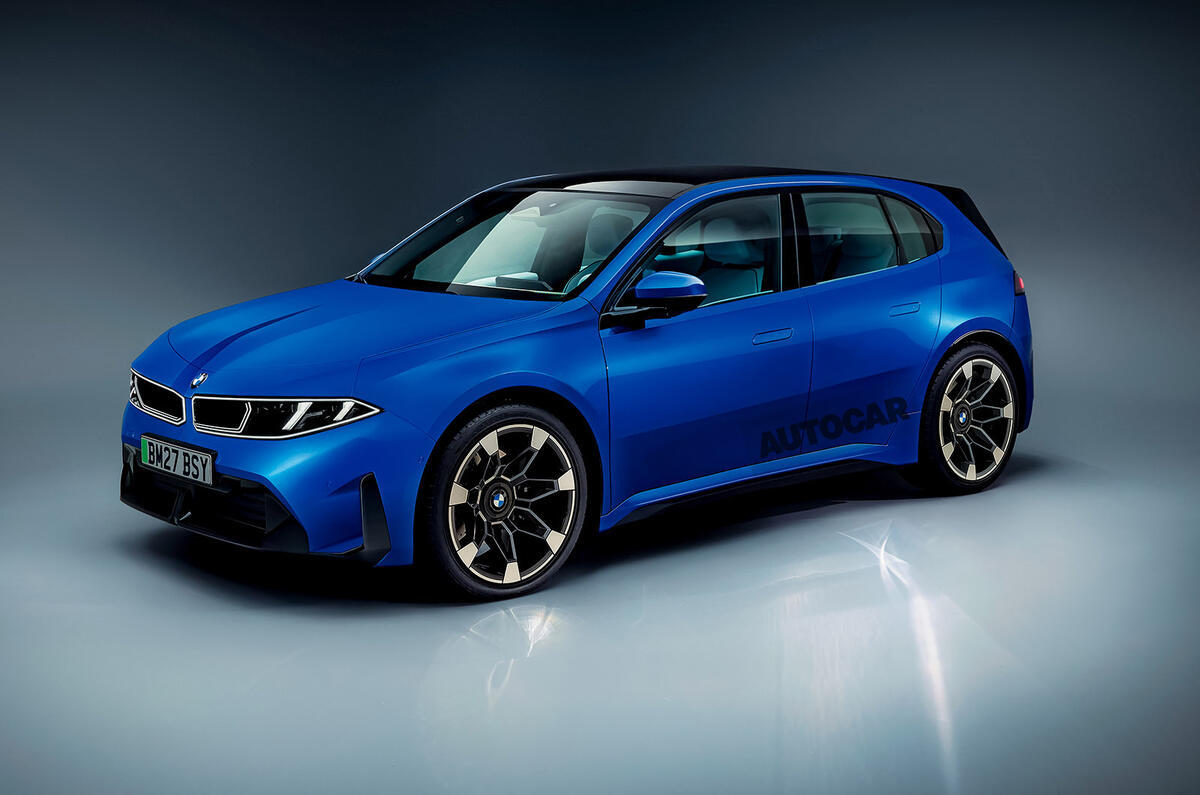

BMW has confirmed it will launch a new compact Neue Klasse EV – set to be the next 1 Series – in 2028 and is evaluating a new large SUV to sit above the X7.
The new compact EV, announced as part of a BMW Capital Markets Day event, will be focused on the European market as part of a renewed focus on the high-volume entry-level segment.
While BMW didn't confirm specifics, Autocar has previously reported that the German brand is on track to launch the fifth-generation 1 Series in 2028.
The car will sit on the electric Neue Klasse platform used by the new iX3 and i3, which means that base versions of the 1 Series EV will return to a rear-wheel-drive layout.
As with the i3 and 3 Series, the 'i1' will sit alongside a combustion-engined 1 Series that will adopt the same styling but be technically different.
The new 1 Series will be part of a new regionalised product initiative as BMW looks to address “diverse regional customers preferences”, which will include “significant adjustments” to its drivetrain portfolio for each region.
BMW will also turn Alpina into a standalone brand sitting between itself and its Rolls-Royce luxury marque.
As well as a focus on compact models for Europe as part of that regionalised approach, BMW will shift more SUV production to the US.
It's investigating a new model that will sit above that current X7, which would likely be called the X8, to take on the growing US market for large SUVs.
In China, BMW will expand the number of Neue Klasse models produced there while limiting imports to “the models with the highest margins”.
Like other car makers, BMW will increase the share of locally manufacturer content in its Chinese vehicles, with a particular focus on technology.
This more regionalised portfolio will lead BMW to reduce the number of model variants it offers and to cut some less profitable models.
While the firm hasn’t shared full details, it has confirmed that it won't replace the 2 Series Active Tourer MPV.
During the Capital Markets Day event, BMW outlined several other steps that it will take to boost its “resilience and enhance the competitiveness of its structures”, with a goal of returning to an EBIT margin of 8-10% by early 2027.
Those will include the “systematic” use of AI tools, particularly to speed up its development process and improve its manufacturing efficiency; a new agency sales model; and a reduction in the number of divisions and associated management roles by 20% by the middle of 2027.