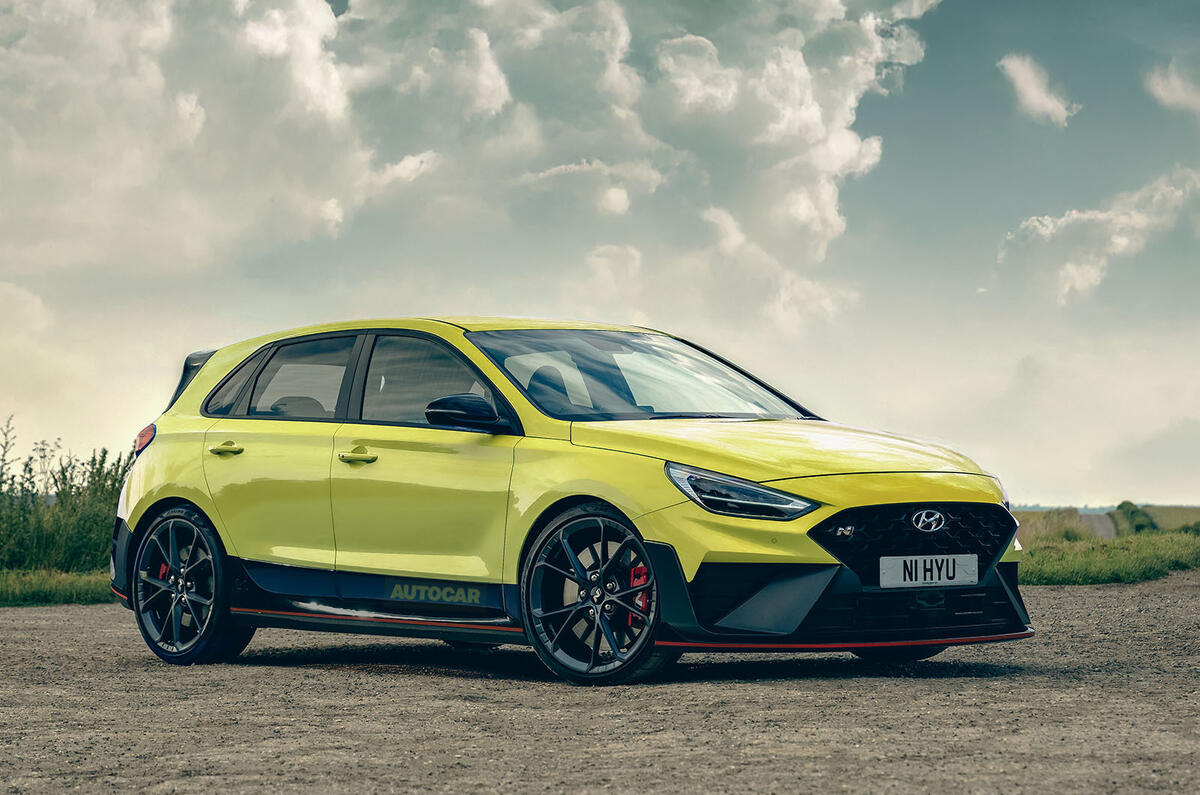

Hyundai is preparing to resurrect the petrol-powered i30 N hot hatch, filling the gap left by the recent demise of the Ford Focus ST and Honda Civic Type R, a well-placed source has told Autocar.
The original i30 N was launched in 2017 as the first model from Hyundai’s N performance brand. A close rival to the Volkswagen Golf GTI, it was based on the third-generation i30 but was a highly bespoke proposition under the skin. It featured a stiffer chassis and an electronic limited-slip differential, for example, while its 2.0-litre turbo four-cylinder was tuned to produce up to 276bhp.
The Korean firm axed its flagship hot hatch along with the smaller i20 N in 2024 as part of a move to reposition the N brand “as a pioneer of high-performance EVs” as it began its push to phase out combustion cars in Europe ahead of the 2035 cut-off. Today, Hyundai’s N line-up consists of the Ioniq 5 N hatch and Ioniq 6 N saloon – both pure-EVs with more than 600bhp.
However, a source has told Autocar that Hyundai has started work on a new version of the i30 N, which will be powered by a combustion engine – likely to be hybridised.
Indeed, N division boss Joon Park told Autocar earlier this year that future Hyundai performance cars won’t necessarily use pure-battery powertrains. He added that the N brand will keep step with its parent company in maintaining a diverse powertrain offering over the coming years.
The problem that we have is that there is a perception from the media and our fans that Hyundai N is only focusing on the EV world, which is not true,” he said. “We are not limiting ourselves to EVs.”
Further details remain to be uncovered, but based on what we know of the N brand’s plans to introduce new hybrid models, the hot new i30 could use an uprated version of an existing electrified drivetrain – possibly the standard i30’s 1.5-litre hybrid, for example – but there is potential for an all-new powertrain entirely.
Hyundai recently confirmed that it was using an outlandish Veloster-based prototype to test a new engine for performance cars, which engineers described as high revving, high performance and combustion powered. In the test mule, it’s mounted in the middle of the chassis, but other orientations are possible. Toyota has similarly used a mid-engined prototype to test its new 2.0-litre four-cylinder engine for upcoming GR sports cars, for instance.
Hyundai said it wants to “develop an engine that meets the performance requirements of the market and to mass produce it without any problems” – hinting at plans to introduce a new ICE-powered sports car in relatively high volumes.
Autocar spy photographers recently caught Hyundai readying a third facelift for the third-generation i30, which is likely to be due next year. This suggests the performance variant will be based on that facelifted version so it may arrive before the end of 2026 or at the start of 2027.
In response to the story, a Hyundai spokesperson told Autocar: "Hyundai is committed to introducing seven new N models by 2030, with plans that include exploring a broad range of powertrains such as internal combustion engines, hybrid and electric vehicles. Future product plans will be announced at a later date as part of our ongoing effort to deliver product strategies that align with our customer lifestyles and government regulations."