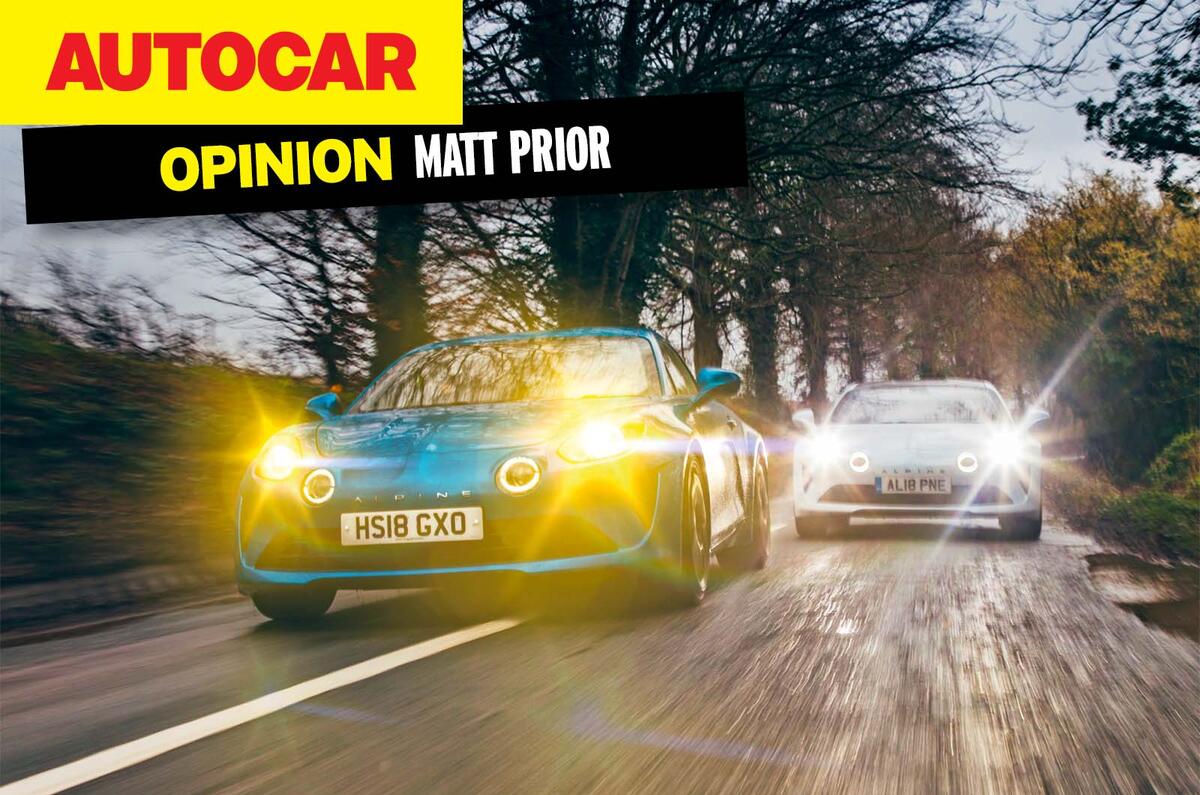

I’m pleased to see the government is to look into the issue of headlight brightness and glare – let’s hope they squint a bit – following a recent RAC survey that found a large number of drivers thought dazzling was a problem.
There may, though, not be a quick legislative fix. The Department for Transport has already been talking to a United Nations expert group on vehicle lighting – who knew? – but proposals to introduce automatic beam alignment, which would lower beams as cars go over hills and the like, won’t come into play until 2027.
And even then? Well, I’ve driven a number of cars with the most advanced ‘intelligent’ lighting on sale, which automatically aligns the beam or limits the areas lit by high beam, and still found oncoming drivers flashed me because they were being dazzled. As in many cases of legislated technology, some of it isn’t up to the job.
No, what we could do with is a solution, and sharpish. Some cars retain a switch to lower the beams in case you’re carrying a load in the back, but it’s an increasingly small number of them. In the vast majority of new cars, there’s not a lot you can do about your own glare.
It’s not like you can take apart a £1500 unit with 1200 LEDs, each with the power of the sun, to replace the bulbs either.
Fortunately, the French used to have the perfect solution, which you’ll remember if you took a holiday there before the 1990s because you’ll have had to pick up a little pot of yellow paint to daub on your headlights to give them an appropriate glow.
An article I found suggests that moving from white light onto a more yellowy part of the spectrum has a longer wavelength, which is quite good for seeing it, and it reflects less off of water.
But also, conveniently, that daubing your headlights with a little yellow pot of paint would, naturally, reduce the brightness as sure as letting them become ever more filthy. Limited research suggests that so long as both sides of the car have a matching hue, MOT testers would give it a nod.
Now, I haven’t fully investigated the scientific rigour of this feature and given it could mean new Alpine A110s running around in French blue and with yellow headlights, and that after every third car wash we’ll be refreshing the yellow tint to make it feel like setting off on a 1980s driving holiday, I’m not about to. But beyond the jokes, might there not be something in it?
Why EV tax breaks are a bad idea

One piece of advice I hope the government doesn’t take too far is the SMMT’s call to halve VAT on electric cars for three years to boost demand. Weird in itself – my LinkedIn feed is full of invested parties telling me how popular they are.
On the bland face of it, a tax break to clean up the air sounds sensible. But the numbers involved get quite big: 1.6 million cars are sold in the UK each year and we want a quarter of them to be zero-emissions, so over three years, that’s 1.2m cars having 10% VAT applied. EVs cost the best part of £50,000 on average. Simply put, that’s a £5 billion tax break.