
We recently mused on the idea of British luxury car makers collaborating on a bespoke, Trump-branded gift for the US president. Of course, there's a long tradition of special vehicles for state leaders, and indeed many of them have been true petrolheads.
'The Donald' may favour big V8s, but the first official car of any US president was powered by steam. It seems it was secretary of war William Taft who instigated the government's purchase of two White Pullman tourers in 1907.
"The cars perform countless missions for the Secret Service men and for other government officials at the 'summer capital," reported Autocar. "They have not been out of commission for an hour, despite the fact that the first 'run to the hill' is at 7am and the last at 1am. The machines are now regarded as absolutely indispensable to the expeditious handling of government work."
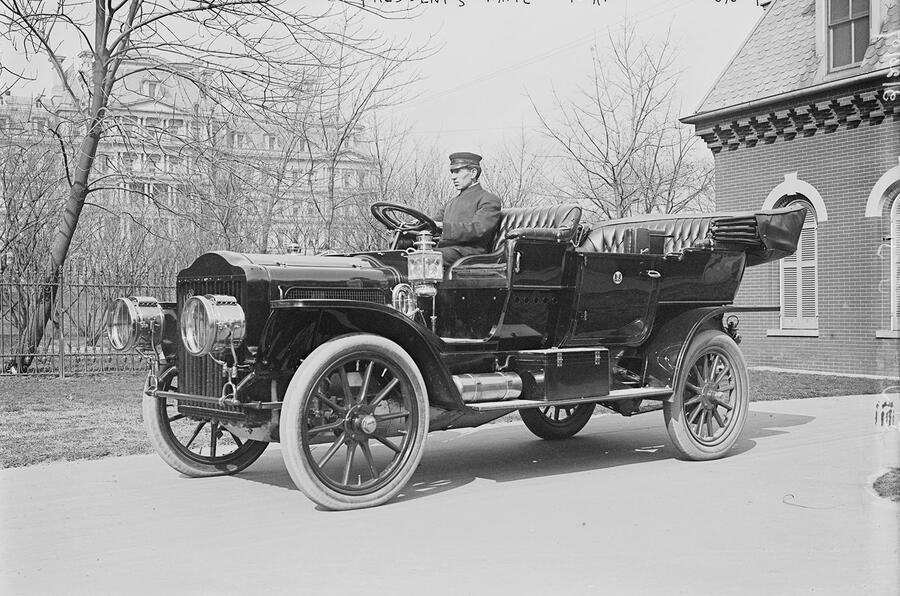
No wonder Taft kept using them after replacing Theodore Roosevelt – who famously preferred horseback or a train – as president in 1909.
Other world leaders had been driving for a long time by then. You might assume the first would have been Kaiser Wilhelm II, seeing as the car had been invented in Germany, but he considered it a "transitory phenomenon", not buying in until the 1900s.
Actually, one of the first was, maybe surprisingly, the sultan of Turkey, and Abdulhamid II chose a British EV. With a chassis by the Acme & Immisch Electric Works of London, his dogcart could average 5-6mph for three or four hours.
Several Indian maharajas were also early adopters of motoring although Waghji Rawaji II of Morvi's enthusiasm got the better of him when, on a tour of British industry in 1897, he requested to travel at 40mph.
"At Coventry he was taken out on a car, and the driver 'let her drop' down Meriden Hill," we reported, "the speed probably approximating 20-22mph. Long before they reached the bottom, however, his Highness called for some application of the brake, and expressed himself as fully satisfied with speed travelling. What he would have said had the forty miles speed actually been attained we can well imagine."
His contemporary from Tikari was much braver, coming to Britain in 1906 to actually race his Renault at Brooklands and do the Shelsley Walsh hillclimb in his De Dietrich.
Another eminent Asian motorist was the emir of Afghanistan, having been wowed by a Wolseley-Siddeley on a 1907 tour of India. A few years later he ordered £30,000 worth of machinery from the British firm (£3.1m today) after it successfully traversed the fearsome Khyber Pass. Wanting Afghans to drive and maintain his cars, Habibullah Khan sent a large group to Mumbai to learn the nature of this new invention.