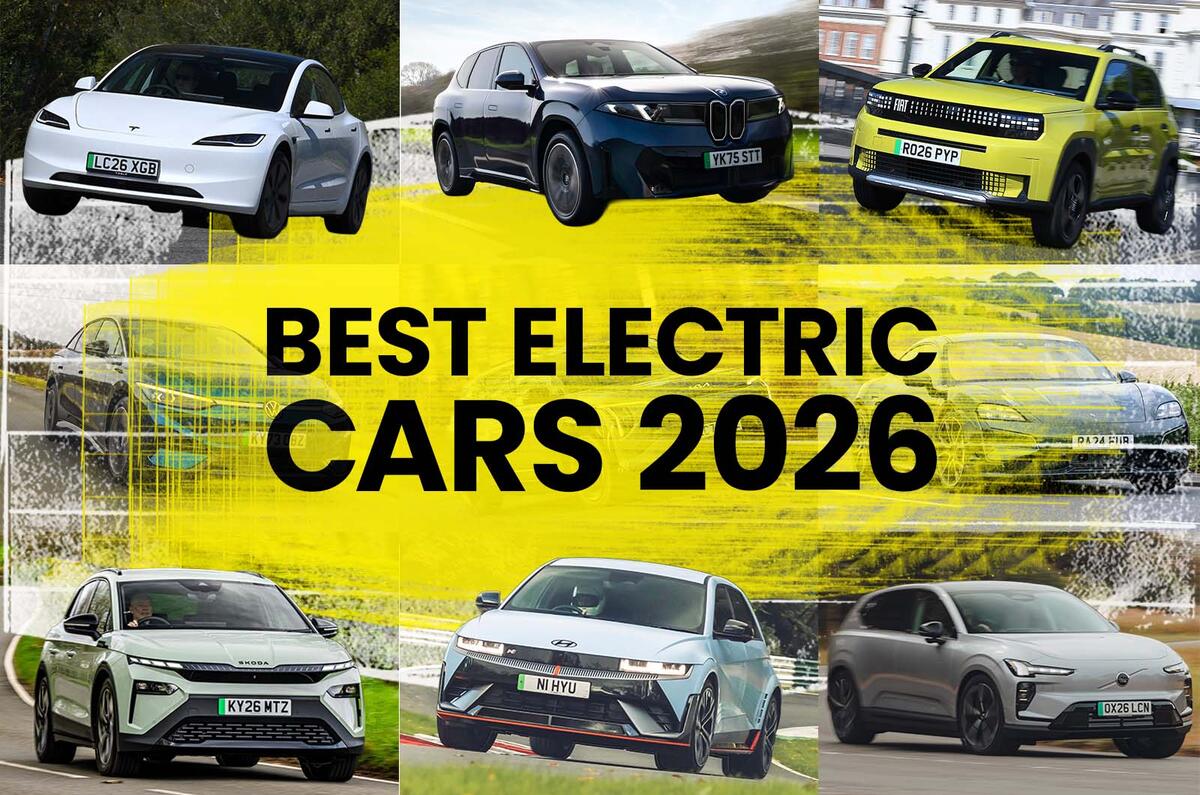
Currently reading: The best electric cars 2026 – driven, rated and ranked
UP NEXT

These are the best EVs on sale in the UK today in our view – each with its own trump card

Electric cars have come a long way in such a short period that there's now no doubting their credentials as genuine, do-it-all transport. 

Only a few years ago, EVs fell way short of the mark, with high price tags, limited real-world ranges and lacklustre charging speeds discouraging drivers from making the switch. 

Market trends now tell a very different story, with electric cars now accounting for more than a quarter of all new car registrations in the UK. 

Advancements in battery technology, public charging infrastructure and driving dynamics have changed the EV landscape, while falling production costs have democratised what used to be an expensive car class. 

Factor in their lower running costs and the UK government’s Electric Car Grant (ECG) and modern-day EVs make a strong case for themselves as the go-to choice for families and fleets.

The pool of choice is now bigger than ever, but which electric car should you actually buy? From long-legged family SUVs to performance derivatives that offer sports car-like thrills, we’ve put together a list of the best electric cars on sale today. 

We think the Skoda Elroq is the best electric car you can buy right now. Few compact SUVs can match its clever blend of versatility, range, maturity and sheer value for money. Plus several derivatives qualify for the band-two ECG, which means you can save up to £1500.   

At a glance

Make and Model Best For Starting Price Official Range (WLTP) Autocar Tested Range Autocar Rating
1. Skoda Elroq Versatility and value £33,970 Up to 372 miles 370 miles 4.5/5
2. BMW iX3 Range and charging speed £60,655 Up to 500 miles 435 miles 4.5/5
3. Hyundai Ioniq 5 N Sports car thrills £65,800 Up to 278 miles 230 miles 5/5
4. Renault 5 Stylish and affordable motoring £21,495 Up to 248 miles 260 miles 4.5/5
5. Porsche Taycan Handling and performance £88,200 Up to 421 miles 360 miles 4.5/5

https://images.cdn.autocar.co.uk/
  • Design8
  • Interior9
  • Performance8
  • Ride & Handling8
  • Costs9

Four years ago, the Skoda Enyaq emerged as a comfortable, reasonably priced, well-conceived mid-size electric SUV. 

Ostensibly the Skoda Elroq takes that formula and reworks it into a smaller, cheaper model. Yet it also represents a shift in design philosophy, all while being assertively strong in all areas.

It’s obligingly supple on typical dual carriageways and A-roads.

Inside, it’s massive. The boot is particularly useful and among the largest in class (although that of the Renault Scenic is bigger) and the storage is on point. For instance, you can keep the charging cables in an underboot cubby or the storage net in the boot and the parcel shelf has multiple heights.

Adaptability also is high up on the list of reasons to buy. Top-spec models have a WLTP range of 360 miles, and even in our real-world testing 270-300 miles was easily achievable. 

Several versions, including the SE L 85 with a WLTP range of 355 miles, qualify for the £1500 ECG, which makes the Elroq an even more desirable proposition. 

Find Skoda Elroq deals with Autocar

Advertisement

Read our review

Car review

Skoda shifts its focus to EVs, starting with a Scenic-rivalling compact SUV

Back to top
https://images.cdn.autocar.co.uk/
  • Design10
  • Interior8
  • Performance9
  • Ride & Handling9
  • Costs10

There was a lot resting on the shoulders of the iX3 well before it launched. BMW poured billions into the development of the Neue Klasse EV platform and at the same time adopted a radical new design language that will shape the brand for the foreseeable.  

Pleasingly for BMW, its efforts have paid dividends, with the iX3 climbing straight to the top of the class for its excellent range, charging speeds and handling dynamics. Fully charged, the iX3 can travel up to a staggering 500 miles and, thanks to 400kW ultra-rapid charging, it can boost its battery from 10-80% in a mere 21 minutes.

For now, the iX3 is a triumph. A firm ride and some usability grumbles preclude a perfect score, but here stands an electric SUV that shifts boundaries for range and charging.

Much thought has also been put into the iX3’s dynamic ability, too, which is showcased by its poised handling and finely-tuned steering. For a near 2.3-tonne car, it hides its mass well, although its passively damped set-up can make it a little stern-riding.  

You won’t find much physical switchgear inside, but iX3’s digital technology is advanced and easy to use. Particularly good are the ADAS, which are unintrusive and actually helpful, unlike many rival systems. 

https://images.cdn.autocar.co.uk/
  • Design8
  • Interior8
  • Performance9
  • Ride & Handling9
  • Costs8

The Hyundai Ioniq 5 N takes the Korean brand's electric crossover and sends it into electric sports car territory.

Utilising a dual-motor powertrain, the Ioniq 5 N produces 641bhp and 549lb ft, hitting 0-62mph in a staggeringly fast 3.4sec. 

The electric driver's car has landed, and it will slot into most of our lives with ease.

Hyundai claims it will do 278 miles on a charge, too, thanks to an 89kWh battery. During our time with the 5 N, it only managed around 230 miles on a charge. 

While it may feel heavier and much bigger than a traditional sports car, you can make it sound and feel like one. It has an inbuilt sound generator that lets you select several different 'engine' notes, working in tandem with simulated gearshifts.

A bit silly? Maybe, but it's more convincing than any other high-performance EV we've tested in terms of bridging the gap between piston power and electric. 

Despite its heft, the hot Ioniq 5 is dynamically impressive and has the feel of a big performance saloon, while the engine note and simulated gears add a layer of engagement that makes it feel like a genuine driver's car. 

See how the Ioniq 5 N stacks up against the market’s quickest machinery with our guide to the best electric sports cars

Find Hyundai Ioniq 5 N deals with Autocar

Back to top
https://images.cdn.autocar.co.uk/
  • Design10
  • Interior9
  • Performance8
  • Ride & Handling9
  • Costs8

What we have here is the standout electric supermini. The Renault 5 effortlessly blends retro design with modern technology and does it all at an affordable price.

Inside, Renault has deployed colours and materials usually found in more expensive models, and it has all the latest tech, including Apple CarPlay and Android Auto.

The 5’s vertical body control is miles more settled than the Mini Cooper's.

It’s available with two different powertrains. The cheapest has a 120bhp motor and a 40kWh battery, while the more expensive has a 150bhp motor and a 50kWh battery. So more money equals more power and more range. Pleasingly, all versions are eligible for the full £3750 ECG. 

Efficiency is the name of the game with small EVs, and the 5 paints a curious picture. During our time with a long-range model, it returned 5.0mpkWh in our everyday test, giving a range equating to 260 miles, surpassing the WLTP range of 253 miles; but our motorway driving test sent its efficiency plummeting to 3.1mpkWh. 

See where its ranks in our guide to the best small electric cars


https://images.cdn.autocar.co.uk/
  • Design9
  • Interior9
  • Performance9
  • Ride & Handling8
  • Costs7

The Taycan, despite being an EV, still feels every bit a Porsche product.

It deftly delivers close body control along with the perfect balance of communication in cornering forces, building up and abating in such neat, linear fashion.

More than its outright performance, I'm impressed by how nice the Taycan is to drive gently.

It’s also devastatingly fast in a straight line. In full-fat Turbo S form, it will officially do the standard 0-62mph sprint in 2.4sec.

Range depends largely on which model you choose, but the biggest-battery option gives the Taycan an outstanding 422 miles on the WLTP combined test.

Our own testing of this model resulted in 3.7mpkWh, making for a real-world range of around 360 miles, which is very impressive for such a car with so much performance on offer.

Access remains quite tight for a luxury GT. Rear passenger space isn’t too generous considering the size, but the driving ergonomics are nothing short of superb. And if you're after a bit more practicality there's always the Sport Turismo variant. 

Back to top
https://images.cdn.autocar.co.uk/
  • Design10
  • Interior9
  • Performance4
  • Ride & Handling4
  • Costs9

Fiat went on the charm offensive for its reincarnated Panda, delivering plenty of substance to match its nostalgic styling. 

A lot of care has been put into the Grande Panda’s design; creative touches, like the embossed Panda logos, give it a standout character in the dog-eat-dog small EV class. 

Every time you look around the car, you seem to notice another detail. Real care has been put into the design of the Grande Panda.

Priced from £20,995, the Grande Panda Electric makes 111bhp and 90lb ft for a fairly gentle 11sec sprint to 60mph. Fast it is not, but then this is a small EV that will be used for school runs and supermarket sweeps. It’s not the most dynamic to drive, but light steering and predictable handling make it ideal for nipping around town. 

Its range is officially up to 199 miles, and during our testing we managed around a highly respectable 185 miles on a variety of mixed-speed roads. 

Equally distinctive and appealing is the interior, which is roomy, is well-equipped, has proper physical buttons and isn’t spoiled by overcomplicated screens and technology. 

Find Fiat Grande Panda Electric deals with Autocar

https://images.cdn.autocar.co.uk/
  • Design9
  • Interior8
  • Performance8
  • Ride & Handling9
  • Costs8

There's a lot to like about the Volkswagen ID 7, the German firm's first electric saloon (and indeed the ID 7 Tourer, its first electric estate).

A good choice for drivers looking to drive longer distances, the ID 7 comes as standard with a single-motor set-up, producing 282bhp and 402lb ft.

It rides very nicely indeed, handles with an intuitive ease that befits this style of saloon and is competitive in terms of the prosaic elements of EV ownership.

Longer-range cars are equipped with an 86kWh battery that offers a range surpassing 400 miles, with maximum charging speeds of 200kW. 

The ID 7 drives brilliantly for such a large, heavy car. It's not quite as sporty as a Tesla Model 3 or a BMW i4 but is very well rounded. It feels agile, offers more than enough poke and grips well in the corners.  

As for everyday practicality, the ID 7 possesses 532 litres of boot space and limo-like rear space. It really is the best in class in this respect, and the whole family will be comfortable. 

Many of Volkswagen's EVs have previously come under fire for poor material quality, but the ID 7 comes close to addressing most of these concerns, although the infotainment system is still frustrating to use and there's still a distinct lack of the material richness possessed by other premium options. 

Find Volkswagen ID 7 deals with Autocar

Back to top
https://images.cdn.autocar.co.uk/
  • Design7
  • Interior7
  • Performance9
  • Ride & Handling8
  • Costs8

The Tesla Model 3 is still as hugely significant for the American EV brand as it has ever been, helping to spearhead its continued charge in Europe. 

A great all-rounder, the compact saloon received a mid-life facelift in 2024, bringing with it a sharp design refresh, plus interior and technology updates. 

Even in its cheapest, lowliest form, this Tesla blends competitive saloon car practicality, striking performance and reasonable handling dynamism in a manner that makes it a fine all-rounder.

Sensitive, direct steering is a huge draw for the Model 3, and it's fun and engaging in most driving situations. A 0-60mph sprint of 4.4sec is rapid, and few EVs will match it for the same price. 

Refinement and ride were weak points in the old Model 3, but this one improves things slightly. It's still not as comfortable as it should be, but it's far quieter than before. 

Range has increased too. While the old Model 3 offered 254 miles in its entry-level specification, the latest car manages 323 miles. And the Long Range Rear Drive version does 466 miles, which is far ahead of several rivals. 

Furthermore, 2026-model-year cars benefit from an indicator stalk rather than the irritating buttons that were introduced as part of the facelift two years ago. 

Prices start from around £40,000, which remains competitive in a market that's increasing in size year on year.

Find Tesla Model 3 deals with Autocar

https://images.cdn.autocar.co.uk/
  • Design9
  • Interior9
  • Performance8
  • Ride & Handling6
  • Costs8

The Kia EV3 is one of the most well-rounded electric cars for the average driver; we even named it the Best Electric Car of 2025 at the Autocar Awards. 

It mixes practicality, performance, range and versatility in a reasonably affordable package and is the far more a§ppealing option among its rivals. 

Although it’s not quite the game-changer it seems at first, the EV3 is still quite the achievement, and is making the class that bit more competitive.

Importantly, it's a car with an atmosphere that would make those aged eight or 80 feel at home, and that's a feeling many cars can't achieve. 

Its large, 81.4kWh battery outshines rivals, enabling a range of 375 miles, but the clincher is its price, which kicks off at just £32,215. It's certainly a lot of car for the money.

Back to top
https://images.cdn.autocar.co.uk/
  • Design9
  • Interior7
  • Performance9
  • Ride & Handling10
  • Costs4

A traditional long-legged limousine with one major change: an EV powertrain. The i7 is a BMW first and an EV second, in that despite its size and weight, it can still carve a line around a tight corner with absolute poise.

For drivers, the ambience is calming. There are clever designations of different leather and veneers, with secondary controls made out of cut glass.

Just 63dBA of ambient noise at a 70mph cruise is very impressive indeed.

In the back, meanwhile, passengers can sit in airline-style twin seats. Complete with ‘sleeping seat’ positions and individual screens. Then there’s BMW’s roof-mounted 31.3in 8K Theatre Screen too.

It’s more technologically advanced and more spacious than any BMW 7 Series before it.

If you are considering a premium, long-range cruiser, find out where the i7 ranks in our guide to the best luxury electric cars

HOW TO CHOOSE THE BEST ELECTRIC CAR

Price and range will likely be the biggest determiners when it comes to choosing an electric car, but there are several other factors to consider that are worth considering when trimming down your shortlist. 

Here’s what you need to look for:

Range

Why it matters: this determines how far an EV can travel on a single charge.

  • Think about how far you drive during a normal week and then compare this to the range figures of the electric cars on your shortlist.
  • An EV with 200-250 miles of range is more than enough for most drivers and will easily cover several commutes during a week.For regular schleps up the motorway, you might want to consider an electric car with more than 300 miles of range.
  • It’s worth noting that an electric car's range is hamstrung by colder temperatures. For example, an EV with a WLTP range of 250 miles will offer 10–20% less mileage during winter months as it takes longer for the battery to warm up.

Price

Why it matters: most electric cars are dearer than their ICE equivalents, but price parity between the two powertrains is becoming more common.

  • Consider the initial cost of an EV and compare prices to find the best value car that meets all of your needs.
  • More than 40 electric cars qualify for the Electric Car Grant, which means you can save as much as £3750 on a new EV. 
  • Take into account the running costs of an EV, such as charging, insurance, tax and future servicing.

Charging speed

Why it matters: having an EV that can accept faster charging speeds is useful when topping up at a public device.

  • When it comes to home charging, most electric cars support 7kW or 11kW for boosting the battery overnight.
  • Home charging is much cheaper than using the public network, and on most occasions you won’t need to top up every night.
  • There are around 18,000 rapid and ultra-rapid charging devices in the UK. Such charging stations offer 150kW-plus speeds, which means you can top up and be on your way in under 30 minutes.

Size and practicality

Why it matters: if your EV will regularly carry passengers and luggage, you might need an SUV, but if your EV will be used for shorter trips, a supermini should serve you well.

  • Check the boot capacity of the EVs on your shortlist. Some electric cars also have the benefit of a frunk, although most of these are small.
  • Most EVs offer good room inside thanks to their flat floors—sit in both the front and second rows to gauge head and leg room.
  • There are only a handful of seven-seat SUVs available today, but they’re typically heavier and more expensive than five-seat models.

New or used

Why it matters: used electric cars are much cheaper and just as good as buying new—EVs that are only a few years old are great value for money.

  • New electric cars offer the latest in technology and charging speeds, plus you can customise the car to your own specification. There’s also the added benefit of a manufacturer warranty.
  • Second-hand electric cars are cheaper, with the previous owner taking the bigger hit when it comes to depreciation. Nearly new used cars may also still have perks from the manufacturer, such as a warranty or service plan.

Is an electric car the right choice for you?

Electric cars are great for: 

  • Drivers with access to a home or workplace charger.
  • People looking to save money on running costs and lower emissions
  • Those who cover the same number of miles each week. 

An EV may be less ideal if:

  • You cover long distances in areas with limited chargers.
  • You don’t have a home charger.
  • You prefer cheaper initial costs over long-term savings. 

HOW WE TESTED AND SELECTED

Each car in this list has been selected by our team of expert journalists. Collectively, we have tested every new electric car on sale today. 

When compiling a list of the best electric cars, we selected the best examples from a broad range of categories and segments, in order to cater for a wide range of buyers. For example, the best performance EV you can buy is the Hyundai Ioniq 5 N, while the Kia EV3 is the best for daily use. 

We also assessed cars for their…

Range

Electric cars come in various shapes and sizes but range is a key selling point. We compared the official WLTP range of the car against its real-world figure, driving the cars on a diverse range of environments, such as motorways, rural backroads and in urban traffic to get a fair reading. We also measured the car’s efficiency in mpkWh to see how the EV managed its energy usage. 

Ride and comfort

We assessed each car's ride comfort, body control and steering response on different roads. We also analysed interior comfort, cabin noise at various speeds and rolling refinement. 

Performance

We evaluated the acceleration and braking performance of each car, both with and without full loads (passengers and luggage). 

Interior space

Head and leg room was measured both front and rear, while the cabin width and boot capacity were also taken into account. We also assessed each car for its ease of child-seat installation.

Technology

We tested each car’s on board infotainment systems for responsiveness and each of uses, while also assessing how easy it was to pair a smartphone. The advanced driver assistance systems (ADAS) such as the lane keep assist, we assessed for their integration. 

FAQs

What's the difference between an electric car’s official WLTP range and its real-world range?

The official range of an electric car is calculated via the Worldwide Harmonised Light Vehicles Test Procedure (WLTP). This is a standardised laboratory test carried out under perfect environmental conditions. This means that an electric car’s official range is often higher than its real-world range. In normal driving conditions, there are several different things to consider, such as terrain, road speed and weather. During winter months, an EV's real-world range typically drops by 10-20%. 

How long does it take to charge an electric car on a UK public charger?

This depends on two different factors: the output of the charger in question and the peak charging speed that your EV can accept. Most electric cars have a 400V electrical architecture, giving a peak charging rate of anything from 50kW right up to 250kW. Therefore a 10-80% boost will normally take 30-35 minutes.  Many premium electric cars (such as the Hyundai Ioniq 5 N and Porsche Taycan) feature 800V electrical architecture so can charge at much higher speeds, ranging from 270kW to 450kW. This means that you can replenish the batter in less than 20 minutes using a suitable charger.

Are electric cars cheaper to run than petrol or diesel equivalents?

Yes, but this depends heavily on whether you charge your car at home or via the public network. If you have access to a home wallbox charger, you can charge your EV overnight on an EV-specific electricity tariff when the price per kWh is much cheaper (around 5p-9p). A full charge should therefore cost around £5-£10, which is substantially cheaper than filling a car up with petrol or diesel. Of course, how much range you get from your charge has a factor in this, but there are clear savings to be made.  However, if you rely on the public charging network, the cost per kWh is much higher and therefore the overall cost of charging an EV is not dissimilar to the cost of refuelling an ICE car. Public charger operators vary in their prices: Gridserve currently charges 82-89p/kWh, for example, while MFG charges 79p/kWh.

Which electric cars qualify for the UK Electric Car Grant (ECG)?

The UK government is offering either £1500 or £3750 off the price of certain new electric cars to help accelerate the transition to EVs, via its Electric Car Grant (ECG) scheme. The incentive targets the cheaper end of the market, with only cars priced below £37,000 (and in some cases £42,000) eligible for the grant. Manufacturers are required to meet a number of strict criteria regarding real-world range, overarching sustainability and long-term warranty cover.  Eligibility also considers the carbon footprint of the car’s production, including the emissions from battery manufacturing and the assembly line. Only the greenest cars are eligible for the full £3750 grant.  You can read about all the cars eligible for the UK's Electric Car Grant here.

Join our WhatsApp community and be the first to read about the latest news and reviews wowing the car world. Our community is the best, easiest and most direct place to tap into the minds of Autocar, and if you join you’ll also be treated to unique WhatsApp content. You can leave at any time after joining - check our full privacy policy here.

Sam Phillips

Sam Phillips
Title: Staff Writer

Sam joined the Autocar team in summer 2024 and has been a contributor since 2021. He is tasked with writing used reviews and first drives as well as updating top 10s and evergreen content on the Autocar website. 

He previously led sister-title Move Electric, which covers the entire spectrum of electric vehicles, from cars to boats – and even trucks. He is an expert in new car news, used cars, electric cars, microbility, classic cars and motorsport. 

Sam graduated from Nottingham Trent University in 2021 with a BA in Journalism. In his final year he produced an in-depth feature on the automotive industry’s transition to electric cars and interviewed a number of leading experts to assess our readiness for the impending ban on the sale of petrol and diesel cars.