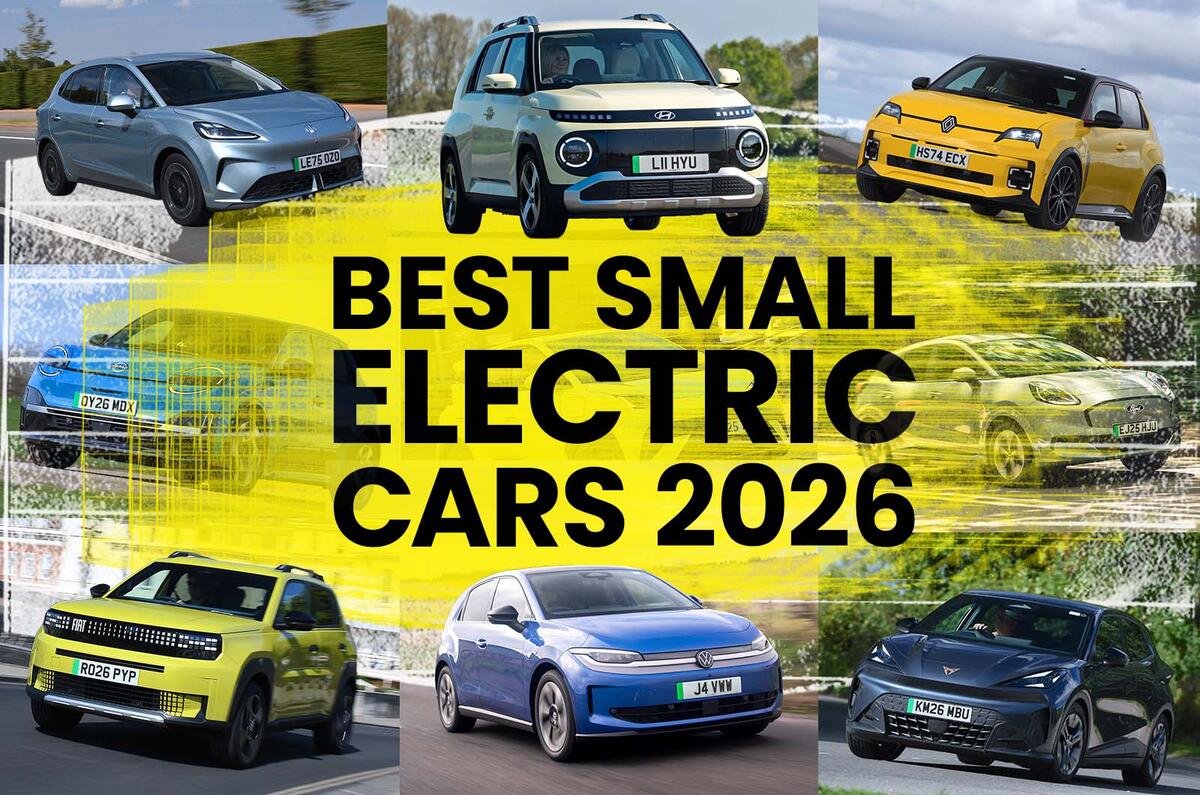
Currently reading: The best small electric cars 2026 – driven, rated and ranked
UP NEXT

Longer real-world range, rapid charging, and sensible price tags prove you don’t need an SUV to go electric. We rank the best small EVs on sale

Cast your mind back just a few years and small electric cars were tough sells, being compromised by a short real-world range, slow charging speeds and a steep list price.

Today the landscape could hardly be more different. The small electric car segment has been revolutionised by evolving battery technology, falling production costs and government incentives sparking a renaissance at the compact end of the market. 

Crucially, the latest generation of small EVs proves that you don’t need an SUV to reap the rearwards of electric motoring. Thanks to the development of energy-dense battery packs and space-efficient platforms, car makers are now able to squeeze all the benefits of an EV into a much smaller package, without sacrificing on range or usability.

But while the class has taken big strides in terms of price and range, the class has never been more vibrant, with buyers able to choose from chic, retro-styled superminis to sensible budget-friendly commuters. 

The question is, which small electric car is the best? Our expert team of road testers have driven, tested and evaluated every one on sale. Key contenders on this list have also been extensively assessed through our instrumented road test, in which we gather raw data at MIRA proving ground in order to deliver the most definitive verdict possible. 

Best small electric cars at a glance

Car Model Best For Starting Price (UK) Official Range (WLTP) Boot Capacity
Volkswagen ID Polo Range, comfort and charging speed £23,945 200–281 miles 441 litres
Cupra Raval Handling and practicality  £26,995 203–277 miles 441 litres
Renault 5 E-Tech Chic styling and all-round ability £21,495 192–248 miles 326 litres
MG 4 EV Urban Practicality, space and value £23,495 200–258 miles 577 litres
Nissan Micra Mature ride and refinement £21,495 196–257 miles 326 litres

The best small electric cars

We think the Volkswagen ID Polo is the best small electric car on sale. This is an electric supermini that makes zero compromises on range, charging, comfort and practicality and brings with it the grown-up completeness and refinement of the Golf in a much smaller package. 

Equally compelling is the Cupra Raval, which brings all the goodness of the ID Polo but in a lower, firmer and sportier package. 

If you’re after something with retro chic, the Renault 5 and Fiat Grande Panda Electric will both appeal on the design front.

Finally, for those who want a small car that maximises practicality and passenger space, the MG 4 EV Urban is the standout value champion.

https://images.cdn.autocar.co.uk/
  • Design8
  • Interior9
  • Performance8
  • Ride & Handling9
  • Costs8

Best for: Range, comfort and refinement 

With its excellent range, fast charging and practical interior, the ID Polo is the new class leader, which is some achievement given the strength of competition in the small EV segment. 

But while it has all the key hallmarks of a good electric car, it's the ID Polo’s user-friendly interior and well-sorted drive drive that sets it apart.

The ID Polo feels nippy on the road, with punchy off-the-line and rolling performance, especially in Sport mode.

Much like the old petrol Polo, it feels poised and mature, as if it could handle longer journeys with the same effortlessness as a much larger car. 

This versatility extends to the inside, too, with a class leading 441-litre boot and enough room in the back for adults. Sure, three across the back row would be a squeeze, but it’s roomier than the Renault 5. 

Prices start at just under £24,000 for the entry-level 37kWh version, which has a range of up to 205 miles. We would plump for the 52kWh model, however, because it can travel up to 281 miles and charge at up to 105kW. 

Buy it if...Skip It If...
You want good a comfortable, refined small EV with predictable road mannersYou crave greater involvement or a more emotive driving character
You value intuitive switchgear, solid cabin fit and finish and fuss-free everyday usabilityYou want a standout retro or head-turning exterior design that pops in the car park

Find Volkswagen ID Polo deals with Autocar

Back to top
https://images.cdn.autocar.co.uk/
  • Design9
  • Interior8
  • Performance9
  • Ride & Handling7
  • Costs8

Best for: Warm-hatch agility and practicality

Despite its sporting pretensions, the Cupra Raval is one of the best small cars going, thanks to its versatility and big-car feel.

With its taut handling and grippy dynamics, it's great fun to drive – and if you want an ever sportier feel, there's the range-topping 221bhp VZ version. 

The Raval is an unusual sort of supermini in that, if you want a more comfortable ride and better dynamic versatility from it, you’re actually best advised to buy the sportiest one: the VZ.

What makes the Raval stand out against its rivals is its efficiency. When we road tested the 52kWh model - which has a WLTP range of 277 miles – it achieved an everyday efficiency of 5.5mpkWh, and a test average of 4.0mpkWh. A peak charging rate of 105kW means you can top up the battery in under 25 minutes. 

Unlike its Volkswagen Group sibling brands, Cupra hasn’t returned to physical buttons, although the Raval's tech-filled interior is still finished well and the touchscreen is easy enough to operate. 

It’s roomier in the back than the Renault 5 and matches the ID Polo for boot capacity, with up to 441 litres. 

The range opens with the V1 and costs from £26,995, rising to £36,995 for the VZ Abt. You can get the 277-mile 52kWh battery model for a hair under £30,000. 

Buy it if...Skip It If...
You want sharp handling, taut body control and genuine junior hot-hatch agilityYou want a soft, pillowy ride over broken British B-roads
Concept-car-like styling and a tech-focused cabin appeal to youYou want plenty of physical switchgear inside instead of relying on touchscreens

Find Cupra Raval deals with Autocar

https://images.cdn.autocar.co.uk/
  • Design10
  • Interior9
  • Performance8
  • Ride & Handling9
  • Costs8

Best for: Retro charm and dynamic sparkle

The best small electric car money can buy today is the reborn Renault 5. 

Its talents range from its fluid, dynamic handling to its supple ride quality, which trumps the Mini Cooper E for comfort while remaining fun to drive.

The 5’s blend of style, value, driving dynamics and fuss-free tech makes it an obvious class leader.

With 148bhp on tap, there’s more than enough oomph for urban jaunts, as well as longer schleps along the motorway. 

The interior is also top-notch, with cues from the original 1970s 5, strong material quality and a generally intuitive layout. 

If there is anything to complain about with the 5, it's its efficiency. It's not awful, but its touring range isn't as good as we would like it to be for motorway journeys.

Opt for the 52kWh battery and it has a claimed range of up to 250 miles – and all versions are eligible for the UK government's £3750 EV grant. 

Buy it if...Skip It If...
You want head-turning retro styling paired with a fun, agile handling dynamicsYou regularly carry tall passengers in the rear or need a family-friendly boot
You do most of your miles in town and want something efficient and compactYou need ultra-fast DC charging speeds
Back to top
https://images.cdn.autocar.co.uk/
  • Design8
  • Interior8
  • Performance8
  • Ride & Handling7
  • Costs9

Best for: Value and space

MG’s affordable electric hatchback may not be the most interesting to drive or ride in but, given its low price, impressive practicality and creditable efficiency, it’s well worthy of a place in this list. 

Just £23,395 gets you the entry-level Standard Range, which can do up to 201 miles on a charge, but we think it’s worth forking out the extra £2500 for the 258-mile Long Range. 

The Urban is manoeuvrable in town; reasonably responsive, controlled and precise out of it; and settled and comfortable-riding, with decent ride isolation and very little coarseness or harshness, over broken surfaces.

Charging speeds aren’t as fast as rivals', with the Urban offering a peak rate of up to 87kW. Topping up the battery using a public device therefore takes around 30 minutes.

That said, the Urban makes up for its slower charging with its excellent efficiency. During our testing, it achieved 5.5mpkWh in everyday running. 

And even though it’s only 4.4m long, the Urban offers generous amounts of head and leg room both front and rear, plus a whopping 577-litre boot.

Factor in the Urban’s respectable body control, handling agility and ride comfort and you have a very complete, albeit quite plain family hatchback.

Buy it if...Skip It If...
You want rear-wheel-drive poise and genuine family-hatchback space at supermini moneyYou want high-quality materials inside and an easy-to-use touchscreen
You want the most range, equipment and space at the lowest priceYou want an ultra-narrow footprint for squeezing into tight parking spaces

Find MG Motor 4 Urban deals with Autocar

https://images.cdn.autocar.co.uk/
  • Design7
  • Interior8
  • Performance8
  • Ride & Handling8
  • Costs8

Best for: Fuss-free daily commuting

You would be forgiven for thinking that you had seen the electric Nissan Micra before. The Japanese marque's electric supermini is actually a reworked version of the brilliant Renault 5 and, in the main, there’s very little that separates the two. 

Thanks to its excellent platform and powertrain, the Micra feels just as mature and polished as Renault's retro-futuristic supermini. It’s good looking and pleasant to cover miles in; it rides and handles well; it’s practical, with plenty of rear passenger space and a generous boot; and it promises good efficiency and a usable range.

If Nissan had invested more money and made an electric supermini all of its own, would it be better than this? Different, sure. But better? I doubt it.

It also qualifies for the UK government's full EV grant of £3750, so you can get a big-battery model for less than £24,000 – about the same as the equivalent 5. 

The 5 is certainly more stylish of the two, but if you’re taken by the Micra’s looks, we wouldn’t blame you for buying what is a well-rounded electric supermini.

Buy it if...Skip It If...
You want the Renault 5’s polished underpinnings wrapped in an understated bodyYou're looking for dynamic sparkle and flair
You prioritise straightforward cabin ergonomics and an easy commuteYou regularly need to carry adult passengers or bulky cargo over long distances

Find Nissan Micra deals with Autocar

Back to top
https://images.cdn.autocar.co.uk/Mini Cooper E Electric front tracking
  • Design8
  • Interior8
  • Performance9
  • Ride & Handling8
  • Costs9

Best for: Upmarket feel and go-kart handling

While the old Mini Electric hatchback was fun, it was let down by poor packaging and a limited range. 

The sleek new Cooper E is more powerful, has a broad choice of batteries and is packed full of usable digital technology from parent company BMW. 

This new electric Mini is certainly a more grown-up electric car than the original, embarrassing its predecessor.

The Cooper E is powered by a 181bhp electric motor and uses a 40.7kWh battery that offers up to 190 miles of range, while the Cooper SE gets a 215bhp motor and a 54.2kWh battery for up to 250 miles of range. 

It’s heavier than before, which means it has lost a bit of driver appeal. That said, it has a better range, a premium feeling interior and it's well priced.

The infotainment touchscreen is a bit fiddly but, despite the odd minor qualm, the Cooper E is up there with the best in the segment. 

Buy it if...Skip It If...
You want engaging handling and go-kart agilityYou can’t tolerate a firm ride over pockmarked urban Tarmac
A premimuin-feeling cabin and modern tech are non-negotiablesYou need usable rear seats or a large boot

Find Mini Cooper SE deals with Autocar

https://images.cdn.autocar.co.uk/
  • Design7
  • Interior8
  • Performance8
  • Ride & Handling8
  • Costs8

Best for: Crossover packaging and dynamic appeal

While it's not quite at the top of our list, the Ford Puma Gen-E might just be the most important, not least because it brings some genuine driver engagement to the class.

This is an electric version of the UK's best-selling car, and it's Ford's second crack at an EV that has been developed fully in-house, following the Mustang Mach-E (the Explorer and Capri were co-developed with Volkswagen). 

This is a nicely rounded small electric crossover and, unlike the Volkswagen-based Explorer, it's recognisably ‘Ford’ in its handling.

Energy comes from a 43.6kWh battery, which drives a 166bhp, front-mounted electric motor. According to Ford, you will get around 251 miles of range on a charge. 

Buy it if...Skip It If...
You want crossover ride height backed by predictable road mannersYou want the flat-floor cabin space and packaging of a dedicated EV platform
You need practical packaging tricks such as the underfloor MegaBoxYou travel long distances and demand 150kW-plus charging speeds
Back to top
https://images.cdn.autocar.co.uk/
  • Design10
  • Interior9
  • Performance4
  • Ride & Handling4
  • Costs10

Best for: Style and affordability 

Cars under the Stellantis umbrella are often criticised for their lack of identity as a result of substantial parts sharing between brands – but this certainly isn’t the case with the new Fiat Grande Panda.

There are clear links to the original 1980 Panda in its design, and plenty of easter eggs dotted around the interior and exterior that highlight just how much attention Fiat has put into its overall aesthetic. 

The Grande Panda offers just about as much refinement and comfort as you could wish for.

And it's not just the Grande Panda’s funky looks that makes a good EV. The entry-level model costs just under £21,000, which is less than a small-battery Renault 5, and has an official range of up to 199 miles. 

Sure, it's not the sharpest to drive, but its recreational appeal makes it a fun car to own. It's also roomy, packed with all the right kit you want and need and competitively priced. 

Buy it if...Skip It If...
You love charming, squared-off retro-styling that maximises interior spaceYou expect whisper-quiet high-speed wind isolation and plush cabin trim
You want an honest urban runabout with an accessible priceYou want a more involving chassis, settled ride and communicative steering

Find Fiat Grande Panda Electric deals with Autocar

https://images.cdn.autocar.co.uk/
  • Design7
  • Interior8
  • Performance7
  • Ride & Handling7
  • Costs7

Best for: Clever packaging and interior versatility

The funky-looking, segment-blending Inster has the dimensions of a smaller A-segment offering, but inside it’s far bigger and more versatile than rivals like the Fiat 500e. 

Indeed, the chunky little Inster is roomy, with its sliding and folding rear bench enhancing cabin flexibility. It’s a very easy car to operate, too, having plenty of physical secondary controls. 

It’s all very predictable to drive, which will suit a large number of buyers, but it would still be nice if the Inster could make you raise a smile.

Around town it’s pliant and easy to drive, while at higher speeds it has the maturity and road manners of a larger car. 

Initially the Inster’s ambitious pricing made it harder to recommend over European competitors, but Hyundai has since introduced its own 'EV grant' to cut the list price down by £3750. 

Prices now start from £20,005 for the entry-level 01 trim, but we would stretch to £23,255 for 02 trim, which gets a larger battery for an impressive 229-mile range. 

Buy it if...Skip It If...
You want a versatile interior with sliding rear seats and a decent bootYou spend most of your time cruising on the motorway
You tackle narrow streets and tight multi-storey car parks dailyYou frequently need to seat five across the rear bench
Back to top
https://images.cdn.autocar.co.uk/
  • Design8
  • Interior8
  • Performance6
  • Ride & Handling7
  • Costs8

Best for: Equipment and price

Price parity with petrol counterparts has long been an issue for small electric cars, but that’s no longer the case, as proven by the BYD Dolphin Surf. 

At £18,675, it’s not just one of the cheapest electric superminis but one of the most affordable EVs full stop, undercutting many European rivals like the Citroën ë-C3 and Renault 5. 

The Dolphin Surf is efficient, well-packaged and well-priced, with some forgivable minor transgressions.

And yet a low price isn’t the Dolphin Surf’s only calling card. Inside it’s spacious, well-equipped and has a sense of quality that surpasses its prices.

To drive it's pleasant and easy-going, but don’t expect much engagement or excitement. 

It can’t match the 5 for kerb appeal and character, but it has a good range of up to 200 miles in Boost form and will return close to 5.6mpkWh during everyday use. 

Buy it if...Skip It If...
You want generous standard kit and cheap monthly leasing billsYou value driver feedback, a comfortable ride and European chassis feel
Your driving is largely urban and suburban, where low-speed efficiency counts mostADAS bongs and menu-heavy touchscreen controls frustrate you

Find BYD Dolphin Surf deals with Autocar

HOW TO CHOOSE THE BEST SMALL ELECTRIC CAR

When choosing the best small electric car, it's important to look beyond key factors such as range and price. You should also consider battery efficiency and how a particular model will fit into your specific lifestyle. 

Here’s what to look for:

Battery size and efficiency

Why it matters: A bigger battery adds weight and cost. In a small EV, efficiency is king.

  • Battery size: For urban drivers, a capacity between 40kWh and 50kW will offer a good range (around 200 miles) at an affordable price. 
  • Efficiency: Look for a model that can achieve more than 4.0mpkWh. The higher the efficiency, the less you will have to pay to charge it. 
  • Lightness: EVs are inherently heavier than their petrol equivalents, but look out for models with a low kerb weight as this will boost efficiency. 

Charging

Why it matters: Being able to charge overnight at home is much more economical than using the public network. 

  • Home charging: if you have a driveway, charging a small EV overnight with an off-peak tariff should cost only between £2 and £10. 
  • On-street charging: Looks for EVs with an 11kW or 22kW AC charging rate, because this will help fill up faster using kerbside chargers, such as those in lampposts. 
  • Public charging: Check the peak DC charging rate, as this will determine how fast it takes to charge from 10-80% via the public network. Smaller EVs often have lower DC speeds, but aim for at least 50kW to 100kW. 

Size

Why it matters: The whole point of a small car is for it to be compact and easy to drive in urban areas.

  • Size: Check the length, because cars less than 4.1 meters long are the easiest to parallel-park in tight city gaps.
  • Visibility: Modern styling can sometimes create large blindspots. Look for cars with large glass areas or ones fitted with a 360deg camera to make it easier to park. 

Cost and incentives

Why it matters: Small EVs are often the entry point to electric motoring and many are now eligible for the UK government’s Electric Car Grant (ECG).

  • Total cost of ownership: Compare the monthly finance or lease deals. Small EVs often have very high residual values, which can make a premium-feeling car surprisingly affordable on a monthly PCP or salary-sacrifice scheme.
  • Electric Car Grant: many of the cars in our list qualify for the top £3750 discount, while others are eligible for the lesser £1500 saving. Alternatively, some manufacturers offer their own EV incentives.

Do you need a small electric car?

A small EV makes sense if:

  • You mainly drive in urban areas. 
  • Your daily mileage is less than 60 miles.
  • You live or work in a clean air zone (CAZ) or ultra-low emission zone (ULEZ).
  • You want and affordable EV with lower running costs.

You shouldn’t buy a small EV if:

  • You regularly carry a full cohort of passengers.
  • You frequently tow a trailer.
  • You cover long distances during the week.

HOW WE TESTED AND SELECTED

When reviewing small electric cars, we don’t just assess how a car performs in its natural habitat. We drive cars across all environments to test their agility, efficiency, drivability, ease of use and how much 'big car' technology has been packed into a compact footprint. 

Here’s what we assessed:

Urban agility 
Small cars need to be easy to live with. We tested the turning circles of every car on this list to ensure they could handle tight mini-roundabouts and multi-storey car parks. We also evaluated visibility and the effectiveness of parking sensors and cameras in real-world urban environments.

Real-world efficiency (mpkWh) 
In a small EV, every kilowatt-hour counts. We didn’t just look at the official WLTP range; we measured real-world efficiency (miles per kWh) across various environments to assess each car's everyday, average and touring economy and range. 

Ride quality
Small cars often have shorter wheelbases, which can make them feel less pliant over potholes and speed bumps. We tested these cars on broken urban surfaces and expansion joints to find the ones that offered the most comfort and rolling refinement. 

Practicality and packaging 
We measured how easily four adults can fit inside, the ease of access to the rear seats and whether the boot could actually handle a weekly shop or a set of charging cables. We also looked for smart storage solutions like frunks and sliding rear benches.

Charging versatility 
Since small car owners are less likely to have a dedicated driveway, we assessed how well these cars handle public charging. We looked for fast AC charging (for lamppost or kerbside chargers) as well as the DC rapid-charging speeds needed for the occasional longer journey.

FAQs

Are small electric cars reliable?

Electric cars are proving to be pretty reliable so far, according to reliability data from our sister title What Car?. In its 2025 reliability survey, EVs ranked very highly, with an overall score of 90.4%. Topping the chart was the groundbreaking BMW i3, which scored a mightily impressive 97.4% reliability rating.  While there are few independents set up to work on EVs right now, meaning maintenance will often have to be carried out at a main dealer, there are far fewer moving parts, so theoretically fewer points of failure. Certainly What Car?’s data suggests there’s little to fear.

Should a family have two electric cars?

EVs have often been relegated to second-car duties: school run, shopping trips and the like, with an ICE car on hand to take on longer journeys, such as family holidays. That's because the first clutch of models, such as the original Nissan Leaf and Renault Zoe, were small and capable of only short ranges. Anecdotally, there’s an increase in the number of all-electric households owning a small EV for daily duties and a larger EV on hand for those longer trips. There’s certainly little reason not to go all-electric; just bear in mind that most homes will still only have one wallbox charger.

What is the smallest electric car?

The Citroën Ami is often thought of being the smallest electric car on sale today. And at 2.4m long and 1.4m wide it’s certainly tiny, yet there’s still decent enough space for a driver and a passenger. Technically, though, the Ami isn’t a car but a quadicycle, which means you can't take it on a motorway – although with a 28mph top speed, you wouldn’t want to. If you want a full-sized EV that's still ultra-compact, the Leamotor T03 and Fiat 500e are the among the smallest models you can buy today.   

Are electric cars good for short trips?

If there’s an area where all EVs excel, it’s on short trips. There’s no worries about engines never getting to operating temperature or clogged particulate filters. Most EVs even allow you to set a timer to heat the car up and defrost the windows on winter mornings, removing the need to have a car idling on the driveway while the air conditioning clears the glass.

What is the cheapest small electric car?

The cheapest electric car on sale in the UK is the Citroën Ami, which costs from £7695, but it’s actually classed as a quadricycle rather than a car and can do just 28mph. The next cheapest EV is the Dacia Spring, which starts at just £15,990 and has a range of up to 140 miles. Dacia has previously offered a discount on the Spring, dropping the price further to £12,240.  Hot on the heels of the Spring is the Leapmotor T03, which costs from £15,995. The Chinese brand offers its own £1500 discount, which cuts the list price down to just £14,495.

Join our WhatsApp community and be the first to read about the latest news and reviews wowing the car world. Our community is the best, easiest and most direct place to tap into the minds of Autocar, and if you join you’ll also be treated to unique WhatsApp content. You can leave at any time after joining - check our full privacy policy here.

Sam Phillips

Sam Phillips
Title: Senior Staff Writer

Sam joined the Autocar team in summer 2024 and has been a contributor since 2021. He is tasked with writing used reviews and first drives as well as updating top 10s and evergreen content on the Autocar website. 

He previously led sister-title Move Electric, which covers the entire spectrum of electric vehicles, from cars to boats – and even trucks. He is an expert in new car news, used cars, electric cars, microbility, classic cars and motorsport. 

Sam graduated from Nottingham Trent University in 2021 with a BA in Journalism. In his final year he produced an in-depth feature on the automotive industry’s transition to electric cars and interviewed a number of leading experts to assess our readiness for the impending ban on the sale of petrol and diesel cars.